During this year’s legislative session, the Connecticut Senate managed what has become a rare occurrence in this state: passing a bipartisan housing bill.
The legislation — commonly referred to as the “Golden Girls bill” — would have required towns to allow homeowners to rent individual rooms in their homes to long-term tenants.
While some Republicans raised concerns, those who are typically the most vocal in their opposition to housing-related measures saw it as a good solution. It offered homeowners control over their properties while not changing the structure or size of buildings in neighborhoods.
After its easy passage through the Senate, the bill was never called in the House of Representatives.
The source of the opposition, however, came from what advocates said was an unexpected source: House Speaker Matt Ritter, D-Hartford.
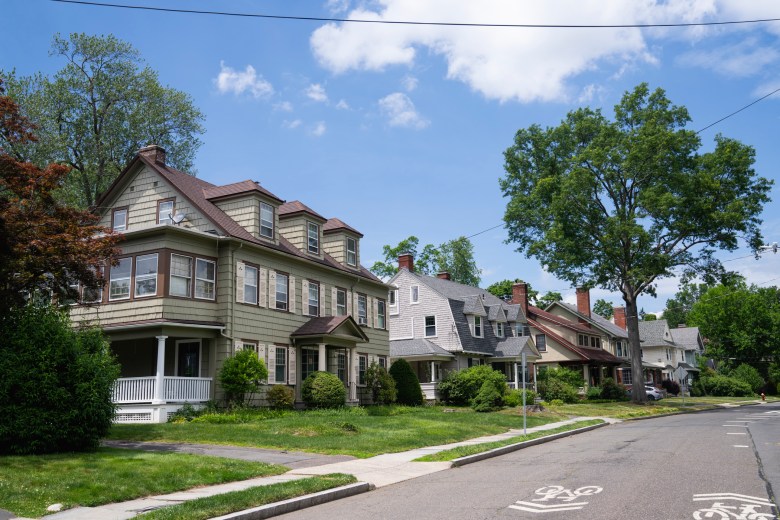
Emails referencing the opposition and an interview with Ritter revealed that his concern was largely centered on how the bill might affect Hartford, particularly the West End — a wealthy neighborhood in one of the state’s poorest cities.
“I understand from a brief conversation with Speaker Ritter on Saturday afternoon that he has concerns with SB 339 as it relates to college students from University of Hartford’s ability to rent out rooms in the West End, or any other neighborhood in Hartford,” wrote lobbyist Hillary Glass in an email to Ritter’s chief of staff Franklin Perry on May 4. Glass declined to comment for this story, and Perry did not return a request for comment.
Perry responded to Glass by asking whether there was an amendment to address the issue of college students renting out homes. Glass, who was representing Pro-Homes CT, said she wasn’t aware of one. The advocacy group, which focuses on housing and transit policy, was the leading force behind the bill.
Ritter said in an interview that he was worried about one particular provision of the law, which required the homes to be owner-occupied, and how it would be enforced.
“What if a neighbor is unhappy about four unrelated people who are 19 years old or 22 years old living in the house? The owner says it’s occupied, but nine months out of the year they’re in another state. I mean, the question really comes down — to me — about who enforces it, and how would you deal with a situation like that?” Ritter said in an interview earlier this month.
Ritter said he was also concerned that if the law passed, people from other towns might start buying up the housing stock as rental property, lowering Hartford’s homeownership rates even further. He added that the bill didn’t do enough to address what he sees as a more pressing problem: ensuring that suburbs and rural areas allow more housing.
Currently, the West End is split into a couple of residential zones. One allows renting rooms in owner-occupied homes. The other does not, but an entire home can be rented to up to three unrelated adults or be split into multiple units. The city of Hartford broadly allows up to two renters with owner-occupancy in most residential areas, according to Pro-Homes fact sheets.
The bill would have allowed a homeowner to rent out up to three rooms in a home they also live in.
Ritter said other lawmakers representing residents of college towns may have been concerned as well.
“I think what’s hard is you come into cities where you’re near universities and major places of employment, and people could take advantage of that, buy up two-family homes and start renting to four to eight people, potentially a two-family home in a residential neighborhood,” Ritter said.

Other House Democrats said they didn’t share his concern.
“It’s another option for us to try to address the issue of access and affordability, so people can co-locate in a home and save money,” said House Majority Leader Jason Rojas, D-East Hartford. He added that he generally believes Ritter is supportive of housing initiatives, and he acknowledged the speaker’s concerns that there could be “unintended consequences” from the bill.
Housing Committee co-Chair Rep. Antonio Felipe, D-Bridgeport, said he hopes to have the chance to consider the bill again next year, adding that that communication about the bill could have been improved.
“I think it’s interesting that in the city of Hartford, right now, you can do this for up to two rooms in your house already, and we were just [proposing] allowing for folks to do up to three, so not a huge significant change,” Felipe said. “But I don’t know that area as well as the speaker would, so I trust his judgment.”
Pete Harrison, Connecticut director of the Regional Plan Association, said he’d been told the bill would only have a chance in the House if it was restricted to renters who are 55 and older.
Housing co-Chair Sen. Martha Marx, D-New London, said she wasn’t willing to make that change.
“It made no sense to put an age limit on it. It made absolutely no sense,” Marx said.
Harrison said another idea to limit eligibility to people 30 and older also hit a wall.
“It is just strange that they carried so much political capital” for major housing legislation that passed last during a November special session, Harrison said. Then “something that is bipartisan, that is meaningful but not radical, did not get through.”
Ritter also received messages from Connecticut residents disappointed in the decision.
“It is true that under ‘Golden Girls,’ rooms might be rented out to college students, but college students need somewhere to live,” a Norwalk resident said in an email to the speaker on May 6, the final day of the legislative session.
“Homeowners need extra income, and many, many people of all ages need affordable apartments,” another Norwalk resident wrote May 5.
Housing Committee ranking member Rep. Tony Scott, R-Monroe, said he was disappointed not to see a bill that had bipartisan support get called for a vote, especially when lawmakers so frequently disagree on housing issues.
“The goal should be getting as much housing as possible for folks, and then letting people who are property owners make that dictation of how they rent their property out,” Scott said.
Marx said she thinks it’s likely there are people across the state already renting out bedrooms in their home who don’t realize that it isn’t allowed in all areas.
“I just couldn’t believe that the speaker was really not going to call ‘Golden Girls,’” Marx said.