


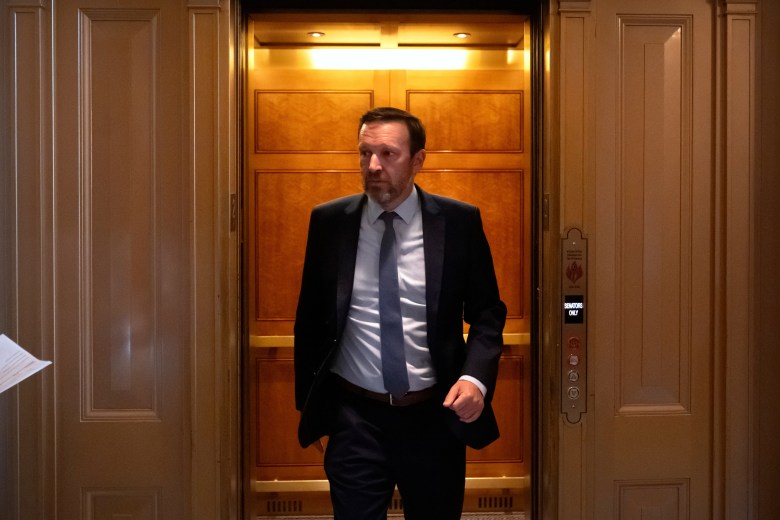
U.S. Sen. Chris Murphy, D-Conn., questioned the legitimacy of a preliminary deal to end hostilities in Iran as members of Congress shared concerns Tuesday about the lack of details provided so far by the Trump administration.
Nearly four months after the war began, President Donald Trump and Vice President JD Vance signed a memorandum of understanding Sunday that would extend the ceasefire and allow for nuclear negotiations. It sets parameters for how the U.S.-Iran relationship “will operate in the future,” according to senior U.S. officials.
But lawmakers have been left in the dark on the contents of the agreement.
Legislative leadership has yet to be briefed, including the “Gang of Eight,” a group of Senate and House leaders plus relevant committee heads in both parties who get briefings on intelligence matters by the administration. U.S. Rep. Jim Himes, D-4th District, is part of that group as the ranking member of the House Intelligence Committee.
And because they haven’t seen any text, some lawmakers are pointing out the mixed signals they’re getting between how the Trump administration characterizes the agreement compared to what Iranian officials claim. Iran reportedly says the deal includes Israel withdrawing from Lebanon, but senior U.S. officials said withdrawal was not part of the tentative agreement. There are also questions over the release of Iran’s frozen assets.
Murphy has been a vocal critic of the war since the U.S. first attacked Iran in late February. He has pushed for Congress to weigh in given its constitutional authority to declare war. Democrats have forced multiple votes on a war powers resolution to rein in the war and end hostilities in the region. Most resolutions have failed, though recent efforts have passed, showing a broader frustration over the conflict.
Based on what’s been reported, Murphy was critical of the early agreement and called it a “surrender.” Still, he said the war needs to come to an end that has threatened lives and elevated prices in the U.S. But without seeing the deal himself, he’s questioning its very existence.
“I doubt that it’s real. But if what’s reported is real, it’s Iran’s terms. It’s essentially a surrender. But I think that’s the only play we can make at this point,” Murphy told reporters on his way to Senate votes on Tuesday. “We have to end this war and stop wasting money and stop killing Americans and civilians and stop driving up prices.”
“It’s a bad deal, but he’s not going to get a better deal,” he continued. “We just have to accept the humiliation.”
With the effective closure of the Strait of Hormuz, oil and gas prices have spiked. That coincides with a high-stakes election this November when Republicans will be defending their majorities in Congress. Affordability has become one of the prominent themes months ahead of the midterm elections.
On a briefing with reporters on Monday, senior U.S. officials projected optimism about the preliminary deal and the outcome on the relationship with Iran. But they also acknowledged that while they expect a “significant” increase in traffic in the Strait of Hormuz, it “probably won’t return to normal in two weeks.”
The administration officials explained that they are “still in the early stages where we’re building trust,” promising transparency on the process and “no side deals.”
Murphy, however, speculated that the possibility of side deals could dictate the terms of the agreement.
“I have no idea what it is. I don’t know that it exists. These guys are born liars. And they seem to think it’s something fundamentally different than what the Iranians think it is,” Murphy said. “And the most important parts of it might not be on paper. It might be in quiet side deals.”
The Connecticut senator said he has “no idea” if or when he’ll receive a briefing on the parameters of the deal. Members of Congress have received congressional briefings from the administration when the U.S. has engaged in military action, including in Iran. Senate Majority Leader John Thune, R-S.D., said he expects a briefing for members.
“I certainly have not yet, although we are requesting that, and I assume we at some point will hear from the administration with greater specificity about what’s in that memorandum,” Thune said.
A signing ceremony of the deal is expected Friday. Trump signaled Tuesday an openness for Congress to vote on approving a final deal. Speaking from the G7 Summit in France, Trump said he expects to confront opposition from Democrats if he does so.
“What I’d like to do is send it to Congress, saying you shouldn’t approve it, and I’ll get it approved, whatever they, whatever I say, they want to do the opposite. It’s not working too well for them, by the way,” Trump said.
U.S. Sen. Lindsey Graham, R-La., a defense hawk and staunch Trump ally, has expressed some skepticism and wants more involvement from Congress.
“The proposal as envisioned by the Vice President and the Trump Administration to end the Iranian conflict would be transformative for the region and a major achievement, leading to broader peace,” Graham posted on X. “It is my understanding the terms of the MOU will be released by the administration in the coming days. I look forward to reviewing the actual document rather than relying on Iranian propaganda reports. The sooner it is released, the better.”
Graham and other Republicans also hope Congress will vote on it in the future.
When asked about the possibility of the Senate taking it up, Murphy said it’s “worthless to speculate” on such a vote when he and other lawmakers haven’t seen what’s in the pact.
The Connecticut Mirror/Connecticut Public Radio federal policy reporter position is made possible, in part, by funding from the Robert and Margaret Patricelli Family Foundation.
