They’ve said it couldn’t be done.
Towns all over Connecticut keep saying it, and saying it, and saying it: “We’ll never make 10% of our housing stock affordable for workers, young professionals and families. It’s impossible. It’ll never happen.”
But at a ribbon-cutting last week, the central Connecticut town of Farmington –- with great schools, abundant services, beautiful neighborhoods and, most important, open-minded, can-do leaders and residents -– very nearly did it. At 9.7%, with its next housing project already in the works, Farmington is about to clear 10%. Twenty years ago it was under 7%. And this is no struggling town: in 2026 it was named one of Connecticut’s most desirable places to live –- proof that doing right by working families and being a sought-after address are not at odds.
Under state law, municipalities that fail to make at least 10% of their housing affordable to low- and moderate-income households must allow developers to build mixed-income homes on property not zoned for residences, unless the town can prove a real threat to public health or safety. Since the law took effect in 1990, the chorus has been unending: “It’s unfair! It’s impossible to reach 10%!”
Yet Farmington got there. How?
First, it recognized two things: that a town hosting UConn Health Center and many other employers needs homes its workers can afford, and that those lower-income workers aren’t a threat – they’re honest people doing hard jobs that simply don’t pay much. Farmington is one of the few towns in central Connecticut where more people work than live, anchored by UConn Health and the global headquarters of Otis Worldwide, the elevator maker.
Second, it understood that creating multifamily housing pays for itself: that the property tax revenue has been shown to compensate -– often, more than compensate -– for the expenses that come with servicing new housing. And since nearly all municipal revenue comes from the property tax, the smartest way to keep taxes low is to develop property the market actually wants -– and the market wants multifamily housing. It’s no accident that Farmington enjoys one of the largest commercial tax bases of any town its size, anchored by Westfarms Mall and a dense cluster of medical offices off I-84.
Third, while sensitive to allowing developments that fit their surroundings, Farmington has been open to conversations about building new rentals in varied locations with an eye to commercial strips and transportation corridors where the new homes fit in and are convenient for the lab techs, nurses and others who serve the public at UConn.
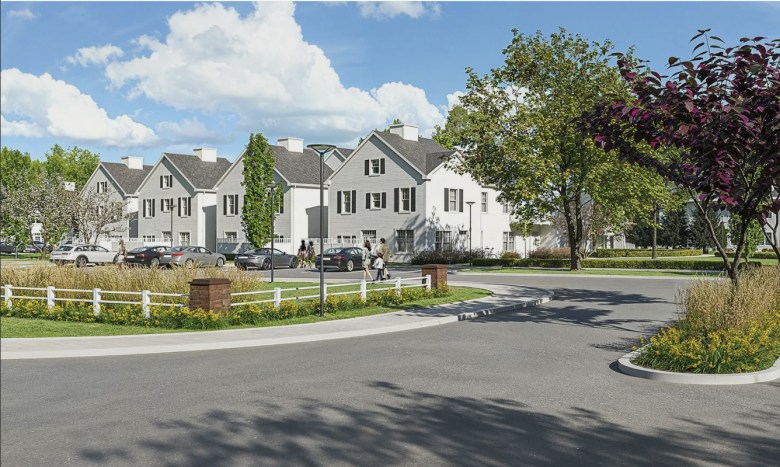
Fourth, it has found developers it could trust to build quality housing and manage it for the long haul, including Metro Realty, which built the 90-home “Trailside” community celebrated last week. Metro has built more than 1,700 units of mixed-income housing across seven towns, nearly 350 of them in Farmington. It doesn’t build shoddy structures, grab the money and leave; it owns and manages its developments, so it has every reason to keep them shipshape. In other words, Metro gets invited back because towns know have learned they can expect good quality.
More to the point, the Metro folks have a conscience. They earn less in revenue because they reserve a share of their units for workers who can’t afford market-level rents – and at Trailside, 20 of the 90 homes are set aside for people with intellectual disabilities, with on-site support from Favarh, the Arc of the Farmington Valley.
Trailside is also a case study in creative problem-solving. The nine-acre site had sat undeveloped for years because, under the town’s commercial zoning, it was tied to the office property next door and couldn’t be built on its own. Rather than walk away, Metro proposed rewriting that zoning rule. Farmington was open-minded; its planners and Planning and Zoning Commission engaged, and the result was a zoning amendment that opened the land to housing while tightening the town’s landscaping and stormwater standards. Because the town said “Yes,” 90 families will get to call Trailside home.
But here’s the part that too often goes untold: even a willing town and a committed developer can’t build a single affordable unit without help to finance it. The rents working families can afford simply don’t cover what quality housing costs to build. Somebody has to bridge that gap.
That’s where the state came in. When Metro applied, the Connecticut Department of Housing (DOH) and the Connecticut Housing Finance Authority (CHFA) vetted the project and provided the loans, grants and federal 9% Low-Income Housing Tax Credits that closed the gap between what Trailside cost and what working families can pay. Farmington wanted the housing, Metro built it, and DOH and CHFA made it possible. That partnership is exactly how it’s supposed to work.
Farmington isn’t alone. Thirty-one of Connecticut’s 169 municipalities are already over 10%, and others – Wethersfield, Canton, East Haven, Hamden, West Hartford, Fairfield – are following the same path.
So it’s not impossible. It’s do-able, if a town wants to do it.
But many don’t. Their leaders know they need rental housing so businesses can find the baristas, landscapers and pre-school teachers to fill open jobs – and many of those officials come from households that struggled to pay the rent. Deep down, they get it. They just don’t have the political courage. They’d rather get reelected than do the right thing.
The ones with courage build a real planning department and work with zoning commissions that know how to stay open-minded and say “Yes,” not just “No.” They pick up the phone and partner with DOH and CHFA, whose financing and expertise are there for the asking. And they tell residents the truth: workforce housing won’t bring ruin to their town.
So the next time you hear a town official say “getting to 10 percent is impossible,” tell him to quit whining and get to work. Creating affordable homes for workers is entirely possible. You just have to have the will to do it.
David Fink is a former Hartford Courant reporter and editor who was a housing policy consultant for 22 years.