


Child protective services need a major overhaul – and fast. As state-funded agencies, child protective service-backed departments are tasked with investigating and acting on reports of child abuse and neglect. But those investigations still leave many vulnerable kids in harm’s way or remove them from homes they would be better off staying in.
Most outcomes suggest that the current system doesn’t work. The solution lies in improving homes before protective services is ever needed. That takes funding, and it’s in short supply in this administration.

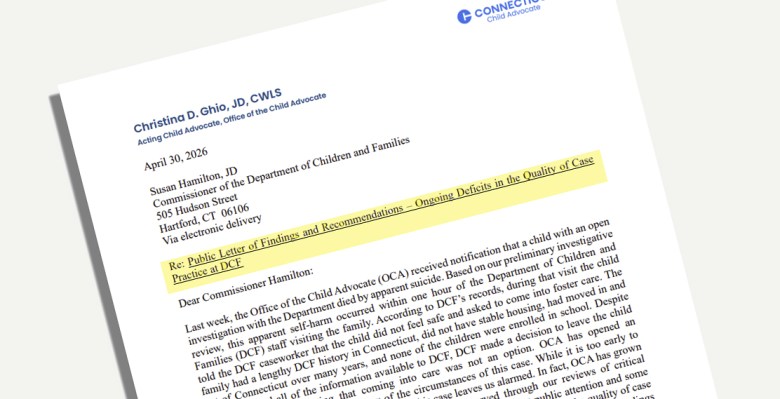
Evidence of agency disfunction is everywhere. A Connecticut child living in a household monitored by the state recently died by suicide just an hour after a caseworker had visited the home. According to reports, the child said they felt unsafe in the house and asked to be placed into foster care. Even though the household had many risk factors that were known to the agency, which had been investigating the family for some time, the caseworker left the child in the house. And tragedy followed.
The real tragedy is that this case is not an outlier, nor Connecticut-specific. Too many children are harmed even when they are in the system. Up to 2,000 children in the U.S. died from maltreatment in 2023; roughly half of these cases were already known to child protective service officials. That’s hundreds of cases that the agencies had investigated or been alerted to ending in a child’s death.
On the flip side, errors also occur when children are unnecessarily removed from their homes. The data on this is also strong: children living in poverty and those who are Native American and Black are much more likely to be removed from their homes than white children. Wrongful separations, especially those due to racial bias and poverty (often mislabeled as “neglect”), can lead to a lifetime of trauma for all involved.
These statistics suggest a lack of attention, which might be right. But it’s not due to simple caseworker negligence. The system is profoundly strained. In 2023, child protective service agencies nationwide received 4.4 million referrals (representing 7.78 million children), of which 47.5% were accepted for investigation; of those, some 550,000 children were determined to be affected by abuse or neglect.
In some states, caseworkers are responsible for up to 100-170 cases annually, far higher than the national average of 66. At those numbers, high staff turnover, improper staff training, and case mismanagement are inevitable.
But all hope is not lost. After the death of Faheem Williams 20 years ago, New Jersey became the gold standard for child welfare in the U.S. by investing billions and revamping its child protection process to become a role model in a preventive approach. To safely keep children in their homes, New Jersey shifted its focus on support for family mental health, financial aid, domestic violence, and housing stability with immense success.
By investing more money early on and using it more efficiently, New Jersey added more caseworkers and achieved a 10% reduction in turnover, 79% decrease in foster care placements, the second lowest national child mortality rate, and an overall 68% decrease in child maltreatment throughout the past 10-20 years.
This framework should be reproducible by other states, but like all good things, it comes down to funding. In January 2026, the U.S. Department of Health and Human Services tried to cut funding for several states’ child care and family aid programs, allegedly due to fears of fraud, including the Social Services Block Grant (SSBG), which supports state child protective service agencies that are already struggling to train and retain workers who are suffering from high rates of burnout.
The attempted SSBG fund cuts (blocked by a federal court) and the proposed cuts to the Community Services Block Grant (CSBG), which aims to set up families for long-term successes, prevent families from accessing programs that help them provide and care for their children. Studies have shown that when benefit programs have more funding, local child protective service agencies also do better.
Instead of targeting abuse and neglect after the harm is done, states need to adapt prevention frameworks in child welfare, and they need the funding to do it well. The Child Abuse Prevention and Treatment Act (CAPTA) State Grant continues to receive federal support for agency training and efficiency, community resource referrals, and interagency collaborations. By investing a larger amount to its Title II grant, which funds primary prevention, CAPTA can help implement those prevention frameworks and, ultimately, save more money at all levels.
Child protective service agencies do not intentionally keep children in unsafe conditions or wish to separate them from their families. They, and the children and families they serve, are victims of inadequate and inconsistent state and federal supports that set them up for failure. Implementation of early intervention programs in child protection and safety are no longer optional, but imperative. We owe at least that much to the children who did not survive the system meant to protect them.
A child with an open child protection investigation in Connecticut told her caseworker she felt unsafe. She asked to be placed in foster care but was told it was “not an option.” Within an hour, she died by suicide. A four-year-old died with ligature marks on her wrists and ankles. Her family had been reported to Connecticut’s Department of Children and Families 13 times before her death. A toddler was killed from a blow to the head. This was not his first physical assault: as an infant he had a broken arm and healing fractures that led to his removal. But he was then returned home to the adults who had abused him.
That some children require foster care is so obvious it should need no defense. And yet, here we are.
These cases in Connecticut are not just isolated failures to protect children. Nor should they be attributed solely to the very real problems of workforce training and retention. They are a product of something larger. Over the past decade, foster care has been recast as an arm of a carceral system. One prominent advocate described it as an “apparatus designed to regulate and police families,” The New York Times ran an article entitled “Foster care as Punishment: The New Reality of ‘Jane Crow’.” On the political right, criticisms are equally extreme. The conservative America First Policy Institute argues that states are financially incentivized to remove children — that we have “created an industry dependent on family separation”. Vilifying foster care is one of the remaining areas of bipartisanship.
Foster care is a serious intervention that should never be taken lightly. And by any measure, it is not. In 2024, approximately 7.7 million children were referred for abuse or neglect. Less than 2% entered foster care. If we follow children from birth through age 18, only 6% experience foster care. And — despite our higher prevalence of violence and social problems — the U.S. doesn’t place more children per capita than peer countries like Canada, England, or Australia.
Far from being overzealous, U.S. caseworkers are heavily disincentivized from placing children in foster care. Due to court and evidentiary safeguards, removing a child requires substantially more time and effort than leaving them at home. For understaffed agencies, time is hard to come by. And, once placed, the agency becomes liable for what happens to that child — but legally owes nothing to that same child if abuse continues at home.
Still, foster care critics across the ideological spectrum continue to mislead the public with two discredited claims: that children are torn from otherwise functional families because of poverty and that foster care itself causes poor outcomes.
In his 2021 Foster Care Month proclamation, President Biden asserted that “too many children are removed from loving homes because poverty is often conflated with neglect.” Ways and Means Chairman Jason Smith (R-MO) echoed last year, “too many families experiencing poverty are wrongly accused of “child neglect” when what they really need is community support.”
These claims are appealing in their simplicity, but demonstrably untrue. Children enter foster care because of maltreatment—often chronic, beginning in infancy — that produces harm that no placement, however stable, can fully undo.
Children who have experienced foster care understand the necessity of their placement, even though the system is imperfect in many ways. In one study that asked youth directly, more than 80% reported that foster care had been helpful. In other large-scale studies, one half to two-thirds of youth reported that they were “lucky to have been placed in foster care.” And recent studies find that children placed in care — even if eventually reunified with their families — fare better than comparable children left at home. Crucially, they are also less likely to die or experience severe injury.
There is no doubt that foster care sometimes falls short. But rhetoric from both ends of the political spectrum – calling non-relative placements “stranger care’” dismissing residential settings as unnecessary, and claiming children are removed because of poverty — is both inaccurate and counterproductive.
When the discourse positions foster care — and not the maltreatment that precedes it — as the problem to be eliminated, caseworkers are more reluctant to act and courts more hesitant to intervene. Foster parents are more difficult to recruit and essential funding is redirected. Ultimately, we will lose the capacity to protect children.
These children in Connecticut were not failed by foster care. They were failed by adults who were too conflicted to use it.
Sevde Felek Boyvat, MD is an assistant professor of pediatrics at the Yale School of Medicine and a Public Voices Fellow of The OpEd Project.