Last November, a group of Connecticut business leaders and state officials gathered with scientists and academics at Yale University’s Kline Tower for an announcement.
Dan O’Keefe, commissioner of the state’s Department of Economic and Community Development, joked that it wasn’t a typical event for him. “It’s not often that I get to share a stage with five Ph.D.s,” he said, drawing laughs.
The audience had assembled for what O’Keefe billed as “historic” news: that Connecticut would be directing $121 million to kickstart a regional economic effort to support quantum computing, a growing technological field that applies quantum mechanics — physics, at a microscopic scale — to boost computing speed and ability.
Proponents commonly say quantum computing will “supercharge” the kind of problem-solving that AI is being deployed for, processing immense amounts of data even faster and handling more complex calculations. That could transform industries from pharmaceuticals to manufacturing and financial services. The federal government, in particular, is interested in how the technology might improve cybersecurity and encryption, vital for national defense.
According to one analyst, the sector could be worth $200 billion by 2040. But the technology is still in development, and the expertise and research needed to figure out how to harness and apply it costs a lot of money.
Connecticut leaders have decided they want the state to invest.
Of the $121 million it has allocated, half is going immediately to QuantumCT, a public-private partnership between DECD, the University of Connecticut and Yale University.
The remaining $60 million will be delivered if QuantumCT and its partners are successful in their ongoing campaign for a federal award from the National Science Foundation’s Regional Innovation Engines initiative, a program offering grants worth upwards of $160 million apiece to technology and science-oriented projects that boost local economic development in fields that the government sees as important to the nation’s success.

Federal officials are investing billions of dollars, and they’re encouraging states to move quickly — to train workers, build infrastructure and incentivize companies in the field.
“This is a Silicon Valley-like moment,” O’Keefe said as he stood at the podium last fall. “The emergence and the convergence of quantum and AI present a new frontier we can either claim or cede.”
“We intend to lead,” he added.
In some ways, Connecticut is already ahead of other states. Yale boasts some of quantum’s foundational developments and players, including Nobel Prize winner Michel H. Devoret, who has made key discoveries in the field.
Naturally, the action is largely concentrated in New Haven, where QuantumCT is working with academic institutions, companies and economic development groups to build a headquarters for its programming, as well as a testbed for new quantum innovation efforts.
The 30,000-square-foot facility will offer equipment and laboratory space for researchers and entrepreneurs working to develop and test new applications for quantum technology. QuantumCT’s leaders have an eye toward the commercial potential of those applications — which could launch successful companies, creating jobs and, in turn, driving all aspects of the local economy.
One homegrown company, Quantum Circuits Inc., has already set an example. The Yale startup, which constructs quantum computers, was acquired in January for $550 million by D-Wave, a leading quantum business based in Palo Alto, Calif. The company plans to double its workforce in New Haven to more than 125.
“The ultimate goal of these [state] investments is to generate innovations and solutions that will foster great jobs all across the state,” said Michael Crair, Yale’s vice provost for research.
Those jobs range from engineering, technology and research to business operations, management, marketing and finance roles.
Still, quantum itself remains mired in a level of uncertainty — from when it will achieve consistent commercial applications to how to train and develop such a wide-ranging, highly skilled workforce.
For Connecticut, the $121 million investment comes with significant risks and some strong competition. Silicon Valley still hosts the strongest technology sector in the U.S., drawing much of the nation’s — and the world’s — talent and funding.
Asked roughly how many such jobs might result from the state’s investment, DECD Commissioner O’Keefe was careful. “This is not necessarily, specifically, about job creation. It’s about preparing our economy and our workforce for these incredibly disruptive innovations,” he said. “I joke: you know, we’re a state of 3.6 million people. This is about 3.6 million jobs.”
And there’s a separate, perhaps more fundamental challenge for the state: how to ensure that the potential economic development benefits brought by quantum translate into good jobs that Connecticut residents can access.
And in a state that continues to see persistent inequality coupled with an affordability crisis, the hope is that Connecticut’s quantum leap doesn’t end up contributing to deeper divides.

A big bet on New Haven
In recent years, state officials have worked alongside local universities to build what they call a “quantum ecosystem” in Connecticut that supports workforce training, academic research and developing new applications for quantum technology that’s potentially sellable.
The effort has looped in the University of Connecticut and Yale University, as well as Southern Connecticut State University, DECD, the state’s quasi-public venture capital outfit Connecticut Innovations, economic development nonprofit AdvanceCT, municipal governments, other nonprofits and private companies.
But Connecticut’s quantum connections go back decades. In the early 2000s, a pioneering technology known as circuit quantum electrodynamics was developed by Yale researchers. The Yale Quantum Institute, founded in 2014, is one of the country’s first quantum research institutes. Its work has included discoveries of new ways to detect and correct quantum computing errors, using quantum technology to make music and finding ways to extend the life of quantum “bits” that are used to process information.
Only recently have state and local officials sought to use that credibility and expertise to attract commercial interest and drive wider economic development — an attempt to replicate some of the success of Silicon Valley.
In 2023, the Yale-UConn collaboration was awarded $1 million from the National Science Foundation to plan its quantum initiative. One year later, DECD announced the launch of its Innovation Clusters program, a $100 million initiative to spur municipalities to partner with a private sector entity or university to propose an economic development initiative that could benefit from state support.
The program focuses on a few industries the state wants to see grow that support highly skilled, high-paying jobs: emerging technologies like artificial intelligence and quantum computing, as well as more established fields like financial technology and advanced manufacturing. It replaces an older initiative known as “Innovation Corridors” that set out to accomplish a similar goal but ended after early struggles and a lack of success.
Speaking with the Connecticut Mirror last year, O’Keefe said that the new Innovation Clusters program has intentionally been structured to avoid similar troubles. When applications opened in 2024, the state requested that applicants show a clear plan for how they would match the requested level of state investment with private sources of funding.
“We’re seeking to activate ecosystems. We want to activate private sector dollars. We want to activate stakeholders,” he said. “We want these programs to bring people together and to catalyze investment energy and collaboration in a way that wouldn’t necessarily happen if it weren’t for these programs.”
In 2025, the state announced three finalists for the grant: an Applied AI Center in Hartford that would support the creation of a workforce savvy in artificial intelligence technology; an AI Innovation Institute in Stamford aimed at developing new technologies and accelerating growth in the locally prominent areas of cybersecurity and fintech; and a Quantum and Bioscience Cluster in New Haven intended to take advantage of local industry and universities to support the expansion of quantum technology.
So far, the New Haven cluster is the only finalist to receive an award. The state announced last September that the quantum and bioscience project would receive $50.5 million in state dollars — half of the total money available for the entire Innovation Clusters effort.
Of this investment, $10 million overlaps with the larger allocation to QuantumCT announced in November. The rest of the state’s $121 million investment is from a separate state initiative.
“Every day in downtown New Haven, workers are developing the cutting-edge research, technologies and products that are changing the world and propelling Connecticut forward as a leader in the fields of life sciences and quantum technologies,” Gov. Ned Lamont said when the Innovation Clusters award was announced. “We want to build on this foundation, encourage new growth and further cement New Haven’s reputation as a groundbreaker in these sectors.”
Jodie Gillon, the president and CEO of BioCT, a life sciences industry group that received $3 million as part of New Haven’s award, said that money will go toward “training, development, a mentorship program and also new events as well.”
New Haven Mayor Justin Elicker said millions will go toward infrastructure and building construction, but he hopes the project will also lead to new jobs and educational opportunities for students.
“We’re interested in our residents benefiting in a lot of different ways, not just through new tax revenue but also the growth that happens,” he said.
When it comes to the quantum aspect of the Innovation Clusters investment, “there are lots of elements,” said Albert Green, the then-president and CEO of QuantumCT, in an interview earlier this year.
In several interviews in late 2025 and early 2026, Green, a physicist by training, explained how the investments would support the organization, helping as it builds up the ecosystem, increases community awareness of the quantum effort and constructs a physical building and quantum testbed that will support a broader range of innovation and development.
“This is something that the U.S. needs. This is a national priority,” Green said of the project. “This kind of platform doesn’t exist yet in the country, so from a national perspective, this is really, really important.”

Building an industry, in CT and the U.S.
Many of the federal programs aimed at increasing quantum research are managed by the National Science Foundation. As the administration largely tamps down on funding for academic research, explicitly targeting high-profile universities, it is also expanding NSF funding around a handful of industries it deems valuable.
Quantum is one of the beneficiaries of this change.
Leaders of QuantumCT are waiting to hear whether they’ve been awarded a grant through the NSF’s Regional Innovation Engines program, an initiative launched under the 2022 CHIPS and Science Act that seeks to use hundreds of millions in federal investment and local knowledge to boost specific industries and technologies.
Unlike academic-oriented efforts, the Regional Innovation Engines program explicitly lists commercialization as the goal: in other words, turning technological breakthroughs into sellable products.
The program is targeting regions that have not received as much federal investment, a shift intended to expand who gets to influence technological innovation in the U.S.
“One of the most important roles the federal government can play here, and the way this program was designed, was for the federal government to be kind of a patient long-term investor in these ecosystems,” said Alex Jones, a fellow at Brookings who is currently working on an NSF-supported project tracking the development and progress of some of the first Regional Innovation Engines.
In its inaugural round of awards in 2024, the NSF awarded grants to 10 projects across the country, ranging from innovation in textile production in North Carolina to energy storage in upstate New York.
Later that year, the organization opened up a second round of applications for new Regional Innovation Engines. QuantumCT is one of a pool of 15 finalists eligible for the award. The awards announcement was expected early this year, but it still hasn’t been made.
If successful, QuantumCT would be eligible to receive roughly $160 million over a decade, pumping considerable federal cash into the state’s effort to build out its quantum economy.
Connecticut is one of two quantum technology-related finalists in the current competition, focusing on bridging the gap between quantum research and commercial applications. The other, a “Quantum Connected” project led by the University of Chicago with support from regional partners in the Midwest, focuses on cybersecurity.
Other states are also spending money to boost quantum-oriented economic development. In Washington, several companies are investing in quantum, including IonQ, which set up a quantum computer factory in the state. In Maryland, officials are supporting a push to become the “Capital of Quantum” through a multifaceted public-private partnership. In Colorado, the effort revolves around commercialization and the rapid development of products. Other quantum initiatives are getting started in Tennessee and Wisconsin.
But even with the multitude of quantum projects bubbling up around the country, those involved in the Connecticut effort are optimistic.
“We’re humble — generally speaking, we don’t brag — but I do think we’re a top-tier quantum hub,” Crair told an audience at this year’s Yale Innovation Summit.
Ensuring equity
Broadly, quantum computing is expected to create 840,000 jobs by 2035, nearly all of which will require significant training.
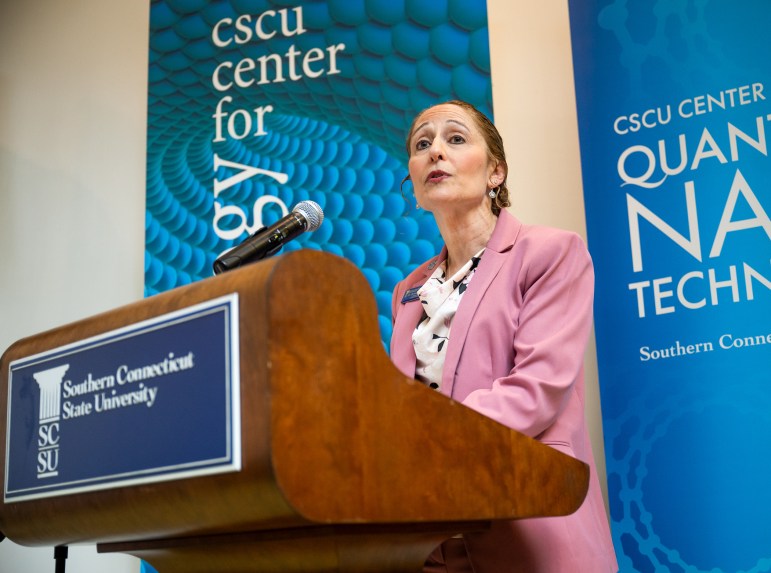
Earlier this spring, Southern Connecticut State University formally opened the CSCU Center for Quantum and Nanotechnology, a center dedicated to developing the next generation of the quantum workforce.
“We want to train people so they’re fluent in these different technologies,” said Christine Broadbridge, a physics professor at Southern and the center’s founding director. “Those are going to be the sought-after people, people that know what tools exist and the right one to use for the particular problem that they’re looking to solve.”
But as the industry gets off of the ground, concerns about access and equity are already present. Women are noticeably underrepresented in the scientific fields that overlap with quantum, according to the World Economic Forum. And deeper concerns persist that quantum, much like artificial intelligence, could end up exacerbating inequality, particularly for low-income communities and historically marginalized groups.
Those concerns already exist within New Haven, and leaders would need to balance the existence of more than $1 billion in combined economic investment into local quantum efforts with the needs of a city where one quarter of residents lived in poverty in 2023.
Yale, a key champion of the quantum effort and an economic anchor in New Haven, has often found itself at the center of local discussions around displacement, gentrification and inequity.
The city has a higher unemployment rate than the statewide average, and New Haven stands out as one of the most expensive cities in one of the nation’s most expensive states. Wide gaps exist along racial, economic and regional lines. DataHaven found that a legacy of racial and residential segregation has contributed to lingering inequality, with Black and Latino communities facing significant disadvantages and lower quality of life.

It’s a disparity that A.M. Bhatt, director of education and training nonprofit dae, thinks about a lot.
“The distance between Fair Haven and where the innovation hub is now centered is, on paper, 1.2 miles,” he said. “In reality, it’s the width of the Atlantic Ocean in terms of the access that people in the community have to what’s happening there.”
For years, dae has worked to expand access to technology education in New Haven, launching programs for local high school students that help them develop skills in computer science, web development and other tracks. The organization is also active in Stamford, with plans to expand to Bridgeport.
Eighty-five percent of dae participants go on to pursue STEM in college, Bhatt said that his focus is on “building good humans.”
But Bhatt said he sees the work supporting a broader purpose. “It was really designed to help kids in New Haven sort of claim themselves, claim their voice,” Bhatt said.
In 2025, dae was awarded a community impact pilot grant from QuantumCT to develop a quantum curriculum for high school students, the first curriculum of its kind in the state and one of a handful in the country.
In the months since, nearly two dozen students have graduated from its free daeZERO program — a multi-week course that introduces students to quantum concepts, from superposition and how quantum computing can be used to run multiple calculations simultaneously, to how quantum building blocks, known as “qubits,” can be used to build new calculations and formulas.
At the end of the course, students present a capstone project designed using quantum software programs, detailing how quantum could be used to solve a real world issue.
“There’s not as many tech opportunities in New Haven. Certain schools have more opportunities and other resources,” said Katherine Flores, a recent graduate from Hill Regional Career High School. “When I first heard of quantum, I really didn’t know much about it, and when I did my research, I saw that it’s something that’s developing, and I saw that opportunity.”
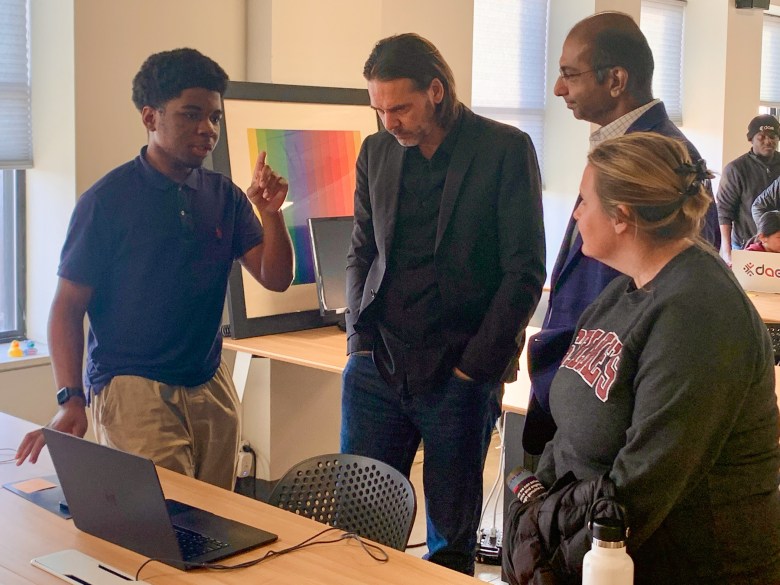
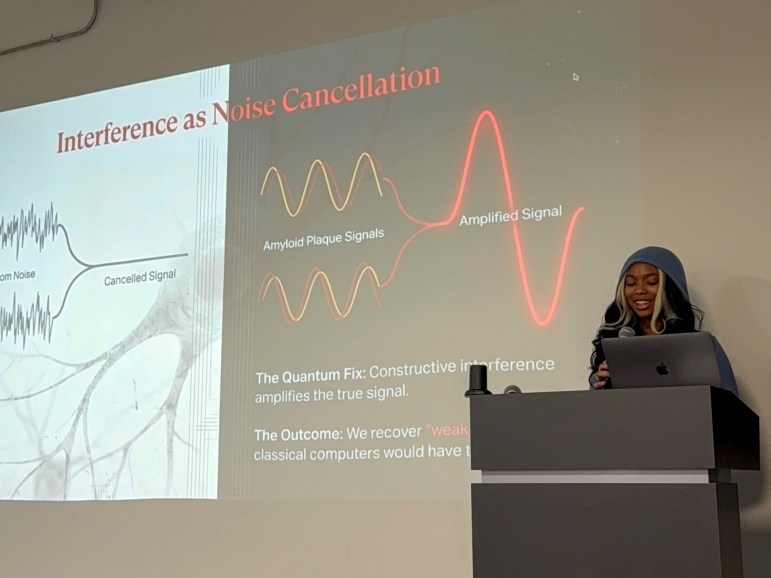
Kimora Dash, a recent graduate from the Sound School, has participated in other dae programs. She said that the quantum program was especially interesting because in New Haven, “there wasn’t really a lot of STEMcoding or stuff like that” available to students. During the quantum program, Dash worked with Flores and another member of the cohort to develop a project examining how quantum computing could be used to detect the early stages of Alzheimer’s disease.

In addition to QuantumCT, daeZERO is receiving financial support from IBM Quantum and Yale. This summer, the organization is taking the program to its Stamford location, giving students in Fairfield County a chance to learn about quantum computing. Later this year, dae plans to launch a longer 10-month quantum program that will give participants the opportunity to earn industry relevant credentials and engage in college-level work.
Bhatt said that his goal is to give a broader group of students access to more than just skills but to options. “In affluent suburbs, they’re getting the kind of education where they’re not just getting skills, they’re not just getting a pathway to a job, they’re getting this more diversified development,” he said. Other students in the region deserve that same level of opportunity, he said.
ReadyCT, a nonprofit focused on helping expose students to career pathways and prepare for the workforce, also received a QuantumCT Community Impact Pilot grant to support expanding knowledge and awareness of quantum computing and mechanics to students. ReadyCT used the funding to incorporate a pilot quantum module into its existing work in a handful of schools in Hartford, exposing students to the industry in a shorter course. The pilot is targeted at “Alliance Districts,” the districts in the state where students have historically been underserved and face limited access to resources.
“I frame quantum to them in the most simple way that I could: AI was my generation’s tech giant and quantum is yours,” said Melissa Vieira, a career pathway development coordinator with ReadyCT who taught the pilot curriculum this year. “As someone who in high school didn’t know what AI was, I tell them, I want to make sure that you’re at least aware of what quantum is and how it can affect the jobs that maybe you want.”
“There’s buckets of talent there, and without the exposure and without an opportunity to build some social capital, that talent is just going to wither and blow away,” said Sheryl McNamee, ReadyCT’s deputy director. “It’s not just a loss to that life, but it’s a loss to that family, that community and the broader Connecticut community and the workforce.”
Preparing for the quantum leap ahead
While the state waits to hear news about the NSF grant, several other initiatives are moving along.
Connecticut Innovations, the state’s venture capital arm, launched a $50 million AI/Q Fund intended to support startups using quantum, artificial intelligence or other emerging technologies. It’s made investments in companies working on drug discovery and AI tools for finance.
In May, supporters gathered for the state’s first quantum summit in Hartford to learn more about how the ongoing quantum moment is unfolding. And quantum was a primary focus at this year’s annual Yale Innovation Summit.
There’s also been some turnover in leadership. Green, the physicist appointed as president and CEO of QuantumCT last year, left the position recently, transitioning to a role as board advisor for the organization. The organization has since announced its search for a new director.
When asked for details about the change, a spokesperson for QuantumCT said in an emailed statement that the organization was “not in a position to share specifics,” adding that “leadership transitions are a natural part of any organization’s evolution, and we remain committed to our mission and to maintaining strong momentum in developing Connecticut’s quantum technology ecosystem.”
Green did not respond to a request for comment.
In the wake of Green’s departure, QuantumCT is being led by interim CEO Vivek Ramakrishnan, QuantumCT’s senior director for technology deployment. In a recent interview, Ramakrishnan explained that as the organization continues its work, his focus is on ensuring that the ecosystem has a strong foundation.
That includes launching new QuantumCT supported pilot projects. Ramakrishnan said that another important part of the work is demystifying quantum and ensuring that the public can understand what is happening as the ecosystem is built. He plans to start an update series called Chai & Quantum, where people can learn more about the New Haven cluster, statewide quantum programming and the latest developments in the industry.
“We have UConn, Yale, Southern, and other places, but for us, for QuantumCT to make a difference, we have to start at the grassroots level,” Ramakrishnan said.
The enthusiasm of students is a bright spot in Connecticut’s quantum efforts.
In early June, a group of students gathered on the second floor of the Ferguson Library in Stamford. The students, part of dae’s Stamford contingent, were there to participate in a two-hour quantum bootcamp, the first time that the organization expanded its quantum programming outside of New Haven.
Students started the program, one of the first events of CT Tech Week, with a huddle, a chance for new participants to introduce themselves while others offered updates on their weeks and talked about what they hoped to learn in the session.
Moments later, dae instructor Kay Detome stood in front of the room, explaining introductory quantum concepts like qubits and entanglement as students followed along on laptops.
The point of the exercise, as Detome put it, was not to walk away from the day with a complete understanding of quantum but to gain exposure.
“If you’re thinking about quantum computers now, you’re setting a good path for yourself,” he said.
When the program ended, students had the chance to sign up for updates on dae’s summer quantum programming, a more complete curriculum that will begin in a few weeks. Several waited to write their names down, interested in giving the longer course a shot.
These are the types of investments — not only in infrastructure and companies, but in people — that Bhatt hopes will endure.
“It is very easy to get lost in the hype, that legit genuine hype,” he said. “But the gaps over course of my lifetime keep getting wider and wider, and quantum has the potential to really accelerate that or to close it.”