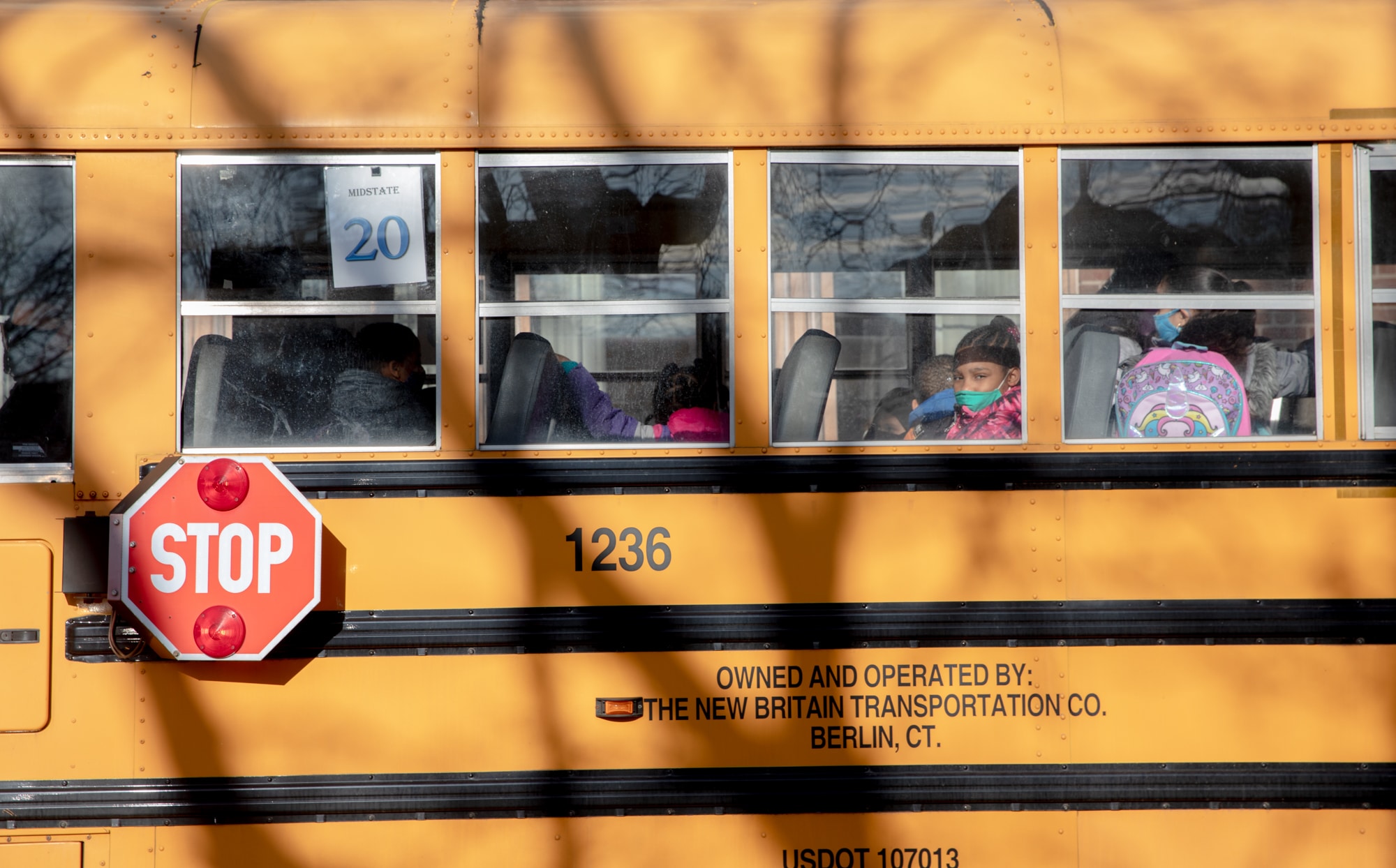
A nationwide study released Monday by Brown’s Promise and The Segregation Tracking Project identified Connecticut as one of the most segregated states in the country.
The study used data from the 2023-24 school year, the latest available, to measure both economic and racial segregation in each state. Researchers found Connecticut had the sixth-highest level of economic segregation and 11th-highest level of racial segregation in the U.S. It also ranked third-worst for “poverty packing,” the practice of cramming low-income students into specific districts while higher-income students attend school just across district lines.
According to those results, Connecticut in 2024 was more segregated than Alabama, home of the famous Montgomery bus boycott, or Kansas, the point of origin for Brown v. Board of Education. The numbers remain high despite a slight overall reduction in both racial and economic segregation in the Nutmeg State over the past decade.
Nationally, researchers said, the results reflect a troubling long-term trend: Seventy years after Brown, school segregation remains high, and little to no progress has been made in reducing it.
“This should be a wake-up call for education leaders and advocates in every state, even those with top-ranked public schools,” said Ann Owens, a sociology professor at UCLA and co-leader of the Segregation Tracking Project.
Interpreting the numbers
The study scored states according to a “segregation” index, or a number representing how student enrollment is balanced around race and income. A score of 0 means no segregation — individual schools reflect their state’s overall demographics perfectly. Conversely, a score of 1 means students of a particular demographic are only exposed to other members of that demographic in their schools — complete segregation.
Connecticut’s racial segregation index of 0.42 indicates that, on average, white students attend schools 42% whiter than schools attended by non-white students. In other words, white students are concentrated with other white students, disproportionate to state’s overall demographics — a sign of strong segregation.
Although the state’s racial segregation index steadily decreased from the late 1990s to the mid-2010s, it has plateaued over the past decade.
“I would hypothesize that demographic changes and student assignment policies play a role,” Owens said. “[The] expansion of charter schools, expiration of mandatory desegregation orders, reduced commitment to integration policies — all could explain stalled progress.”
The state’s immediate neighbors also showed high levels of segregation, with New York topping the list for racial segregation. The northernmost New England states fared better, with Vermont in particular standing out for having extremely low levels of both racial and economic segregation. However, Owens noted that it’s possible this is more a product of lower population density than a particular set of policies to encourage integration.
Less dense places often have fewer schools, creating fewer opportunities to segregate, Owens said.
“More choice — whether it’s a state carved up into more, smaller districts or more school options within a district — tends to lead to segregation,” she said.
And, she added, if low-scoring states like Vermont are less diverse, it could obscure segregating behaviors like white avoidance.
Segregation is not a new conversation in CT
Sen. Doug McCrory, D-Hartford, said nothing in the report came as a surprise to him.
“Living in Connecticut all my life, we already know … we have some of the most segregated schools in the country,” said McCrory, who co-chairs the General Assembly’s Education Committee.
McCrory said he doesn’t think the state ever responded appropriately to the principles set forth in Brown v. Board of Education. There have been efforts to integrate, but those have been voluntary — and, judging by the numbers, insufficient.
“People don’t decide to place their children in a, quote-unquote, integrated setting. They’re not required to, so we have what we continue to have today,” McCrory said.
Connecticut Association of Public School Superintendents Executive Director Fran Rabinowitz said she also wasn’t surprised about the results of the report. Part of the issue, she said, is that the state has a different school district for each town.
“We’re not regionalized in any way, shape or form, which many states are,” Rabinowitz said. “You pull together maybe seven or eight or 10 of those districts … you would certainly cut down” on the lack of integration.
But both Rabinowitz and McCrory said that idea has proven politically radioactive in Connecticut.
“Those conversations get shut down immediately,” McCrory said. “This is a Connecticut issue where people just feel their local rights will be hampered if you have to work in a collaborative space … If you bring in the concept of race and income, it gets even more complicated.”
Rabinowitz said she remembers a 2019 effort by the General Assembly to merge the Norwalk and Wilton school districts. It did not go over well.
To address segregation, Connecticut has instead favored policies to promote voluntary integration, as in the landmark Sheff v. O’Neill case. In Sheff, the state Supreme Court found that predominantly Black and Hispanic students living in Hartford enjoyed far fewer educational resources and opportunities than their white peers in neighboring towns. The case led to the creation of a new magnet school system to encourage voluntary integration across district lines.
As it happens, Brown’s Promise cites the Sheff agreement as an example of a potential policy solution to segregation nationwide. However, the organization also acknowledges the drawbacks of Sheff: namely, that there aren’t enough seats for every student to attend the school of their choice, and that Hartford’s neighborhood schools — which still serve hundreds of students each — remain severely under-resourced.
The way to avoid that, the organization suggests, is “to instead redraw district lines altogether.” But that would mean imposing the very regionalization Connecticut residents so vehemently oppose.
Rabinowitz said one possible remedy to segregation is the effort in Connecticut to build more affordable housing. In theory, that will bring more lower-income residents to wealthier areas, increasing economic diversity.
There is another strategy that recently received strong bipartisan support: Increasing state funding for schools that can’t get what they need through local property taxes. Both Democrats and Republicans pushed for that in the recent legislative session, resulting in a school funding boost of about $192 million (though many feel schools are owed around $800 million).
In theory, state money can reduce the resource gap between the wealthiest and least wealthy districts. That’s why it’s also one of the solutions to segregation that Brown’s Promise proposes. The organization argues enhanced state-level funding dramatically increases resources for underserved students and makes their schools look more attractive.
But although McCrory said he supports increasing state funding for Connecticut schools, he’s not optimistic that this alone would promote integration.
“We tried multiple times to direct more resources into those communities [that are] financially behind. That doesn’t always equate to better outcomes for students,” McCrory said.
Rabinowitz, who spent much of her career working in Bridgeport and served as the district’s superintendent, disagreed.
“Yeah, you know, they increased the funding, but it never was enough,” Rabinowitz said. “It was never the amount of funding that was predictable and enough to let me lower class size and provide reading interventionists and to provide behavior interventionists, et cetera.”
Rabinowitz said many teachers who left the district told her they weren’t doing so for a better salary elsewhere.
“They were leaving because I did not have the systems in place to make them feel successful. And they were right. I didn’t, because I didn’t have the resources,” Rabinowitz said.
She said she’s hopeful that Gov. Ned Lamont’s Blue Ribbon Commission on K-12 Education Funding and Affordability will lead to meaningful reforms.
“More than 40 years ago, I was fighting the same battles. And I hope that before I finish my career, we can have a significant impact,” Rabinowitz said. “And I do believe this funding commission might be significant. I’m hoping it is.”