




This story has been updated.
Four members of the University of Connecticut Fencing Club walked into a nearby fencing school on a November night last year. From the outside, the building looked like an unassuming warehouse. But a step inside revealed bright fluorescent lights and a dozen fencers hard at work.
Wasting no time, the students adorned their white padded uniforms. Three of them sported clear blue lettering on their backs, noting their last names and schools.
But for Red Sullivan, the faded green letters spelled out, almost unrecognizably, the word “Wagner.”
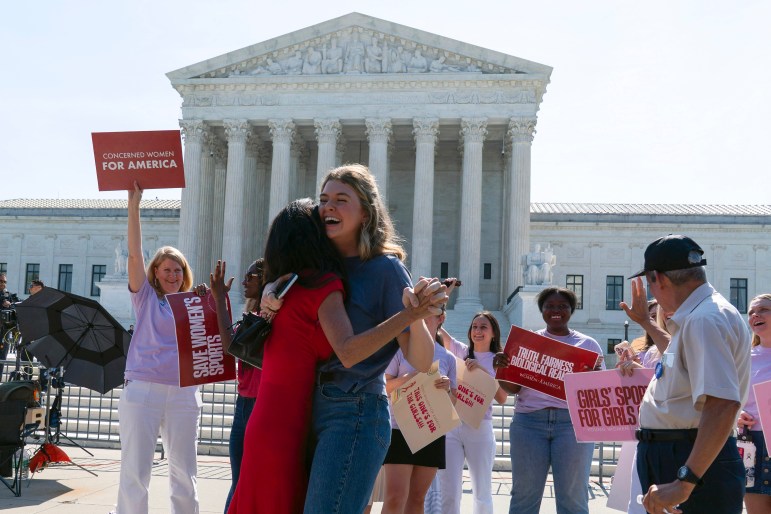
Sullivan, 21, used to fence for Wagner College. Before President Donald J. Trump signed an executive order banning transgender athletes like her from women’s sports. Before she lost her $5,000-a-semester athletic scholarship. Before a USA Fencing competitor refused to fence Sullivan, and a video of the opponent kneeling in forfeit went viral. And long before the U.S. Supreme Court upheld state laws that ban transgender athletes from participating in girls’ and women’s sports. In a 6-3 vote Tuesday, the court ruled against two transgender students who had challenged restrictive laws in West Virginia and Idaho.
Sullivan is now rebuilding her life at UConn, majoring in history and secondary education, making friends in fencing and competing in mixed-gender competitions when she can. As fencing takes a backseat in her life, Sullivan, of Madison, said academics, socializing and bringing awareness to issues in women’s sports have become more pressing priorities.
“My life is now rotated to focus on different goals, and it’s not fencing,” Sullivan said. “Which was going to happen eventually because it’s something that you can only do for so long. But I would’ve liked to have chased fencing for a little bit longer.”
Sullivan grew up in Connecticut with her parents and two younger siblings. Her father works at UConn while her mother manages a maintenance call center.
Sullivan’s fencing journey began in high school, when she was 14. At first, her interest was casual. But after the COVID-19 pandemic, when she was 15, she started falling in love with the sport and taking it seriously.
Around the same time, Sullivan, who was assigned male at birth, began questioning her gender identity. While she said she was aware that transgender people existed before, she did not view transitioning as an option until she saw an online post that presented it as fulfilling.
“I was at a point in my life where I felt very — I was just depressed,” Sullivan said. “My thought around it was, I think I’d be a lot happier if I did this.”
Sullivan said that as she seriously considered transitioning, she felt she might have to sacrifice it or fencing because of the potential political backlash. She said she had to decide whether she could both transition and fence, which both became facets of her identity.
“[I] decided that I care enough about sports that I am going to just be myself while playing sports,” Sullivan said.
Connecticut’s policy for transgender athletes in interscholastic sports allows students to compete with the team that fits their gender identity. Sullivan fenced on the high school girls team in her senior year. Sullivan said she did not receive criticism for being transgender, at least directly.
“Things weren’t said to me, but I know things were definitely said behind my back,” Sullivan said. “At that point I was much…less aware of how much people would say, so, I wasn’t thinking about it as much. Which was definitely a good thing for me at least, where if I was more hyper aware and anxious of the things that people were saying, then I definitely wouldn’t have been the same person that I was, where ignorance was definitely bliss at that time.”
When she was recruited as a Division I fencer for Wagner, she said she “was just a body to fill the roster slot.” But she was determined to change that. Sullivan said she would practice with her high school team for one to two hours before driving to her fencing club, where she would practice for another three to four hours.
“I was putting as much time as I could into fencing,” Sullivan said. “Definitely like an addiction, where it was like, I just wanted to be fencing as much as I could.”
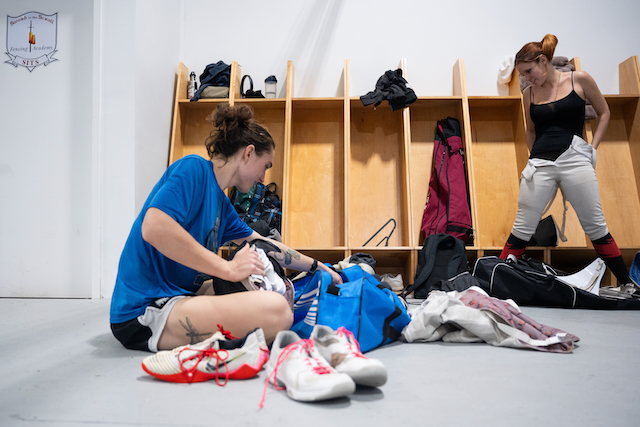
Sullivan’s wish was granted when she started attending Wagner, a private liberal arts college in Staten Island, in 2023. At the time, the NCAA allowed transgender women to compete on women’s teams after a year of hormone treatment and having blood tested for testosterone levels, Sullivan said. Because she began hormones just after graduating from high school, she had to compete for the men’s team for her first year at Wagner and switched to the women’s team in 2024.
While at Wagner, Sullivan said she put everything she had into fencing. She would practice with her team for the maximum hours allowed a week and spend free time improving her footwork at the gym.
Sullivan said her teammates, coaches and competitors were largely supportive, but she noticed an uptick in people who were judgmental.
“There was definitely more people that were saying things,” Sullivan said. “Not really stuff to my face, but seeing things online and then also having some teammates that didn’t say anything directly, but… if you can’t read a room or if you can’t read between the lines, then you might need to get your vision checked.”
While Sullivan said she enjoyed fencing at Wagner and had a relatively accepting environment, it changed when Trump won the 2024 election. Sullivan said she told the Wagner head coach that she was scared after the election and suspected she would be banned from competition. Still, she said she wanted “to have the best season I have for as long as I can.”
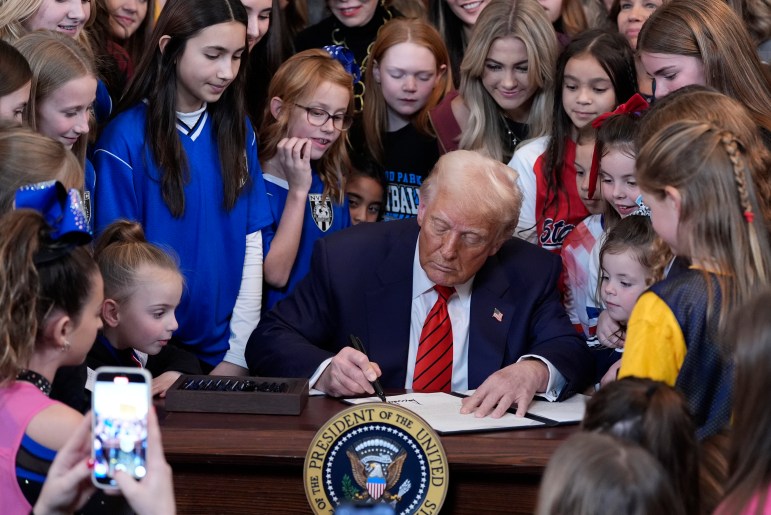
When winter break ended, she said she hoped to get a chance to fence in one more competition with Wagner. But that final tournament never came. On Feb. 2, 2025, Trump signed the executive order, “Keeping Men Out of Women’s Sports.” By banning transgender women athletes from sports competitions held by entities that receive federal funding, the NCAA changed its inclusive transgender policy after the order. Sullivan was removed from Wagner’s fencing tournament roster and lost her athletic scholarship.
After the NCAA ban, she could still compete in non-NCAA events through USA Fencing. But she said she worried about USA Fencing changing its policy and went into every tournament knowing it could be her last.
“It acted like another clock where it’s like, ‘Okay, I’m going to get banned from this as well,’” Sullivan said. “I want to keep competing for as long as I can and see the best results that I can get. And I definitely could have done more, but I think that with the pressure on me and the emotional strain, there wasn’t much to be done differently.”
Adeline Chung-Feder, an assistant foil coach at Wagner, said she noticed Sullivan’s disappointment but felt powerless.
“Transgender or not, she’s just a child and she really just [wanted] to be in that school and just [wanted] to fence,” Chung-Feder said. “I really felt for her, and I didn’t know how to help her.”
The kneeling protest
On March 30, 2025, Sullivan attended the Cherry Blossom Open, a regional fencing tournament at the University of Maryland. She faced 31-year-old Stephanie Turner in a bout with relatively low stakes.
Before the bout could begin, Turner knelt and took off her mask. When the referee came over, she told him she would not face Sullivan and referred to her as a man. Turner was told that according to the rules, refusing to fence would disqualify her. She continued her protest and was issued a black card, ejecting her from the tournament.
Sullivan walked over while Turner was still kneeling to ask if she was okay. Turner told Sullivan that she had respect for her but would not fence her because she “was a man.” When Sullivan walked away, she noticed two people recording the incident.
Three days later, a video of the protest was posted to X by the Independent Council on Women’s Sports, an advocacy group that seeks to end “sex-based discrimination” against women by acting against transgender athletes in women’s sports. The post mentioned Sullivan by name and referred to her as a man. It received almost 9 million views, 46,000 likes and 11,000 retweets from various accounts, including from people known for speaking out against transgender athletes. Of the thousands who retweeted the post, one of them was J.K. Rowling, author of the Harry Potter series.
Former collegiate swimmer Riley Gaines shared the video on her X account later that day, writing, “THIS is how you say enough is enough. BOYcott!!!” It received over 80,000 likes. Gaines has been outspoken against transgender athletes participating in women’s sports after she tied for fifth place with Lia Thomas, a transgender woman, in a NCAA race in 2022.
The social media buzz escalated, with hundreds of accounts weighing in on the issue, many of which lambasted Sullivan and USA Fencing while praising Turner.
On the same day, Fox News published a story about the incident from Turner’s perspective and aired an interview with Turner. Sullivan said the coverage kept building with follow-up articles and more reaction on social media.
“I was looking at the comments and just always looking at it,” Sullivan said. “I was just very aware of where the narrative was going and just trying to track that from the beginning and seeing how people were responding to it.”
The backlash did not only affect Sullivan. A Fox News article confirmed that Sullivan was no longer a member of Wagner’s fencing team and named the fencing club Sullivan competed with, Iconic Fencing Club in Wallingford. Cooper Johnson, its owner, said his business received dozens of emails and negative online reviews.
“There were people that left reviews for the business on Facebook and on Google, people that I had never heard of, never talked to that gave me one star, zero stars, however many is the lowest because I supported a trans athlete,” Johnson said.
After about a month, when the social media and news backlash started to settle down, Johnson said the hateful comments stopped coming in.
Then U.S. Secretary of Education Linda McMahon announced on Fox News that the U.S. Education and Justice Departments were conducting a Title IX investigation for “anyone associated” with the incident at the Cherry Blossom Open.
Sullivan said her friends in fencing were sympathetic.
“The community was very supportive and made competing and fencing after it a thing that I can emotionally withstand,” Sullivan said. “And if it wasn’t for the community, I don’t think I would have been able to keep competing afterwards, which would have really sucked.”
USA Fencing policy change
In mid-July 2025, USA Fencing announced an updated policy for transgender athletes, which required transgender women to compete in the men’s category. The organization said it was following recommendations from the U.S. Olympic & Paralympic Committee, which had also changed its transgender athlete policy to comply with Trump’s executive order ban.
A USA Fencing spokesperson declined to comment due to ongoing litigation.
Sullivan was already signed up for a small tournament that took place between the announced policy change and Aug. 1, 2025, when it would go into effect. She placed first.
“It was very surreal walking into it knowing that this is very likely my last tournament in a women’s event,” Sullivan said, adding that she was happy with her win.
Now, the only USA Fencing tournaments Sullivan can participate in are mixed events that are not segregated by gender.
On Aug. 1, 2025, the same day the new USA Fencing guidelines went into effect, Wagner issued a statement with its new policy that prohibited transgender women athletes from competing on women’s teams. It apologized for any student-athletes who “experienced a competitive disadvantage” or experienced “distress” because of Sullivan’s ability to fence. It did not refer to Sullivan by name but alluded to her as a “transgender student-athlete who was born male.”
Wagner’s statement was part of an agreement reached with the DOE and DOJ following the Title IX investigation. McMahon praised Wagner for complying with federal guidelines in a DOE press release.

Coming to Storrs
Sullivan transferred to UConn for her third year of college. She said that while not being able to fence and losing her scholarship were part of why she left Wagner, her history major was also getting cut by the college.
Because Sullivan’s dad works for UConn, she receives free tuition and that was the main reason why she chose the university. Wagner’s Staten Island location meant that city life was fulfilling. She misses that in rural Storrs.
“I loved just like going and turning off my phone and just like getting lost and trying to get unlost without Google Maps, and then if I can’t, then there’s always the train,” Sullivan said. “But now it’s just the woods.”
Sullivan practices with UConn’s Fencing Club and is still polishing her skills, but the sport is no longer her top priority.
“My lifestyle’s different,” Sullivan said. “I’m much more stagnant. And I had a couple of moments where I’m realizing that there’s things that I can’t do and I’m not as athletic as I was a couple months ago.”
The massive backlash is still with her, she said, making her “very afraid” that those close to her in fencing will be targeted, too.
Sullivan said she still hopes to become a high school teacher one day. But her experiences with women’s sports have given her a passion to advocate for athletes. She said she wants to highlight issues such as eating disorders and sexual abuse that get overshadowed by the controversy surrounding transgender athletes.
Sullivan said she hopes to explore these problems through research and writing. This might include studying media coverage and rhetoric from people like Gaines.
“There’s like twofold aspects to it, where I want it to change, but it’s also I want it to be called out for how like it’s being used right now to, like, harm people,” Sullivan said. “And I hate that I’m being used as the scapegoat.”
Now
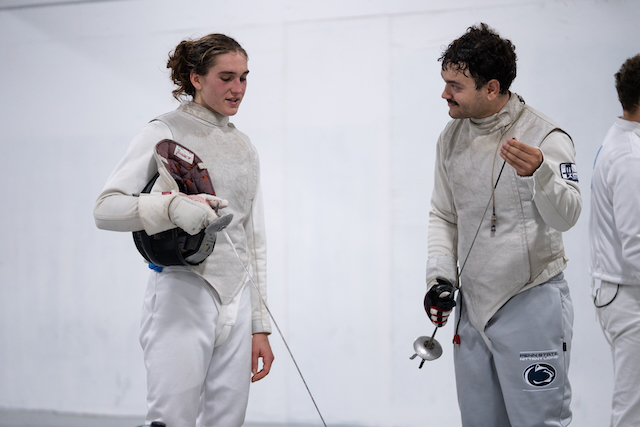
After a brief warm up at the Sword in the Scroll in Willimantic on that same night last November, Sullivan made her way over to practice with Alejandro Toro, one of the coaches and the most experienced foil fencer at the club. They trained with practice bouts and worked on her skills.
Toro, who fenced for Pennsylvania State University, said Sullivan is a “great” and “technically talented” fencer. Toro said Sullivan typically chooses to practice alone, in part because there are few foil fencers at the school.
“Red comes from a different school of thought of more discipline, more rigidity in the sport,” Toro said.
As fencing students began to leave or do cooldown stretches, Sullivan continued to practice her footwork and precision with her foil by a target bag. Each step was deft. Each swing was exact. But it is not enough, and Sullivan describes herself as “washed” when it comes to the little things.
Johnson said he can see that Sullivan is still passionate about the sport. “There is still a love for fencing there that has not gone away at all,’’ he said. “The work ethic is still there. She still wants to be the best fencer that she can be.”
Sullivan took another swing, taking Toro’s advice on her technique.
“Use it or lose it,” Sullivan said between drills. “I wanna get back to where I was.”
Editor’s Note: Two statements from Adeline Chung-Feder were removed due to a misunderstanding about whether they could be included in the published story.
Elijah Polance is a senior at the University of Connecticut majoring in English and Journalism. This story is republished via CT Community News, a service of the Connecticut Student Journalism Collaborative, an organization sponsored by journalism departments at college and university campuses across the state.