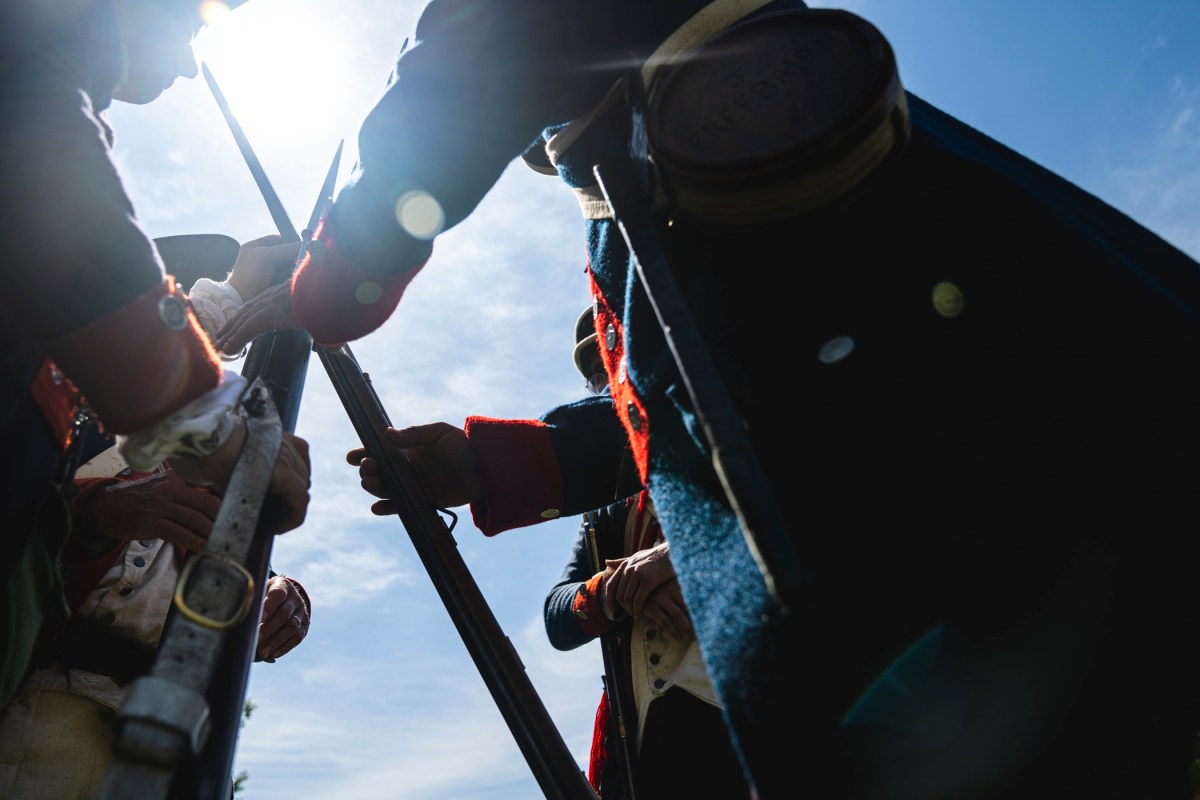



As America celebrates its 250th year of independence, a group of Revolutionary War reenactors known as the Fifth Connecticut Regiment is marking its 54th season of staging armed skirmishes and dramatizing colonial domestic life.
Last Sunday, members of the regiment gathered in Greenwich to participate in the town’s celebration of America’s Semiquincentennial, making camp that morning at Roger Sherman Baldwin Park. By midafternoon, members dressed as British and American soldiers began preparing for battle, lining up with their teenage flagbearers on the lawn in front of the Greenwich yacht club.
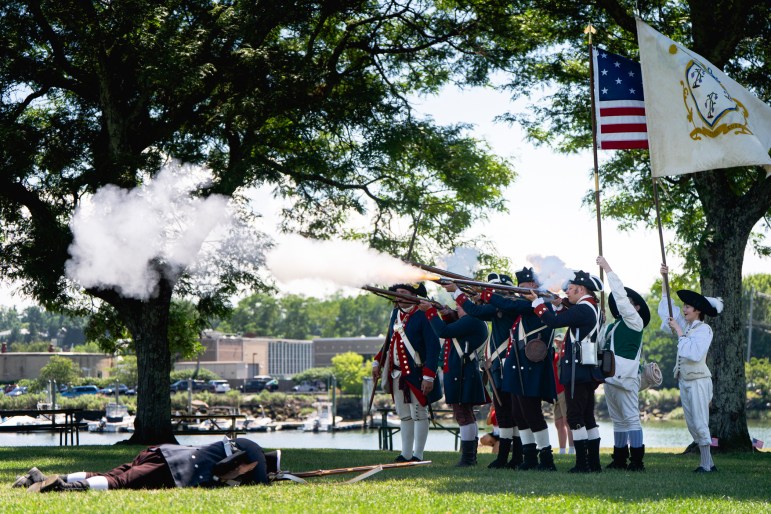
Then marching commenced, muskets were fired (without actual bullets), and several soldiers fell to the ground, feigning death or injury at the hands of their opponents.
Members of the Fifth Regiment say the reenactments make them feel connected to the Patriots and Continentals who walked the same dirt less than three centuries ago, fighting a war that rewrote history.
“It’s like you’re standing in the same spot,” commander of the Fifth Regiment, Al Abraham, said. “It’s just a real, real humbling experience.”
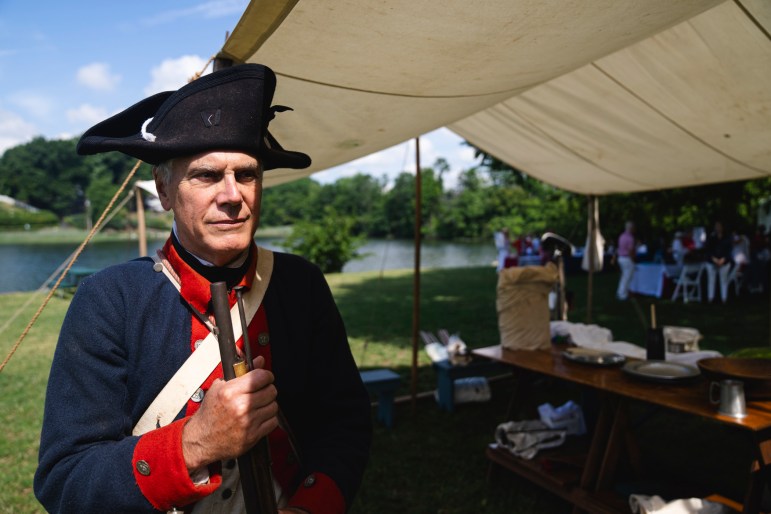


According to members of the group, there’s more to know about the Revolutionary War than just the Battles of Saratoga, Lexington and Concord, and Bunker Hill. For each reenactment, the group’s members — their ranks nearly 60-strong — don era-specific wool coats, hand woven stockings and tricorn hats, often handmade by women in the regiment.
Some of the events require as much as a year of planning. And some last a full weekend, with members camping in canvas tents, drinking home brewed ales, and waking at sunrise to the sound of the fife and drum.
Sunday’s event was on the shorter side. After about 10 minutes of fighting, members of the regiment packed away their muskets, rolled up their tents and began heading for the parking lot.
The commander
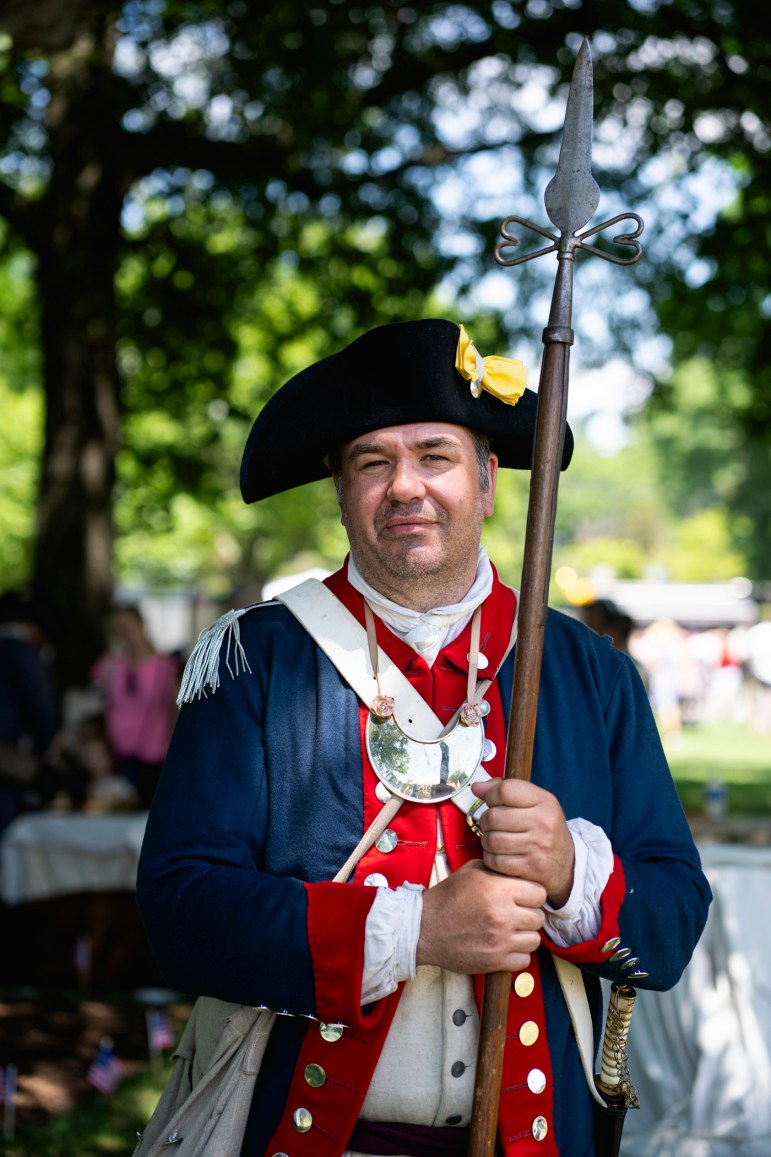
Al Abraham, the group’s commander, lives in Redding — a town often referred to as “Connecticut’s Valley Forge.” Like Valley Forge, Pa., Redding served as the winter encampment for one division of the Continental Army.
Connecticut came to be known as the “Provisions State,” largely for its role providing food and supplies to the Continental Army. Redding served as a supply depot after the Battle of Ridgefield in 1777, when British forces raided parts of Connecticut, destroying much of the army’s stock of provisions.
Abraham was in attendance as a spectator at the Battle of Ridgefield’s 240-year anniversary reenactment in 2017, and he recounted how he’d strained to see the action while peering over people in the crowd. That’s when he realized, “The best seat in the house is actually to be in the battle.”
So he joined the Fifth Regiment, which had been organizing reenactments since its founding in the 1970s in Fairfield County. After serving in various positions, Abraham was voted commander roughly a year ago; He’s currently halfway through his two-year term leading the group.
While the reenactments put him at the center of the Revolutionary War action, Abraham also feels personally connected to the war’s local history in Redding.

Growing up, Abraham said one of his favorite books was “My Brother Sam Is Dead,” a young adult novel about a family divided over the Revolutionary War. He later learned that the story took place just down the street from his home.
Marking 250 years since the Declaration of Independence is more than a one-day celebration for Abraham, he said. The regiment will be holding events throughout the coming year, and Abraham said he’s expecting to attend the 250th anniversary reenactment of the Battle of Ridgefield next April.

The homesteader
Off the battlefield, some members of the Fifth Regiment explore other aspects of 18th century life, bringing a careful eye to their reenactments. Some specialize in textiles, muskets or metal goods, like founding member Jim Freebairn, who casts spoons and buttons out of pewter in his cellar.
Karina Lovette concentrates on food preservation. A homesteader in Bristol, Lovette harvests hundreds of pounds of produce each year, including watermelon, potatoes and strawberries. She even ferments her own fertilizers from comfrey plants and grass clippings.


Lovette preserves her hauls with the same techniques that farmers used during the Revolutionary War. Her home is stocked full of canned, jammed and fermented foods. “The work comes in the harvest,” she said.
Lovette learned about the Fifth Regiment through her son, James-Peyton, who first marched with the group in 2022 during the Battle of Ridgefield’s 245th anniversary. Disappointed he wouldn’t be allowed to carry a musket, James-Peyton — who was nine years old at the time — took up the fife. The regiment doesn’t allow members to march in battle until age 12.


Last Sunday, on a carved wooden chair in the shade, Lovette sat next to another woman in the regiment, who was weaving on a loom propped up on her apron. At one point, Lovette stood and walked to a nearby canvas tent, where she uncovered a glass jar filled with glistening, pickled watermelon rinds. Her pickling practices are true to the era; The jar, she said, not so much.
James-Peyton rested under the tent, preparing for battle.