


A gym membership that has gone unused for months. An unwanted magazine subscription that automatically started after a free trial. A monthly delivery service that seems impossible to cancel.
These sorts of subscriptions can add up quickly for consumers, adding recurring expenses at a time when many are struggling to stay afloat. Things become even more frustrating when buyers can’t easily cancel, leaving them to navigate an often complicated and confusing process. Many simply give up.
Connecticut state officials want residents to know they now have a solution: new state regulations that protect consumers against automatic subscription renewals and memberships.
Under the law, which went into effect July 1, companies must notify consumers of automatic renewals and give subscribers a clear ability to cancel. If that doesn’t happen, residents can file a complaint with the state Attorney General or the Connecticut Department of Consumer Protection.
Businesses that do not comply with the law could be investigated under the Connecticut Unfair Trade Practices Act and may face fines.
“Businesses don’t get to profit by trapping consumers in subscriptions they no longer want,” Attorney General William Tong said in a statement released on Thursday. “Connecticut is putting consumers back in control with strong new ‘click to cancel’ rights. Businesses that fail to comply may be engaging in unfair trade practices, and we will not hesitate to enforce the law.”
The rules around automatic renewals include a provision known as “click-to cancel”, a rule that requires companies to give consumers a simple and clear process for cancelling subscriptions and memberships.
In other words, it can’t be harder to cancel a subscription or membership than it was to sign up for one.
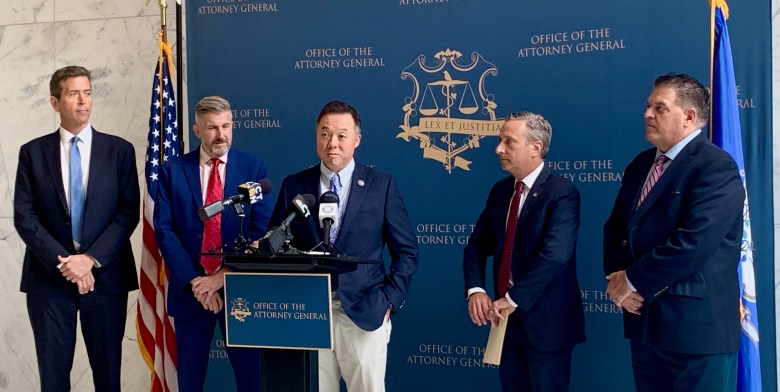
During a Thursday morning press conference in Hartford, Tong — joined by Department of Consumer Protection Commissioner Bryan Cafferelli, Senate Majority Leader Bob Duff of Norwalk, General Law Committee co-Chair Sen. James Maroney of Milford, and committee ranking member Rep. David Rutigliano of Trumbull — laid out consumers’ rights under the law.
And officials said the new protections will encourage companies to consider the needs and rights of the people using their products.
“Businesses don’t get to profit by trapping consumers in subscriptions they no longer want. Connecticut is putting consumers back in control with strong new ‘click to cancel’ rights. Businesses that fail to comply may be engaging in unfair trade practices, and we will not hesitate to enforce the law,” Tong said.
More states are adopting ‘click-to-cancel’ rules
Proposals giving residents the ability to easily end subscriptions and memberships have emerged in more state legislatures in recent years, as local governments grapple with how to protect consumers.
In Connecticut, protections were passed in 2025 as part of Senate Bill 3, a wide-ranging consumer protection bill that included a number of provisions, including requiring businesses to disclose junk fees, granting the attorney general power to go after price gouging, and ordering certain companies to send annual information about automatic renewals to consumers. That information includes the types of services covered by the renewal, the frequency and cost of renewing the service, and clear instructions on how to cancel the subscription or membership.
The requirement that companies have clear processes for cancelling a subscription or membership does not apply to all businesses. Public utilities, internet service providers, banks and insurance companies received exemptions under the law.
Other states, including Maine and California have also adopted “click-to-cancel” policies in recent years. The policy is also spreading to the municipal level; in July, New York City Mayor Zohran Mamdani announced that the city would adopt its own “click-to-cancel” rule that is estimated to save city residents up to $162.5 million per year. The rule will go into effect on Oct. 1.
Federal efforts to pass similar protections have been harder to enact. In 2024, the Federal Trade Commission announced that it would implement a national “click-to-cancel” rule, but the law was later blocked by the Eighth U.S. Circuit Court of Appeals shortly before it went into effect. Despite repeated calls from several democratic senators, including U.S. Sen. Richard Blumenthal of Connecticut, the rule has not been taken back up.
Connecticut is deepening its consumer protection laws
Speaking on Thursday, state officials said the new rule is part of a broader state effort to protect consumers in the digital era. “Our state is joining a growing national movement to protect digital rights and hold businesses accountable,” Cafferelli said.
State legislators and officials have broadly pursued protections around digital privacy, consumer protections and artificial intelligence regulations, enacting policies aimed at outlining responsible uses for technologies and the rights residents have as new digital tools are adopted.
Those efforts have run into obstacles at times, with critics charging that the protections could make the state unattractive for business development.
State leaders counter that their work, which is led in the legislature by the General Law Committee and has received bipartisan support, should serve as a model for other states in the months and years to come.
“We are no longer waiting for Congress. We have abandoned that many years ago,” Duff said. “We are going to make sure that we are protecting our consumers in this state and doing it in a way that is aggressive and that works, and that is fair.”
