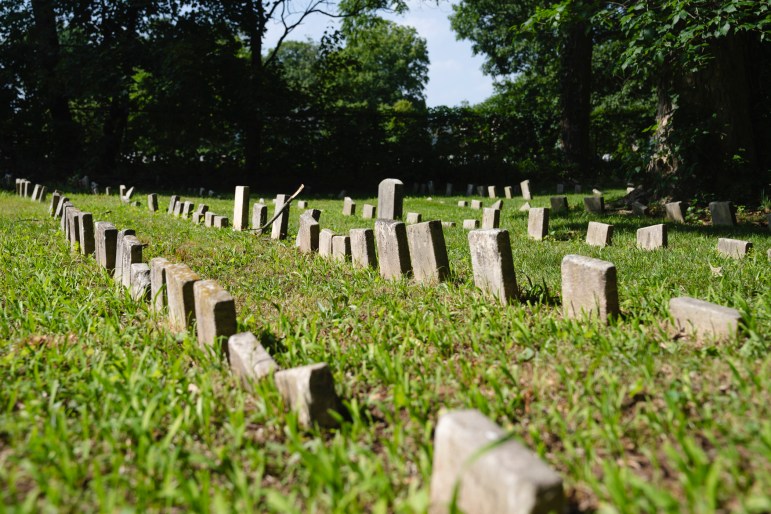
For more than a century, Anna Horan’s gravesite was one of the thousands marked by squat, featureless headstones arranged in uneven rows along the hillside in New Haven’s Blake Street Cemetery.
The only identifying marking, the number 685, was slowly eroded away by the elements until it, too, was gone.
Horan, the daughter of Irish immigrants, died penniless at the Springside Almshouse in 1907. Her life was marked by occasional misfortunes recorded in the city’s newspapers: her father died during her infancy, and later in life, she was abandoned by her husband, forcing her to place her own children in a orphanage. A run-in with the police in 1891 led her to file a slander lawsuit seeking $5,000 in damages, for which she received just $25.
Her body was taken to the Blake Street Cemetery, which served as New Haven’s paupers’ graveyard — a place to bury poor and unclaimed bodies — between 1884 and 1931.
A few years ago, some Horan’s descendants — aided by modern genetic testing and online records — began researching their family tree, and Horan’s hardscrabble life in New Haven began to emerge from obscurity.
Seeking more information last year, they contacted Sherill Baldwin.
Baldwin is an amateur genealogist who has spent the last five years researching the identities of the roughly 2,200 people who are buried at Blake Street Cemetery, the vast majority of them in graves marked only with numbers. Using census records, newspaper archives and other historical records, Baldwin has pieced together narratives about their lives, which she publishes on her blog, Buried Stories.
“New Haven is trying to uncover stories that are not always told,” Baldwin said. “And people who are buried here, while they may have been sort of economically disadvantaged, they contributed in some way into the creation of the community.”
After connecting with one of Horan’s great-grandchildren, Michael Knappman, Baldwin began researching Horan’s life and searching for her final resting place among the rows of stones.
The search was hampered by the fact that Horan’s gravestone, like many at Blake Street, had eroded to the point that it could no longer be identified.
But Baldwin hit a break when she and Knappman discovered the names of two men who had died within weeks of Horan, and were given sequential burial numbers that lined up with Horan’s. Incredibly, Baldwin said, both men had headstones engraved with their still-legible names right next to each other.
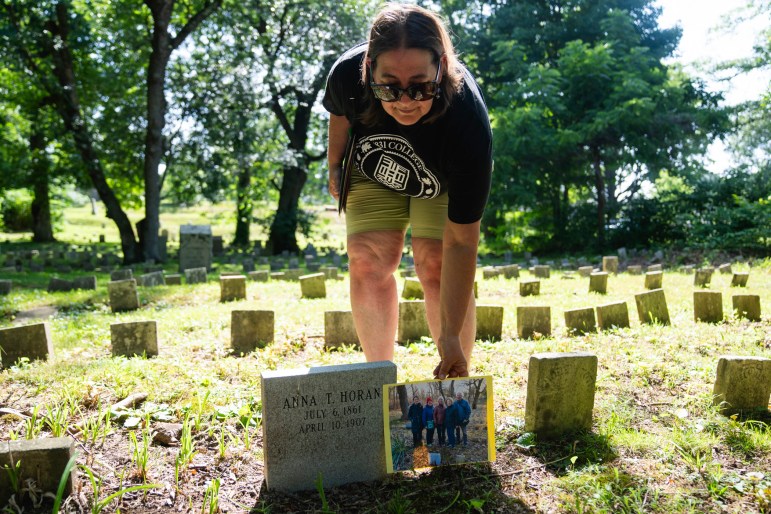
The third stone in the row, Baldwin concluded, must be Horan’s.
In August, Baldwin messaged Knappman that she had located his great-grandmother’s grave and included a photo of the stone marked with a small orange flag. Knappman, who lives in California, coordinated with his sister in Louisiana and a pair of cousins from Maine and North Carolina to purchase a new headstone engraved with Horan’s name and the dates of her birth and death.
Earlier this year, the family gathered in New Haven to see the new headstone and memorialize Horan’s life for the first time.
“Just the thought that Anna’s gravestone was uncared for and not acknowledged was just — it was so sad,” Knappman said. “I felt so much satisfaction knowing that we could put a stone back there with her name on it and recognize her, even though who knows when we might be able to get back to New Haven and lay some flowers down there again.”
What is this place?
Baldwin, a native of Cape Cod, first became interested in genealogy as a teenager, researching her own family’s history at local cemeteries near her hometown of Harwich, Mass. While the interest never developed into a professional career, she later received a research certificate from Boston University after conducting a survey of the people buried in a plot that had belonged to her family since 1862.
Baldwin moved to New Haven in the 2000s and began working for the state Department of Energy and Environmental Protection. When the COVID-19 pandemic struck, Baldwin said, she was unable to make regular trips back to Massachusetts and she began exploring old cemeteries near her home, starting with Fair Haven’s Union Cemetery.
Eventually Baldwin’s interest led her across town to the larger Westville Cemetery and adjacent cemetery owned by the Congregation Mishkan Israel. Behind those two cemeteries is the small, hillside parcel with thousands of small, numbered headstones — Blake Street Cemetery.
“One day I found this, and I was just like, ‘What is this place?'” Baldwin recalled. “I was just bitten. I wanted to know the stories: who’s buried here? What’s going on with this place?'”
Baldwin’s search for more information led her to the Charles R. Hale Collection at the Connecticut State Library. Hale, a necrologist who originally focused on the graves of Union Civil War veterans, was hired by the Works Progress Administration in the 1930s to survey burial plots at more than 2,000 cemeteries across Connecticut.
“It’s phenomenal if you’re a researcher,” Baldwin said. “He had staff that transcribed every single headstone in every single cemetery they could find in Connecticut.”
Even during Hale’s time, however, most of the stones at Blake Street did not have engraved names. Instead, Hale relied on a written list that included names and plot numbers of the 2,200 people buried there.
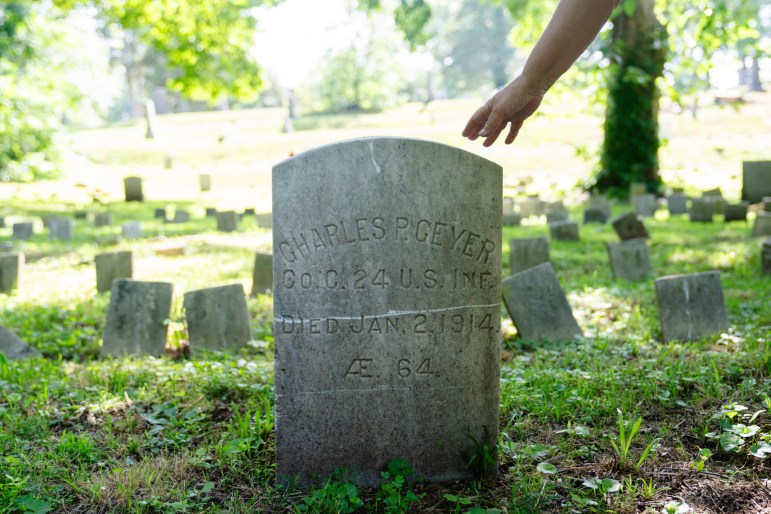
As a result of Hale’s research, military veterans buried at Blake Street Cemetery received new, larger headstones with engraved names. Those stones are still largely standing today, providing an easier reference point for researchers like Baldwin to navigate the cemetery.
After obtaining a copy of Hale’s list, Baldwin converted it into a digital spreadsheet that allowed her to sort the plots by name, age and date of death. One of the quirks of Hale’s collection, Baldwin said, is that it identified the race of people buried at Blake Street — something she said was uncommon for the time period.
About one quarter of the people buried at Blake Street were of African American descent, Baldwin said. Seeking a challenge, Baldwin said she decided to focus her initial research on those names.
One of the first names that attracted her interest was that of Lois Tritton, who, at 95, stood out for being the oldest person buried at the cemetery.
Baldwin soon discovered that Tritton was also one of the most famous people to be buried there. Around the time of her death in 1894, Tritton was the subject of numerous newspaper articles that noted she was the last living person sold at auction on the New Haven Green.
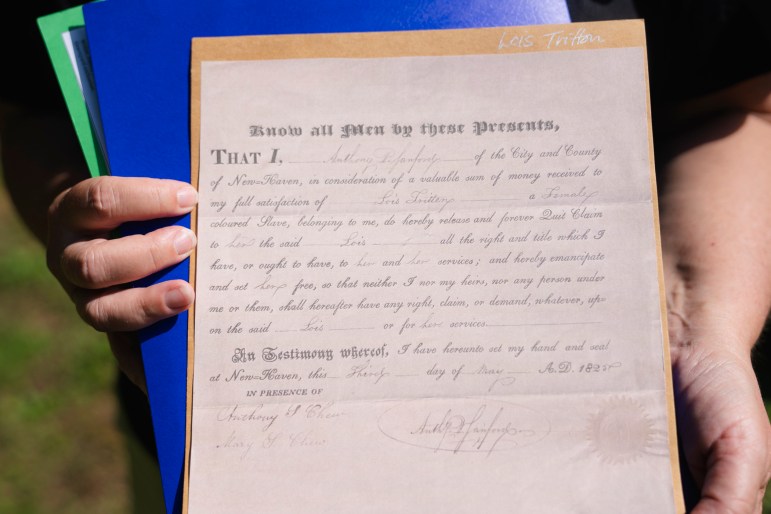
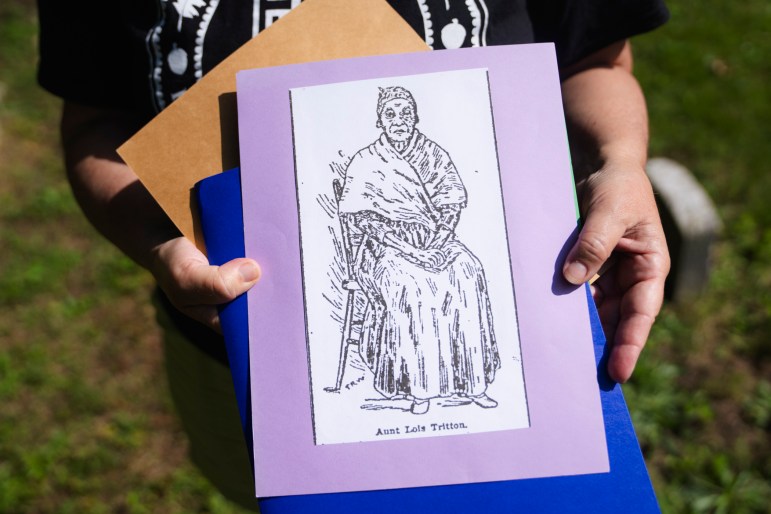
At right, Baldwin holds a printed drawing depicting Tritton.
Much of the information about Tritton’s life has been collected by Jill Snyder, a community historian who first came across the story in the 1990s, when she was looking into the history of New Haven’s St. Luke’s Church, one of the nation’s first predominantly Black Episcopal congregations.
Snyder said that Tritton was born a slave in Nova Scotia and was later brought to New Haven along with her mother, Lucy. The mother and daughter were sold, for $10 each, to help cover their owner’s debts in 1825. Snyder said the man who purchased them, Anthony Sanford, claimed to have freed the pair but actually made Lois work for several years as an indentured servant. (Connecticut began the gradual abolition of slavery in 1784 but did not formally ban the practice until 1848.)
From there, Tritton worked as a laundress in New Haven, where she became historical curiosity as one of the state’s last living linkages to slavery.
“She had her 15 minutes of fame, if you will, and and then was forgotten,” Snyder said.
Spurred in part by Snyder’s research, the Trittons’ story has seen a resurgence in recent years. In 2022, a pair of witness stones were placed in front of the steps of Trinity on the Green Episcopal Church, near the spot where Lois and her mother were paraded and sold. Last March, the church held a special service in conjunction with St. Luke’s to mark the 200th anniversary of the event.
Members of both congregations also began a collection to raise money to place a new headstone at Tritton’s grave at Blake Street. The new stone, featuring the names of Lucy, Lois and Lois’s son Frederick, was placed during a dedication ceremony at the cemetery in June.
“They’re almost alive in my mind, I’ve spent so much time with them,” Snyder said. “Their story is so representative of what happened to African women, being used in such a terrible way, kept enslaved. So they’re very representative, but theirs is also a triumphant story because they were free, and Lois was able to live out her own life, which was rare.”
Hard lives
To date, Baldwin has published articles recounting the lives of around two dozen people buried at Blake Street. They include John Bray, a Civil War veteran who fought with the 29th Regiment of Connecticut Volunteers — the state’s first all-Black infantry regiment — and Charles Coe, a mason who helped construct the old State House on the New Haven Green.
There’s also Mary Hazelton, a woman who was murdered and found stuffed in trunk inside her apartment in 1909. Hazelton’s husband, James Hazelton, who was known for a history of abuse, was immediately suspected of the crime. He was later captured in New York City, tried and sentenced to life in prison for the crime, only to be pardoned in 1928.
“I just hope she’s found a better place, because she lived a very hard life, and it was really hard researching and reading about her demise,” Baldwin said. “And I’m hoping that this is a better spot for her, which is why, to me, I think we need to take care of cemeteries in general.”
After Blake Street Cemetery stopped accepting new burials in 1931, New Haven began relying on another paupers’ cemetery located on Woodin Street. By the 1990s, the responsibility of handling unclaimed and unidentified bodies had shifted to the state’s Office of the Chief Medical Examiner, which works with local funeral homes to arrange burials and cremations.
In addition to her blog posts, Baldwin has begun hosting tours of Blake Street Cemetery, to share her research, and clean up days to remove weeds and litter from around the headstones.
The full story of Anna Horan, the woman whose identity was recently discovered by her family, is another that Baldwin has shared on the Buried Stories website.
In 1885, Anna’s husband Thomas Horan sold all the family’s furniture and left his wife and oldest child without a place to stay or anything to eat, according to a notice about “a cruel husband,” which Baldwin found published in the New Haven Morning Journal and Courier.
At some point, Thomas returned, and he and Anna had four more children, according to Baldwin’s research. When he left the family again, Anna was forced to place her children in the St. Francis Orphan Asylum, while she went to live in the almshouse.
The Horans’ youngest child, John, died at the orphanage at age 8, while the older children later spread out across the country. In some cases, they took steps to conceal their family tree.
For example, Anna’s third child, Thomas, later changed his name to Horace Theodore Sanford when he joined the Army and was sent to Texas, according to his granddaughter, Caron Wilbur.
Knappman — the man who reached out to Baldwin last year to fine Anna’s grave — said his grandmother, Maude, erroneously told him that her parents died in a fire in Baltimore. His mother, Maude’s daughter, would occasionally respond to her kids’ begging with the admonition, “You kids are going to send us all to the poorhouse” — a phrase that stood out to Knappman in the 1950s, and which he now believes was a clue into the family’s background.
“I think my grandmother was hiding some of her history because of shame or just anger, or we’re not sure,” Knappman said. “Maybe she was trying to give us some misdirection to not find out her true birthplace.”
It was not until Knappman and Wilbur completed DNA testing through Ancestry.com in 2019 that they became aware of each other. Even then, it took hiring a professional genealogist to discover the mutual relative: Anna Horan.
The cousins met for the first time in person in New Haven, where they shared pizza and caught up on family stories.
“Without her, we wouldn’t be here today, and for me it brings some closure in this emotional feeling of the unknown, not knowing who your family is,” Wilbur said. “It brings a little bit of a connection, I think, to this human aspect of family.”
Baldwin said she’d eventually like to see every one of the small, numbered stones raised in places where they have sunk into the ground, and to have missing stones replaced. In the meantime, she said, people who believe they have a relative buried at Blake Street should reach out to her to see what information she can uncover.
“It’s regular people, and some of them have very sad endings, but I’m enjoying telling [their] stories,” Baldwin said.