
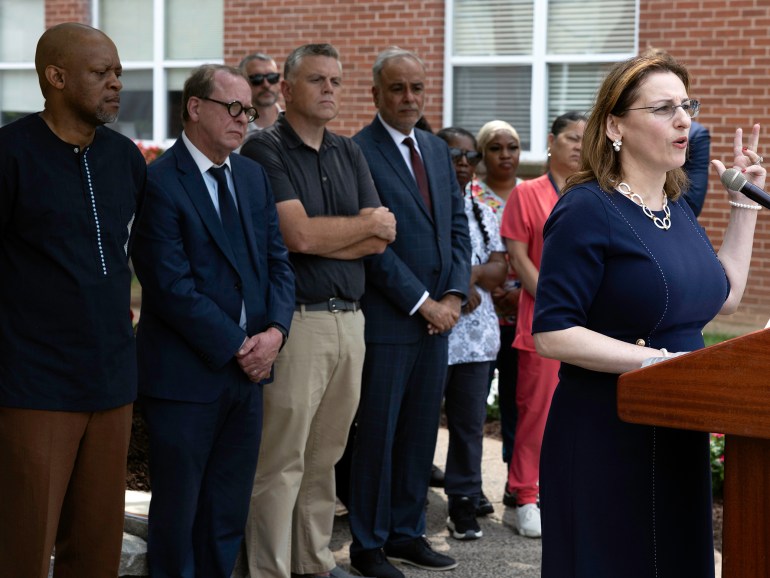
Elected officials gathered with immigrant advocates and staff of a Manchester nursing home on Tuesday to bring attention to how the revocation of Temporary Protective Status from Haitians in Connecticut will affect the state’s workforce and residents, specifically in the healthcare industry.
“It’s my job to track what happens with our economy, and I and other people who do work across the country are really worried about the impact that this has on our labor force, and about the impact that this will have on our labor market at a time when we are stretched for people to work in jobs like in the facility behind us,” said Comptroller Sean Scanlon, standing in front of the Westside Care Center.
TPS provides protection for people fleeing armed conflict and environmental disaster. Haiti was first designated for TPS after a devastating earthquake in 2010 that left more than 300,000 people dead and more than a million homeless.
Losing TPS means that Haitians, many of whom have lived here for more than a decade, can no longer legally work in the U.S. and can be deported. The Trump administration is reportedly planning to deport scores of Haitians.
“These are registered nurses, LPNs, CNAs, home care workers, group home workers. These are people who make the full chain of care,” said Stephanie Deceus, vice president of SEIU District 1199, which represents workers at the Westside Care Center nursing home, along with other facilities throughout the state. “They care for our parents. They care for our grandparents. They care for our neighbors. They care for some of the most vulnerable people in our communities.”
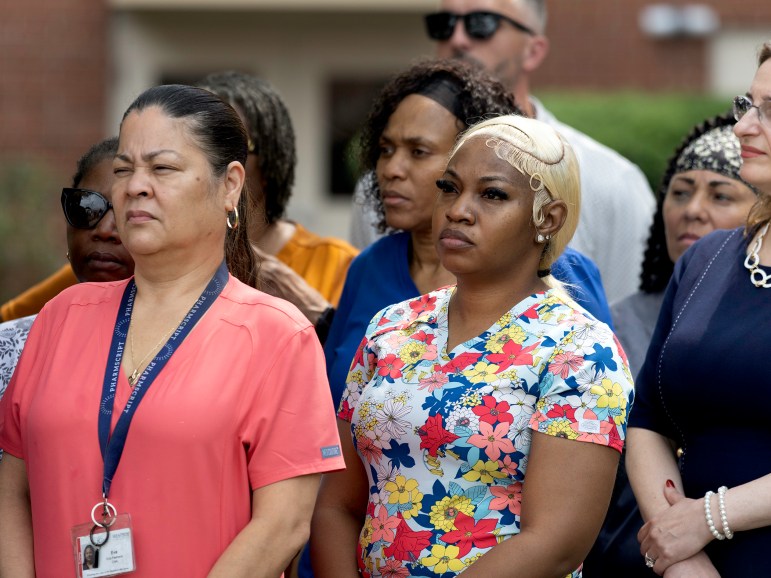
Matthew Barrett, president and CEO of the Connecticut Association of Health Care Facilities, said some facilities had lost as many as 13 workers as of Tuesday due to the end of TPS for Haitians. He said his organization had been surveying its membership and found at least 100 people impacted by the end of the program. Most of those were certified nursing assistants, but there were also three nurses, a registered nurse and some housekeeping workers.
“Even if it’s one or two employees, that’s too many,” in the midst of a staffing shortage that worsened post-COVID pandemic, Barrett said.
Sen. Saud Anwar, D-South Windsor, who is a physician, said the loss of staff will affect patient health.
“What this would mean for individuals is the ones who need their treatment, the medications, they will not get this in time. The ones who need their bed changed, they will not get that in time. That is going to develop more infections, skin infections,” he said, “leading to skin breakdown,” also known as bed sores or pressure sores.
Those conditions can lead to increased hospitalizations, Anwar said. “The hospitals are overwhelmed. This is a decision that is going to result in a healthcare disaster for the well-being of the people in our state of Connecticut,” he said.
Scanlon urged members of Congress to pass a bill that would extend TPS for Haitians. The Safe Environment from Countries Under Repression and Emergency Act, or SECURE, was introduced by U.S. Sen. Richard Blumenthal, D-Conn., and dozens of other Democratic senators. A similar proposal was passed by the House in April.
“This is about people, and this is about the kind of people that have been working hard in buildings like this to care for your loved ones and have been a part of our communities for a long time,” Scanlon said.
The Supreme Court upheld the end of TPS for Haitians in June, cementing the administration’s decision to close what some say is a legal loophole that allows migrants to remain in the U.S. for long periods of time.
But critics say that TPS is ending for Haitians at a time when that country is racked by extreme gang violence and has one of the highest homicide rates in the world. The U.S. Department of State has assigned Haiti a level 4 “do not travel” warning and tells Americans not to go to Haiti “due to the risk of crime, terrorism, kidnapping, unrest, and limited healthcare.” North Korea, Iran and South Sudan carry the same level of risk, according to the ratings.
At Tuesday’s press conference, attorney Dana R. Buchin urged Haitians who have lost TPS to meet with an immigration attorney to assess whether other pathways to remain in the U.S., like asylum, might apply to them.