An ambitious proposal to transform a defunct power plant on Norwalk’s Manresa Island into a public park and event space is facing growing unease from a group of neighbors who have expressed alarm over the developers’ expansive vision for the site, which holds commanding views of Long Island Sound.
The effort to redevelop Manresa Island is being led by a pair of local billionaire philanthropists, Austin and Allison McChord, who purchased the property in 2024 and announced plans to privately fund the cleanup of coal ash and other industrial pollutants left behind on the property before eventually opening access to the public.
Until recently, the response to the couple’s plans had been overwhelmingly positive: public officials, including Gov. Ned Lamont, Norwalk Mayor Barbara Smyth and members of Congress lined up to support the project. The McChords announced partnerships with local institutions, including the Maritime Aquarium and Norwalk Public Schools, and pledged to incorporate feedback from a series of packed listening sessions into the project’s final design.
In a review published last year, the New York Times’ architectural critic praised the McChords’ plans to preserve the power plant buildings and wrote that it was “encouraging to see a public-spirited project that hasn’t yet gotten bogged down by red tape or NIMBY opposition.”
The initial phase of the project, which consists of a series of passive walking trails, picnic areas and an outdoor classroom, is already under construction and is expected to open early next year.
But after revealing their “final vision” for the rest of the property earlier this year, the McChords’ team submitted an application for a special zoning district that included a list of potential uses that some neighbors said they found surprising: a hotel, amphitheater, restaurants, parking garages and a performing arts center.
During a pair of meetings this month before the Norwalk Planning and Zoning Commission, dozens of residents showed up to voice their opposition to the proposal and call for further vetting of the project’s impacts on traffic, noise and pollution.
Representatives of the development team — known formally as Manresa Wilds — have responded by saying that some of the concerns are the result of confusion over the project’s design plans, which they described as a work in process. A third public meeting is planned for August.
Kimberly Tromba, who lives in the Harbor View neighborhood abutting Manresa Island, said she was an initial supporter of the project after attending several community meetings at which glossy renderings were released showing the old power plant building wrapped in a glass facade, surrounded by open fields, wooded trails and a waterfront area complete with a small beach.
But as those renderings have given way to requests for special permits, Tromba said, her support has wavered.
“What feels very alarming is that since then, this new zoning application encompasses way more than that,” Tromba said. “It’s pushing [the project] to more of a regional destination than more of a local park. What was once a snack bar is now going to be potentially a brewery, hotel, and several restaurants. It’s gotten so much bigger.”

Jess Vonashek, the executive director of Manresa Wilds, said in an interview this week that the application for a special zoning district was intentionally drafted to cover many potential uses — even if there are no concrete plans to include them in park’s designs for the foreseeable future.
Other items may have sparked confusion because they used specific terminology used in existing zoning regulations, Vonashek said. For example, she said the request for an “amphitheater” actually referred to the outdoor classroom that was already approved by zoning officials.
In response to some of the concerns raised during the zoning process, Manresa Wilds notified city officials this week of their plans to remove hotel lodging from their application, as well as reducing the size of the classroom/amphitheater from 150 seats to 100.
“All of those uses, while not planned, were things that we included in the application because we heard people talking about them,” Vonashek said. “For as many people in close neighborhoods that don’t like those things, there are other people who actually do like those things and talked very strongly with us about those things.”
Still, the changes have yet to placate residents who say their chief concern is the amount of traffic that will be generated by people driving to park once it is opened.
According to planning documents submitted to the city, Manresa Wilds’ estimates show that nearly 800,000 people could try to access the site once the final phases of construction are completed around 2037, with the busiest crowds predicted during the summer months. Currently, access to the property is limited to a two-lane causeway that also serves as the road connecting the Harbor View neighborhood to the rest of Norwalk. (Despite its name, Manresa Island is actually located on a narrow peninsula that was expanded significantly during the power plant’s operation).
Neighbors say the road sometimes becomes impassable during floods, which could leave visitors stranded at the park. Others have raised concerns about traffic backing up along the causeway, blocking access for local residents and first responders.
Already during the construction of the first phase of the project, Tromba said, she’s contacted the police to complain about a line of trucks waiting to access the property.
“If somehow we could beam people in, that’d be great — it’s really the traffic that’s the issue, not the people,” said Daniel Ryan, who lives on a side street just off the causeway.
Manresa Wilds officials have proposed several ideas for reducing the number of vehicles seeking to access the park, such as capping the number of parking spaces and charging private vehicles an entrance fee, extending bus lines and bike paths to reach the property or having visitors park offsite and take a private shuttle. In the future, some visitors could even arrive at the property via ferry, according to planning documents.
Officials have also pledged to complete a more comprehensive traffic study as designs are completed for additional phases of the project. Opponents, however, say those studies should be done before the city signs off on the permit for a new zoning district.
“A neighborhood traffic problem is a Manresa Wilds traffic problem, right?” Vonashek said.
“We hear what people were saying, and we understand that there is concern, and we’re looking forward to figuring out what the solution is to meet everybody’s needs for the project,” she added.
Still other residents who have spoken up with concerns about the project say that much of the problem stems from the McChords’ efforts to find some way to make use of the hulking, blue-metal-clad structure of the old power plant, which shut down in 2013. The plant and its smokestack are visible from many of the surrounding neighborhoods, as well as Norwalk Harbor and Long Island Sound.
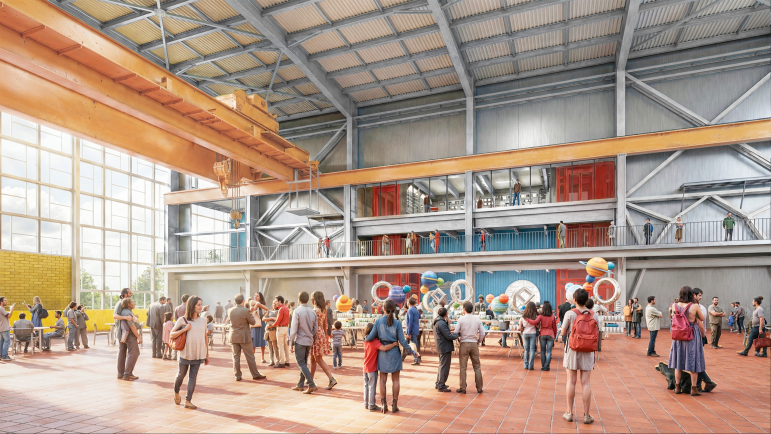
Renderings released by Manresa Wilds earlier this year show the plant’s old turbine hall converted into an event space for galas, black-tie dinners and other celebrations.
Plans have yet to be finalized for the largest of the buildings, which formerly housed the plant’s gigantic boilers, but options include classrooms, an indoor play space or an oceanographic institute, according to the project’s designers.
“My personal preference would be that those buildings would be taken down and removed because they’ve been an eyesore in Norwalk ever since they were built,” said David Lindsay, who has lived in the area since the 1960s.
“I think that all of Norwalk would appreciate that being done,” he said.
Jenn McMurrer, a spokesperson for Mayor Smyth, declined to comment this week on the specific application before Planning and Zoning but said the city is in frequent talks with the developers as they finalize their long-term plans for the property.
“We understand people’s concern. It is a big project and a big change for the area,” McMurrer said. “We’ll continue to work with Manresa and make sure those concerns are addressed to the best of their ability.”
Of course, the project also has its share of supporters within Norwalk and surrounding communities.
Several residents who spoke at the meetings characterized the opposition as a vocal minority of residents who have fixated on a few mostly parochial issues. Others said Manresa Wilds — and the McChords’ commitment of hundreds of millions of dollars in private funding to back the cleanup and redevelopment of the property — presented a “once in a lifetime” opportunity for the city.
“If this project dies, I ask, what is the grand alternative?” said Josh Bleggi, a Norwalk resident who spoke at Wednesday’s meeting. “They’ve already fought off private development, now they’re fighting off a public nature conservatory. Is there an actual plan, or do they just want to leave a toxic, dilapidated power plant to rot in the Sound?
Jason Patlis, the chief executive of the Maritime Aquarium, also spoke up in defense of the project at the meeting. He noted that the aquarium, which opened in 1988, also had its share of naysayers at the time.
“I would put the Maritime Aquarium, almost 40 years later, as an example of how the city can look beyond immediate controversy, the immediate debates, and see the longer-term benefits for the community, for the city,” Patlis said.
But many of those who spoke out against the project at the recent meetings said the very thing they feared was that Manresa Wilds would become a regional attraction plopped in among small residential neighborhoods.
“It’s fine for Norwalk, but to open it up — there are about a million people that live within an hour of this place, and if you invite everyone in the world, it’s going to be a disaster,” Ryan said.
Asked this week whether the McChords’ vision for the project was fundamentally at odds with neighbors who have expressed a desire for a more toned-down design, Vonashek said the park was being planned with both groups in mind.
For example, she said that the first phase of the project — which will consist mostly of walking trails and be limited to no more than 50 parking spaces — is expected to cater largely to local residents, especially those who live in neighborhoods immediately surrounding Manresa Island.
But, she added, the long-term designs are being driven by a “value system” that includes wider access to the public at large.
“We’ve always talked about this park being open for all,” Vonashek said. “That means not only just to local neighbors, but also, you know, regional residents as well.”