


Inside the Charles F. Greene Homes public housing complex, residents have learned to live with elevators that break down often, mold in aging buildings, broken windows, unsafe basements and hallways where strangers sometimes gather.
But the photographs residents took this year as part of a photovoice project were never meant to tell only the story about what is broken.
They also captured the people who live there, the places they find comfort, the friendships, the beauty and the community they fear could disappear as Greene Homes moves toward demolition and an uncertain future.
For five weeks this spring, eight Greene Homes residents worked on the photovideo project with the organization PT Partners and Sacred Heart University staffers Tricia Lewis, an assistant professor, and Julia Bates, an assistant teaching professor. Residents took photographs of their community, discussed what the images meant to them and selected the work they wanted to share publicly.
The resulting exhibit at BPT Creates took place earlier this week and gave residents control over how their community was represented.

Greene Homes, in Bridgeport’s Hollow neighborhood, is home to more than 700 residents, most of whom identify as Black or Latino. Historical material displayed alongside the photographs describes the original purpose of the public housing as providing decent and safe homes for families.
More than seven decades later, residents say the conditions inside Greene Homes tell a different story.
Deshawn Russell, who has lived there since 2009, said the project gave residents a way to document what they experience every day.
“I had to pause and really look at the bigger picture and realize, OK, this is really happening,” Russell said. “We’re finally going to basically bring receipts on what’s really going on, put it in the face of society, and show them what we are going through.”
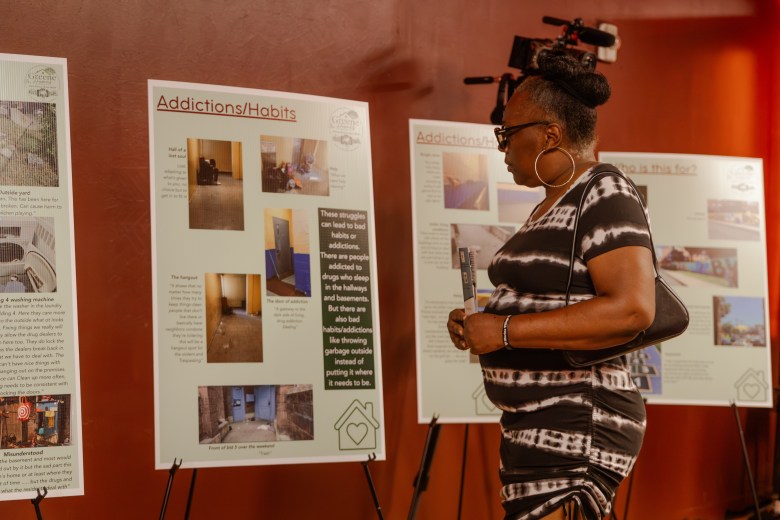
Built in 1950, the development’s five eight-story buildings are equipped with elevators. But the photographs document one elevator that residents say is frequently out of service, along with mold, damaged windows, broken areas of the grounds and poorly maintained laundry facilities. One photograph shows a basement where residents said people sleep, with the smell of urine lingering in the space.
For Russell, those problems are not occasional inconveniences. They affect the most basic parts of daily life. He recalled recovering from surgery while an elevator was out and watching people climb the stairs to bring him paperwork.
He also photographed the hallway outside his apartment for the photovideo project. “I hate walking through my hallway and seeing garbage and writing on the walls and stickers on the doors,” Russell said.
The exhibit’s five themes — damage and disrespect, addictions and bad habits, escape, once a community and “who is this for?” — reflect the complicated picture residents wanted to present. Alongside photographs of deterioration and neglect are images of fashion, nature, the sky and places where residents find comfort.
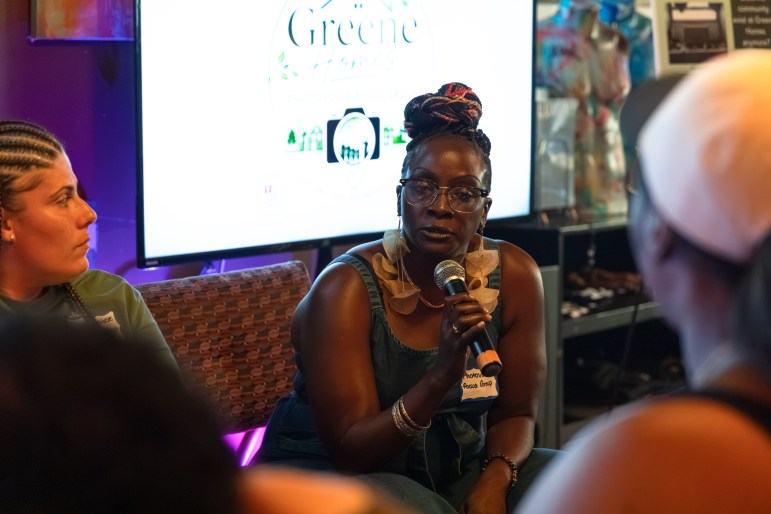
Otika Fulton, a former Greene Homes resident, said outsiders can easily see public housing only through the problems they associate with it. She said that misses the people who live there.
“It’s not the projects; it’s the people in the projects,” Fulton said. “It’s never the building; it’s the people in the building.”
Fulton said residents are grateful to have housing, but that gratitude should not mean accepting poor conditions.
“They’re making the outside look beautiful, and we look, and we’re living horrible at the inside,” she said.
She compared it to “putting glitter on mold.”
Still, Fulton said the conditions have not erased the sense of community among residents. She described neighbors looking out for one another and said she often thinks about residents whose apartments are in worse condition than the one she lived in.
That sense of community is part of what former residents fear losing.
Angie Rendon lived at Greene Homes for three years beginning in 2021. She said those who’ve lived in the buildings should be the ones telling the story because they are the ones who lived it.
She said people in positions of power can take residents’ experiences, reinterpret them and make decisions based on what they want rather than what residents need. “When you let other people tell it, it doesn’t get told in the way that it needs to,” Rendon said.
Greene Homes residents have been living with the possibility of demolition for years. Mayor Joe Ganim announced plans in 2018 to demolish and rebuild the development. In 2023, Park City Communities, which manages Bridgeport’s public housing, received a Choice Neighborhoods Initiative grant to begin planning for the demolition and redevelopment of Greene Homes as part of a broader effort to revitalize the Hollow neighborhood.
But residents say the future remains unclear while repairs go unaddressed.
“What stood out to me with some of the disturbing photos is the fact that housing and maintenance see the issues, and they ignore it,” Rendon said. “It doesn’t matter how many work orders you put in. It doesn’t matter how many times you go to the office. Their excuses for the past two years have been the same thing. Well, demolition is coming. Demolition is coming. But no one should have to live like that.”

Park City Communities did not respond Tuesday to questions about the concerns raised by residents.
Lanice Johnson, who has lived at Greene Homes for five years, said the elevators are among her biggest concerns, particularly for older residents who cannot easily use the stairs when they stop working. She said the elevators can break down frequently, leaving some older residents unable to leave their apartments.
“And I feel sorry for the older people. They can’t walk up and down the steps and stuff. They gotta stay in until they get fixed,” Johnson said.
Johnson said residents also need to come together and support one another.
“We have good residents,” she said. “We just got to get them to come out and support more. If they don’t, nothing’s gonna happen. We gotta support each other. We gotta help each other out.”
For some residents, the question of what happens after demolition is not theoretical.
Charlene Colson, a former Marina Village resident, participated in a panel with Greene Homes residents during the exhibit’s opening events. She spent much of her childhood and adult life connected to Marina Village, a South End public housing complex which was demolished in 2018.
Colson remembers Marina as a place where neighbors relied on one another. “It didn’t matter who you were. Everybody was family there,” Colson said. “Everybody came together.”
She said neighbors shared what they had when someone else was without, teaching her lessons about survival, empathy and caring for others.
Today, the site where Marina Village once stood is home to the Windward Apartments, a mixed-income development. Colson said the Marina buildings may be gone, but the memories remain.
“They could knock it down. The memories are still here,” she said. “We still talk about it.”
Her experience has shaped the advice she gives Greene Homes residents now facing possible displacement. Ask questions before the buildings come down, she said.
“What’s going to happen for us?” Colson said residents should ask. “Do we get a choice of where we’re going to go? Are we getting vouchers? And what are these vouchers going to entail?”

Colson urged residents to attend meetings, understand their options and develop a plan rather than wait for decisions to be made for them.
Residents need to be included in decisions about their future, she said.
“We are important. We matter,” Colson said. “You guys, you have to use your voice.”
That idea is at the heart of the photovoice project.
Lewis, a housing scholar at Sacred Heart University, said the project grew from her interest in housing inequality in Bridgeport and her desire to conduct research differently. Rather than arriving with questions of her own, she wanted residents to help shape the research.
In 2023, residents helped create a survey about conditions at Greene Homes. Eighty-nine households responded. Residents wanted to understand living conditions, mental health and what people knew about the demolition and relocation process.
The photography project took that approach further.
“It’s not really about like what I want because we made sure this was very resident driven — 100%,” Lewis said. “These pictures are all, you know, from the residents and what they wanted to show their community as.”
Lewis said her role was to provide a platform for residents to share their stories in their own way.
Bates said the researchers also found a connection between the photographs residents took in 2026 and the history of Greene Homes.
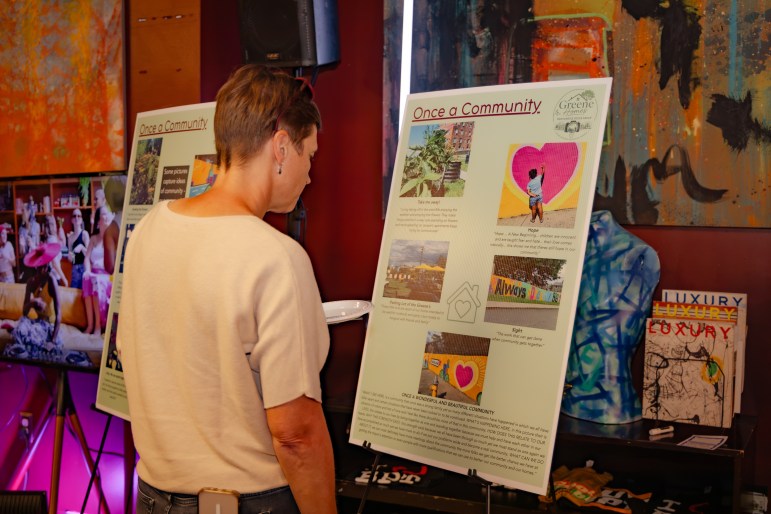
Archival materials, including old news clippings and documents, displayed alongside the photographs document decades of elevator failures and resident complaints. The development was originally built with elevators to serve elderly residents and others who needed them, yet the archive includes accounts of residents becoming trapped inside them.
For Bates, that history shows why it matters who gets to preserve a community’s story.
“Usually history is told by those in power,” Bates said, “and so the archive usually doesn’t actually provide voice to the people who are actually living through things.”
The photographs, she said, create something different: a “living archive” made by the people experiencing the history themselves.
For residents, the cameras became more than a way to document deteriorating buildings. They became a way to challenge the idea that Greene Homes can be reduced to a collection of problems.
Rendon sees the project as a beginning.
“If us eight could get together and just do this, what could we do with bigger numbers?” she said.
For residents who have spent years hearing that demolition is coming, the immediate request is more basic.
Make the homes livable now.
And when the time comes to decide what replaces them, they want to be in the room.
“It’s our story to tell,” Rendon said.
