



Violet Carol Moss, my grandmother, whom we affectionately called Big Mommy, packed up her two-year-old son and moved across the country to build the machines of war.
It was the 1940s, the height of World War II. My grandfather had been called to serve, and Big Mommy left Cleveland, Ohio for Tacoma, Washington, with my father, Nathaniel Gachette Moss Jr., a smiley, talkative baby boy.

She became one of the women the country would later romanticize as Rosie the Riveter. In the Pacific Northwest, they had their own name, the Wendy Welders. They were paid roughly 60 percent of what men earned for the same work. They built the war anyway.
Three generations later, I write from Connecticut, a state that still runs on exactly what Big Mommy built.
Consider the numbers, then decide for yourself what to feel.
Connecticut ranks sixth in the nation for aerospace and defense jobs, according to the Aerospace Industries Association: more than 113,000 jobs and $63.8 billion in economic output. Researchers at the Yale School of Management estimate that nearly ten percent of this small state’s entire GDP flows from the defense industry. On Pentagon spending per capita, Connecticut ranks at or near number one.
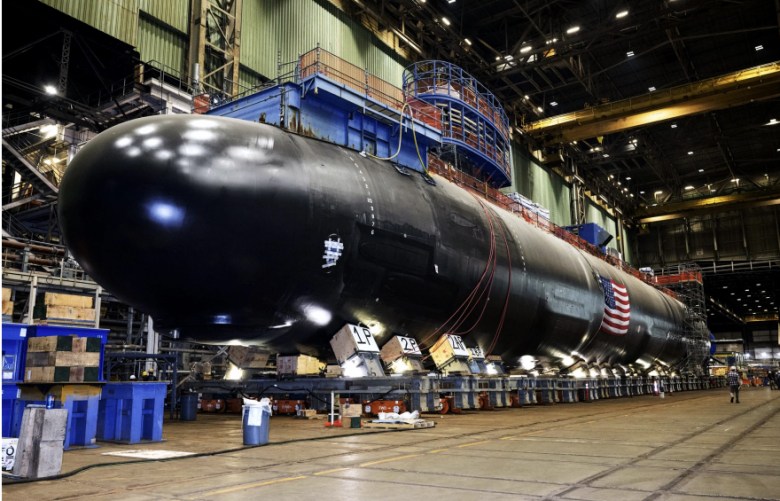
The machinery behind those numbers is familiar to anyone who lives here. In fiscal 2024 alone, the Department of Defense spent $18.7 billion at Connecticut contractors, most of it flowing through General Dynamics Electric Boat, building submarines in Groton, RTX’s Pratt & Whitney, building engines in East Hartford and Middletown, and Lockheed’s Sikorsky, building Black Hawk helicopters in Stratford.
Every F-35 in the American fleet, and in the fleets of allies from Norway to Israel, is powered by a Pratt & Whitney F135 engine built right here. The airframe is assembled in Texas; the heart is made in Connecticut. The older F100 engine powers the F-16s and F-15s of more than 20 air forces worldwide. When any ally goes to war, Connecticut’s economy hums.
This is not a recent arrangement. It is the state where Samuel Colt built the American gun in 1855, and Colt is still there, still in West Hartford, still making rifles for the military, a living passed down through generations of Hartford families, now under Czech ownership. War in Connecticut has never been distant news. It has been the employer.
I do not write this as an outsider. Before my State Department years, I was a communications consultant to the National Minority Supplier Development Council on the 51% Minority Ownership Rule Change, reporting to Shelley Stewart Jr., then United Technologies’ Director of Worldwide Sourcing, alongside former chairman George David. Years later, as a leadership and communications trainer for the U.S. Department of State promoting public diplomacy, I worked in the war zones themselves: Bosnia, Kosovo, Afghanistan. I knew this world from the corporate side, then met it in the field.
Which is why I want to be precise and fair. Even now, prosperity is uneven. Pratt & Whitney furloughed union machinists last year, and the union walked out in its first strike since 2001 before settling. But that pain sits on the commercial side of the house, the airliner engines that have grounded planes worldwide. The F135, the war engine, is surging, boosted by the new contracts in the fiscal 2026 defense bill Congress passed in December. The lesson is uncomfortable. It is the military work that holds steadiest here.

So here is the question I cannot stop turning over. On April 28, roughly 150 soldiers of the 192nd Military Police Battalion boarded aircraft at Bradley for Operation Epic Fury, the campaign against Iran, joining hundreds more from the state already deployed across the region. Maj. Gen. Francis J. Evon Jr., the Connecticut National Guard’s adjutant general, said most people will never fully appreciate “what it costs a person to step away from a job, a family, a routine, and the life they’ve built to answer that call.” In a state where one in ten dollars flows from defense, the same economy that sends these soldiers also feeds the families they leave behind. The dread and the dependence live in the same households. That is Connecticut’s paradox.
Big Mommy knew that tension in her hands. She built the instruments of a war her husband, my grandfather, was fighting in, and that work fed her child, my dad. Whether you are for or against this administration, in a state that leans the other way, the arithmetic does not care about your politics.
For most of America, whether war still stimulates an economy is a historical question. For Connecticut, it is a paycheck.
I will let you sit with the question mark; the same one Big Mommy carried in her hands.
Yvonne Renee Davis, of Avon, is Founder, President and CEO of DAVISIntelligence, a strategic communications and crisis management firm. A former Presidential Appointee under President George W. Bush, she served as a trainer and speaker for the U.S. Department of State across three Presidential Administrations, with assignments and business spanning 68 countries.