



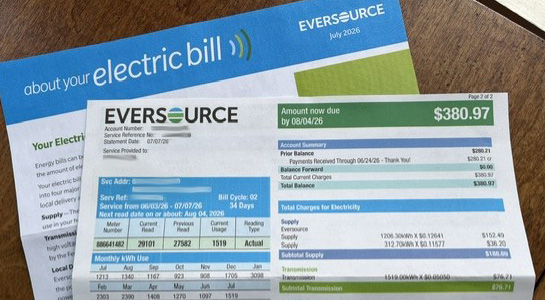
To anyone looking at their electricity bill, it comes as no surprise that Connecticut has some of the highest electricity prices in the country. In 2025 CT ranked second overall with rates expected to rise further.
In this year’s governor’s race, voters will hear several perspectives of what should be done to lower energy costs. Our organization, Regional Plan Association, would like to offer another: make the shift to renewables, reduce energy demand, and ensure transparent and efficient utility practices.
The unfortunate reality is that there is little a governor or legislature can do to immediately lower energy costs. Transmission rates are set by federal legislators, and supply rates are determined by regional market costs. However, concrete actions can be taken to reduce long-term costs and price volatility. But as election season ramps up, we must resist gimmicks, easy scapegoats, or short-term thinking that could undermine this important work.
Last year, RPA released an electricity bill explainer to help demystify the cost of power, and just published a deep dive into the permitting process in Connecticut as well. Electricity bills consist of four parts: supply (38-42% of your bill), transmission (12-15%), local delivery (30-37%), and public policy fees (12-14%). We need to consider what drives the rates in each section to understand what steps can be taken to lower them.
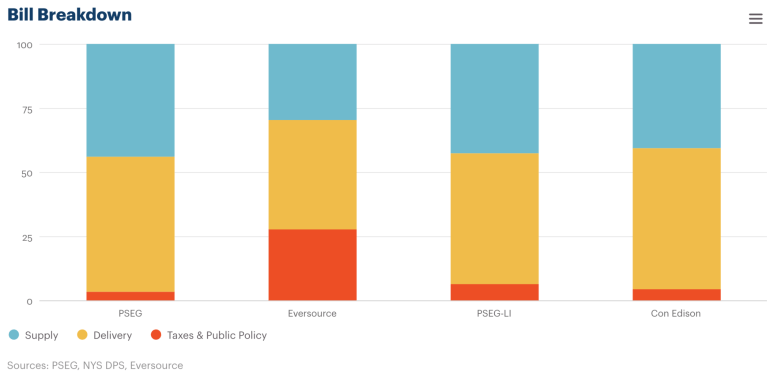
Let’s start with the public policy fees, which have come under political fire, but are not easily or wisely removed. Forty percent of public policy fees are federal and state contracts that cannot be repealed via legislation.
The remaining 60% is the Public Benefits Charge (PBC), which includes funding for low-income ratepayer relief as well as incentive programs for energy efficiency and renewable energy.
We don’t cut off power for people struggling in Connecticut, but someone has to pay for it. Removing this fee would only transfer it to our taxes (and would likely cost more). The remaining incentive programs within the PBC are actively helping reduce energy consumption and supply costs, and accelerating the shift to renewables, including funds going to the Green Bank that have catalyzed nearly $7 of private investment for every public dollar.
Transmission and delivery charges are what utilities collect to enable the movement of power from points of generation to large substations and then onto homes, businesses, and critical facilities. New England has the highest transmission costs of any other region in the country, which can be attributed to geographic constraints in the northeast, population concentrating along the coast, labor costs, and high developer return on equity set by federal and state regulators. Federal regulators recently lowered utility return on investment to around 9.5%, which Eversource and Avangrid have appealed.
The supply charge is the cost to produce electricity, affected by market prices within a competitive auction controlled by the region’s nonprofit grid operator, ISO-NE. Supply, demand, and fuel costs are the largest contributors to price fluctuations in this portion of your bill.
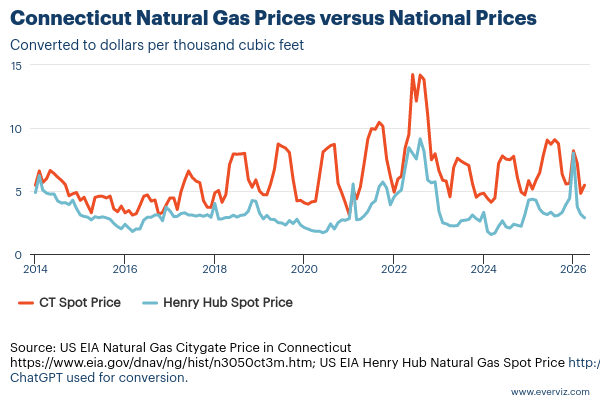
While Connecticut generates over 40% of New England’s electricity, most of this comes from natural gas. As a recent report from Connecticut LCV and UCONN’s Connecticut Center for Economic Analysis point out, Connecticut significantly expanded its natural gas footprint over a decade ago. While the move eliminated costly, aging, and heavily polluting coal plants, it made the state more reliant on a fuel source subject to fluctuating prices, as we’ve seen through cold winters and international conflicts.
So what can be done to stabilize and reduce energy costs in Connecticut?
First, we should dramatically increase the percentage of renewables in our energy mix by switching to more stable, alternative power sources that will ultimately reduce the supply charge on bills.
Spurring the growth of solar and wind – paired with battery and energy storage – is our best bet, and Connecticut should increase solar incentives and expand decentralized solar on existing public infrastructure, while positioning the state for additional offshore wind projects, once federal opposition inevitably ends.
We should also explore the opportunities for geothermal, and determine whether nuclear energy is worth the environmental, capital, and operating costs. Importantly, we must also increase interstate and interregional transmission capability to connect to renewable sources beyond Connecticut’s border.
The good news is, this shift is already underway, albeit slowly. Revolution Wind – an offshore wind project – is expected to come fully online later this year, and is forecast to save ratepayers over $500 million by reducing our reliance on price-volatile natural gas, particularly during the winter months when the wind blows strongest and fuel prices are high.
Second, we must continue to reduce our energy demand. Since electricity rates are tied to usage, the lower the demand, the lower the bills. Connecticut’s next governor should prioritize energy efficiency programs and commit to a development strategy around transit-oriented communities with higher-density housing, walkability, and transit – all proven to reduce household energy consumption.
Finally, we must require greater transparency and efficiency from our utility companies. As rates have risen steadily over the last few years, utility profits have also skyrocketed. At the same time, there is a need to combat over-investment by utilities that yields them a higher return on equity–a practice known as “gold plating.”
Steps to achieve greater transparency and efficiency could be achieved either through reforming the Public Utility Regulatory Authority (PURA) rate assessment process, changing the incentive structure to ensure we are building only what we need; or by reconfiguring rate classes to ensure large energy users pay their fair share and better align utility incentives with customer benefits, as Nevada did. Other pathways could include allowing the expansion of municipal utilities.
A healthy focus by gubernatorial candidates on ways to reduce energy costs is welcome, but there are no easy fixes. Instead, Connecticut needs a comprehensive energy strategy that expands energy supply, with a focus on renewables; reduces energy consumption through smart public programs and high-efficiency transit-oriented communities; and holds utilities to best practices and transparency.
Taking these steps can ensure reliable, more affordable power that will allow you to open your electric bill without fear of what’s inside.
Pete Harrison is the Connecticut Director, Rob Freudenberg is the Vice President of Energy and Environment; and Kyle Mason is an Associate Planner Energy and Environment, all for the Regional Plan Association.