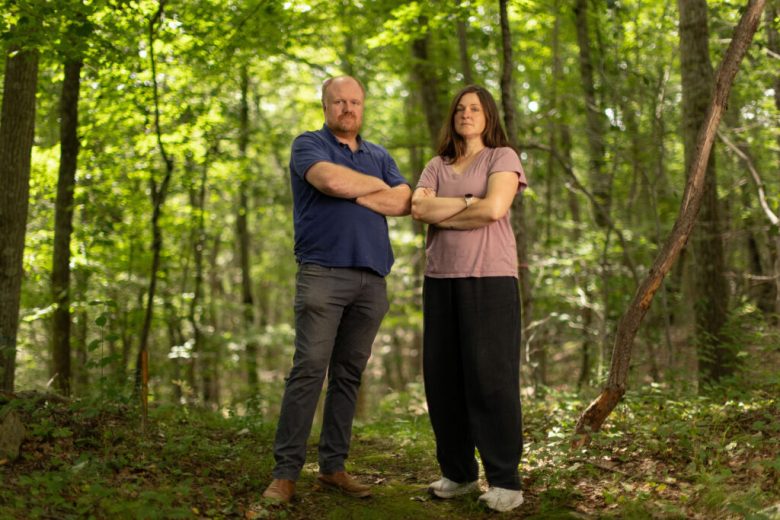
A Roxbury couple is threatening legal action against town officials after being told that local zoning rules prohibit them from opening up their 50-acre property to hikers and dog walkers — for an hourly fee.
On Thursday, attorneys for Charles Copley and his wife, Eli, sent a letter to town officials demanding they be allowed to rent out portions of the property for recreation, or be provided an explanation for why such activities violate local zoning ordinances. The letter states that without such an explanation, the couple will resume offering access to the property on Oct. 1.
If the town maintains its position against the Copleys, their attorneys said they would pursue the matter in court.
“The town has been unable to explain how allowing people to walk outside on private property could possibly be problematic, and that’s because there is no reason,” said John Korevec, an attorney for the Institute for Justice, a libertarian, public-interest law firm that is representing the Copleys.
“The Copleys have done this before without incident, and to our knowledge, there’s been no complaints,” Korevec added. “Zoning codes are supposed to prevent genuine nuisances, not punish peaceful people who are doing nothing wrong. That’s zoning abuse.”
Roxbury First Selectman Patrick Roy could not be reached for comment regarding the letter Thursday. Officials at the town’s land use office declined to comment.
According to the letter from they Copleys’ attorneys, the couple purchased two parcels of land totaling 50 acres along Rocum Road in 2022, with plans to fix up and move into an old cottage on the property. The woods surrounding the cottage also needed work to remove trash, deteriorating hunting structures and invasive species, the letter said.
The Copleys worked with a forester to develop a management plan, which included a goal of installing a trail system to improve access for maintenance and harvesting of timber. Charles Copley said he eventually blazed about 1.3 miles of trails throughout the property.
Seeking a way to maintain the trails, the Copleys decided to rely on foot traffic from hikers to keep down vegetation. In 2024, the couple began advertising the property on Sniffspot, an online platform that allows hosts to “rent” out their properties to dog owners by the hour.
The Copleys charged $10 per hour, according to a now-inactive listing describing the property as “ideal for owners seeking a quiet, uncrowded environment away from other dogs.” Charles Copley said the fees would help to offset some of the cost of the forest management plan, while also allowing the couple to control when people are allowed onto the property. “We don’t just want anybody to be able to come on at any time,” he said.
While the listing was active, Copley said he averaged about two or three bookings a week.
After several months, the couple received a letter from the Roxbury Land Use Department alerting them of a possible zoning violation for operating a “dog park.” The letter included a copy of the Sniffspot listing, as well as a list of requirements for operating a “home enterprise.” The letter advised them to stop renting out the property until those requirements were met.
At first, Copley said he tried to work with the town by applying for a permit allowing him to rent out his trails. After waiting for several months, he said he was told he would need to consolidate the two parcels of his property into a single lot. Doing that would require costly surveys to be conducted and would limit his ability to build a second house on the property. Copley said he was unwilling to do so.
After several more months of negotiations with the town — which, he said, included applying for a text amendment to the zoning ordinances — Copley said he grew frustrated over the impasse and contacted the Institute for Justice in Virginia for help. In addition to the IJ, the Copleys have retained attorneys from the Hartford firm Robinson & Cole, according to their letter.
“I just kept thinking, like, how can this be so hard with something as innocuous as this?” Copley said during a virtual press conference on Thursday. “Like, if I can’t do this, can anybody do anything?”
While many Connecticut towns already regulate short-term home rentals through services such as Airbnb and VRBO, officials are now having to contend with a variety of other hosting services available online. Earlier this month, CT Insider reported that several towns have taken action against homeowners for renting out swimming pools by the hour through a service called Swimply.
Tim Hollister, a land use attorney at the Hartford firm Hinckley Allen, said home enterprise regulations are a common feature of Connecticut zoning codes, and are often applied to businesses such as a small medical office located within a single-family residence.
However, he said he’d never heard of an example of those rules being applied to outdoor activities. “It doesn’t occur inside your house, so it’s not a home enterprise,” Hollister said.
Hollister said other aspects of the Copleys’ situation could come into conflict with zoning rules, such as whether they offer parking or access to portable restrooms. “It may be something else, but it’s not the general understanding of the term home enterprise,” he said.
David Adams, the CEO of Sniffspot, said in an email Thursday that the company supports the Copleys’ efforts and that “private land sharing” offered by its hosts is generally lawful.
“Land-use questions like the one Roxbury is raising come up periodically as local officials work through how a newer model like ours fits into zoning codes written before this kind of activity existed,” Adams said. “In our experience, communities generally welcome Sniffspot hosts because they provide dogs with safe places to exercise and can help reduce issues with off-leash dogs in public spaces.”
Adams said that Sniffspot is active in more than 40,000 locations globally.