


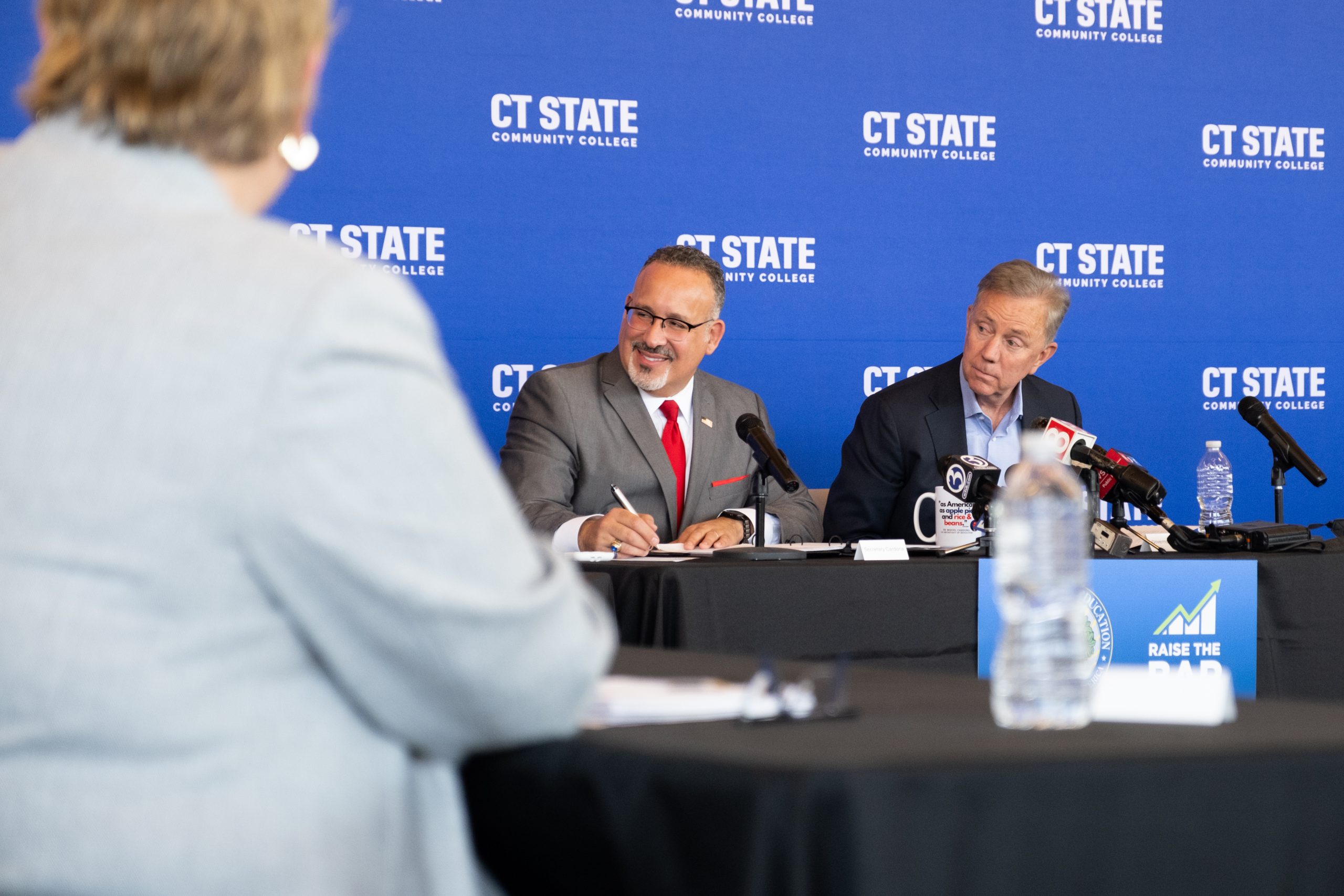
Earlier this year, Gov. Ned Lamont signed an executive order creating the Connecticut Career Pathway Commission, a new advisory board tasked with helping students and workers in the state find jobs in an economy that is being shaped by artificial intelligence, automation and global competition.
In a press release, the Democratic governor announced that he was appointing dozens of education officials, business owners, labor leaders and other experts to the new commission, and he emphasized that all of those members would serve the state as “unpaid volunteers.”
But documents reviewed this week by the Connecticut Mirror show that former U.S. Education Secretary Miguel Cardona, who also served as the state’s education commissioner from 2019 to early 2021 and was named by Lamont to chair the commission, will be paid up to a quarter of a million dollars as a consultant for the new commission.
The records show that Lamont’s Office of Workforce Strategy entered into a contract that will pay Cardona Solutions LLC, a consulting firm created by the former education secretary, $250,000 to “facilitate” the commission’s work, analyze the state’s current career pathways and produce a report that the commission would send to the governor and General Assembly.
For context, the contract is worth more money than Cardona earned in a year serving as Lamont’s education commissioner.
State officials confirmed on Friday that the state did not solicit bids from other consulting companies prior to drafting the contract for Cardona’s business.
Connecticut law generally requires state officials to put contracts, especially larger ones such as Cardona’s, out to bid so multiple businesses can compete for the work and the state can get the best deal for taxpayers.
But Kelli-Marie Vallieres, who leads the state Office of Workforce Strategy, said her office chose to waive those procurement rules in Cardona’s case because they were in a time crunch and because Cardona was uniquely qualified for the job.
“OWS sole sourced a contract with Cardona Solutions due to the immediate need for a contractor to lead the scope of work with recommendations due to the Office of the Governor by November, the unique qualifications of Dr. Cardona’s experience, and his credibility to lead this important Commission,” Vallieres wrote in an email to CT Mirror.
Cardona did not respond to emails sent to his consulting business Thursday and Friday.
House Minority Leader Vincent Candelora, R-Branford, said the Lamont administration’s explanation that they didn’t have time to seek bids from other companies is “a cop out.”
“It’s just a way of masking the fact that this is a political patronage job,” Candelora said.
Meanwhile, Cathryn Vaulman, a spokesperson for Lamont, said the contract “reflects work Mr. Cardona is doing beyond the role and expectations of a commission chair.”
Candelora acknowledged that Cardona does have some unique experience, given his previous roles but said he is not the only person who is capable of drafting a workforce development plan for the state.
“Now there is going to be a cloud of nepotism that hangs over this selection process given that a no-bid contract was given to someone who has held political office and has been a Lamont insider,” Candelora added.
The fact that Cardona’s consulting firm was expected to perform work for a commission that he leads also raised ethical concerns. In June, OWS sought an informal opinion from state ethics officials to determine if the arrangement violated Connecticut’s conflict of interest statutes.
“OWS requested advice from the staff of the Office of State Ethics to ensure (Cardona’s) role as chair would not be a procurement conflict,” Vallieres wrote.
Over the course of several weeks, records show, an attorney from the Office of State Ethics questioned the staff at the Office of Workforce Strategy about Cardona’s role on the commission and how the state’s contract with his company came to be.
In emails among the officials, OWS staff acknowledged that Vallieres met with Cardona to discuss the consulting contract before Lamont signed the executive order on April 2 creating the new commission.
“The Chief Workforce Officer and Dr. Cardona first discussed entering into a (personal service agreement) on or around March 30, 2026,” they wrote.
The OWS staff also answered a variety of questions about how Cardona, as a paid consultant, would interact with and perform work for a state commission that he leads.
Initially, state officials said the contract with Cardona Solutions was created to pay “for the work that Dr. Cardona will be doing as chair of the Commission,” a distinction that could have classified him as a public official, subject to state ethics rules.
In a subsequent email, OWS staff backtracked from that statement, however, telling the ethics office that the contract was meant to “help the Commission accomplish its purpose.”
Lindsey Leung, the ethics liason at OWS, said Cardona would not review his consulting firm’s work or approve payments to his business. And she noted that the commission does not have any funding of its own, meaning Cardona would not make any spending decisions as the chair of the commission.
“OWS would oversee Dr. Cardona’ s work to ensure he is meeting his deliverables,” she said.
In the end, attorneys at the Office of State Ethics determined that the business arrangement “does not appear” to violate Connecticut’s conflict of interest statutes, primarily because the people who serve on advisory boards are not considered public officials and are exempt from the state ethics code.
“One way or the other, Dr. Cardona does not appear to be, as CPC chair, ‘generally’ subject to the code,” Brian Dowd, the general counsel for the Office of State Ethics wrote in the informal opinion.
Dowd reminded OWS staff, however, that some business deals can still present the appearance of a conflict, even if state law doesn’t strictly prohibit such relationships.
“Before closing, I stress that the Office of State Ethics has no jurisdiction over appearance issues, as they are beyond the code’s scope. We are limited, by statute, from addressing appearances or perceptions of conflict of interest,” Dowd wrote.
Peter Lewandowski, the executive director of the Office of State Ethics, said his staff often issues similar warnings in cases that are likely to face scrutiny from the public.
“We put that in, but that is really for the recipient to consider,” Lewandowski said.
“Let’s put it this way: Not every informal opinion we issue from this office — and we issue many of them — has that language,” he added.
Candelora said that although the contract with Cardona may not constitute a conflict under the state’s ethics law, the business relationship still raises serious concerns about whether state officials can properly vet Cardona’s work.
“There certainly is a conflict over the state’s ability to scrutinize and properly oversee the consultant when they are the chairman of the board,” Candelora said.
