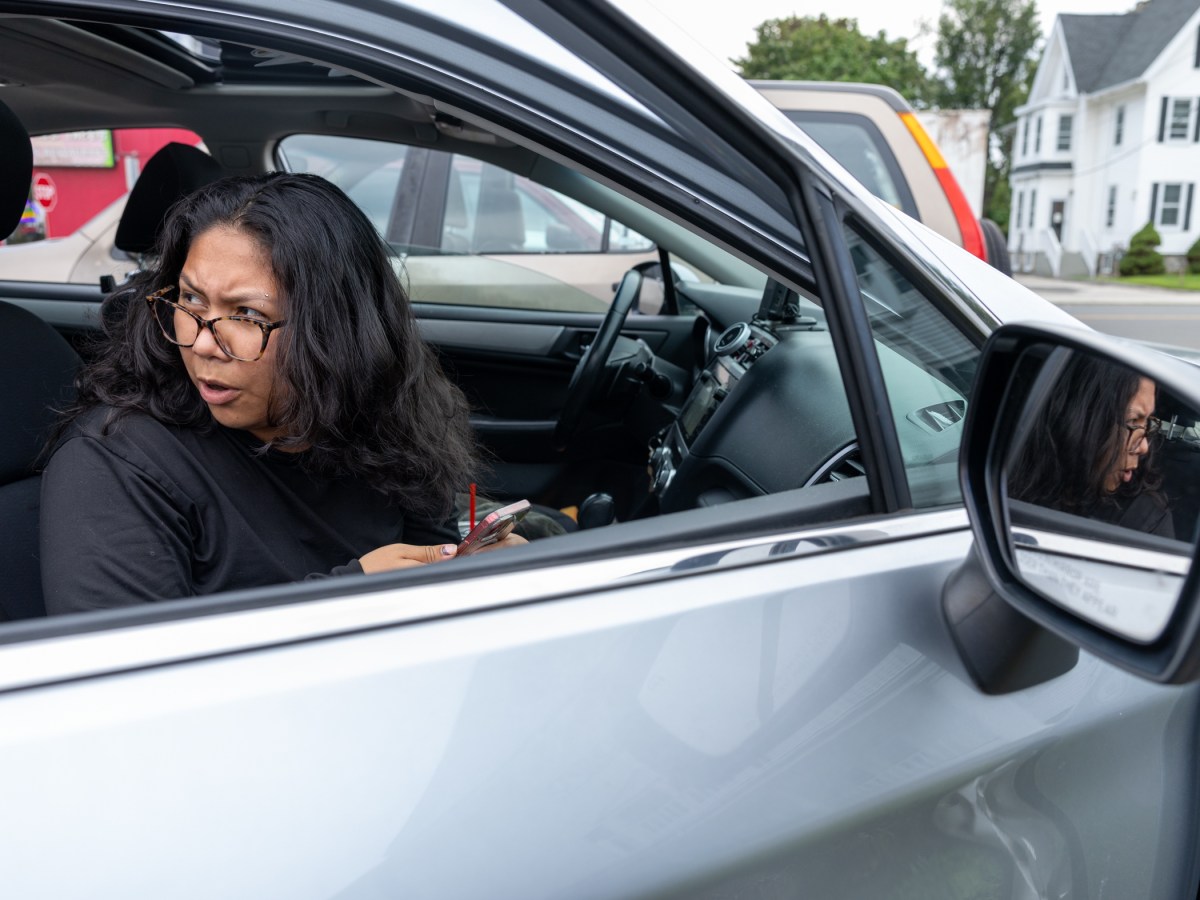


Hartford, Thursday Aug. 27, 4:30 a.m.
It wasn’t a normal morning. Helen Garcia knew that when she got up in the dark.
First, a cold shower to wash off the restless night. Then she put on a long-sleeved shirt to cover a tattoo that could identify her. After more than a year of activist work, Garcia had learned how to dress and what to carry when she might face off with U.S. Immigration and Customs Enforcement agents in her role as a member of a rapid response team that tracks ICE activity in Connecticut.
That might happen today, she thought.
It took an hour for Garcia to drive from Hartford to Danbury. She’d never been to the city before she joined Danbury Unites for Immigrants, a group that works to protect and support the immigrant community in one of the nation’s most diverse cities. Garcia had helped out in Danbury in the past, but since Monday, she’d spent every waking hour there, as ICE was conducting one of the largest immigration enforcement operations in the state’s history.
She arrived in Danbury around 6 a.m. Danbury is a nice town, she thought: Every time she’s here, she sees kids riding bikes. The families walking down the sidewalks look happy, and the kids getting out of school are laughing and talking. She wondered: Do they know what’s going on?
“Do they know why so many of these SUVs have such dark windows?” she asked. “They’re just existing casually among these atrocities that are targeted at them.”
On election night in 2024, Garcia had stayed up late to watch the polls. It was the first time she’d been old enough to cast her vote. When the results solidified, she started to cry. She’d read about Project 2025, and she knew what was likely to come next.
“I was thinking about my community. I was thinking about women,” she said. “You cry for a little bit, and then you do what you’ve gotta do. You do what you can.”
On Thursday, she called in sick to work — it didn’t make sense to be anywhere but Danbury.
“I’m supposed to be at work, and I’m so far below the poverty line I couldn’t touch it if I jumped 10 feet, but how am I supposed to work right now?” she said.
ICE agents had taken dozens of people from places like supermarkets and parks in Danbury over the course of the week, according to advocates who keep track. Agents appeared at school bus stops on the first day of school, according to advocates and elected officials. A video shared with The Connecticut Mirror showed ICE vehicles outside of a daycare.
Scenes Garcia recalled over the past few days in Danbury — happy residents walking down tree-lined streets, ICE agents in unmarked cars careening through school zones at high speed, chasing people and putting them in handcuffs — were a surreal combination.
For a year, members of Danbury Unites for Immigrants had prepared for the kind of scenario that was now playing out. In less than a week, the number of arrests they counted in Connecticut had reached nearly 100, including incidents in Stamford and Bridgeport. The group had conducted trainings, prepared kits of supplies to confront agents who deploy pepper spray and tear gas, distributed cards with emergency contact information and tried to help members of the community prepare legal paperwork in case parents get separated from citizen children. All of that preparation was now coming to a head.
Officials and advocates in Danbury said they witnessed ICE sweeps targeting people based on racial profiling. Compared to the beginning of this year, a larger percentage of people arrested by ICE in recent weeks have no criminal or pending criminal charges. In July, just 11%, or seven of the 64 people arrested on the ground by ICE had a criminal charge.
This mirrors the national trend, where increasingly more people across the nation arrested by ICE have no criminal charges.
Since January of last year, ICE arrested more than 1,200 people in Connecticut during on-the-ground operations alone. Only 190 people arrested in the state have been charged with a crime.
Danbury, Kennedy Park, 6 a.m.
Garcia met up with her buddy for the day, “J,” at a parking garage. As members of the Danbury Unites for Immigrants rapid response team, they began driving around the areas of the city where day laborers typically wait to be picked up for work and where ICE agents might, therefore, be conducting raids.
One of those locations, Kennedy Park, is where, in 2006, a group of day laborers were lured into a van by a local police officer posing as a construction worker. The men were then turned over to federal authorities.
On Wednesday, Mayor Roberto Alves held a press conference at the park with Gov. Ned Lamont, U.S. Rep. Jahana Hayes and Sen. Chris Murphy, an attempt to call for unity in the face of the ongoing ICE operations. But members of the crowd raised their voices in frustration, sometimes making it difficult for speakers to continue. Lamont ultimately left the podium mid-answer.
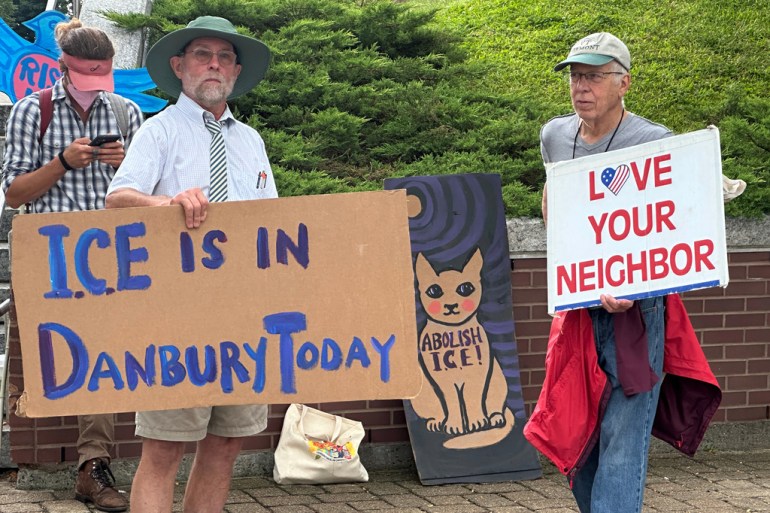
Danbury, 8 a.m.: ICE in the mirror
As Garcia made loops through the city scanning for ICE vehicles, Danbury resident Edel Hernandez Cervantes was just waking up at home so he could get ready for school and began his commute to CT State Community College in Danbury, where he’s studying to become a physical therapist. He was born in the U.S. but spent part of his life in Mexico, and he’s part of a close-knit family.
Around 8 a.m., a call came in from his father. It immediately struck him as strange. They’d just said goodbye at home.
“I was like, OK, something is happening, right?” he said. “It’s something in Mexico, or something right here.”

Hernandez’s dad told him that his uncle had been leaving for work at his construction job with four other people when they saw what looked like an ICE vehicle in the car’s rearview mirror. They decided to change course, turning back toward home, according to an account the family heard later. But the vehicle followed them.
Those details came to Hernandez second-hand, but as videos taken by neighbors were posted on social media, he would see with his own eyes what happened next: His uncle had been pulled most of the way out of a car and lay face-down on an asphalt driveway. His feet were still inside the car, his chest on the ground. He was surrounded by three ICE agents — in some moments, as many as five — some of them masked. One agent kicked him. As he lay face down, an agent shocked him with a Taser. Then again.
Hernandez was struck by how his uncle was treated compared to the other men in the video.
“The other people looked so calm in the video. He’s the only one on the floor,” Hernandez said. As the video popped up on social media and the Spanish-language Facebook group Danbury Al Dia, Hernandez grew uneasy.
“It’s kind of shocking. I didn’t know how to react. Everybody is posting the video, and I know that person.” This was his uncle, the expert baker, the man who always had the radio on when he worked and who loved to sing. Now, he was an anonymous man being brutalized. As more videos were posted, he saw him from the vantage point of a person quietly recording from a second story window. You couldn’t see his uncle’s face in this video — he was just a blurred mound on the asphalt partially covered by ICE agents, the Taser’s white light flickering in the negative space between their bodies.
At 6:45 a.m., the call came in to Danbury 911 from an ICE officer.
“We’re ICE, we had to tase a guy that was resisting us, and he’s kind of convulsing a little bit,” the agent says. A voice in the background adds that “he complains of hypertension,” according to audio later provided by the mayor’s office.
The agent goes on: “He’s kind of like shaking and he’s talking, but he’s kind of like a little bit out of it. His breathing is a little labored. I thought he was having a panic attack a little bit, but we’re trying to get him to breathe through this.”
An ambulance arrived on the scene, and the man was loaded in the back on a gurney. This, too, was captured by witnesses.
Hernandez and his family knew raids were happening in the city — news and social media posts about them were everywhere. Some of his friends had urged their parents not to go to work, to wait until ICE had left Danbury. But Hernandez, like many of those working people, learned at a young age that not working was not an option.
“When I was growing up, they taught me that: In America, nothing is free,” he said. His neighbors knew that, too. “In America, nothing is free, and they have to go to work.”

Danbury hospital, 9:30 a.m.
Garcia, still driving around with the rapid response team, got word of the ICE encounter from social media and messages. She was struck by the detail of the ambulance and what it implied: “They hurt this man to the point where he needs an ambulance.”
Some members of the rapid response team drove to Danbury Hospital, trying to determine what had happened to the man and how they could help.
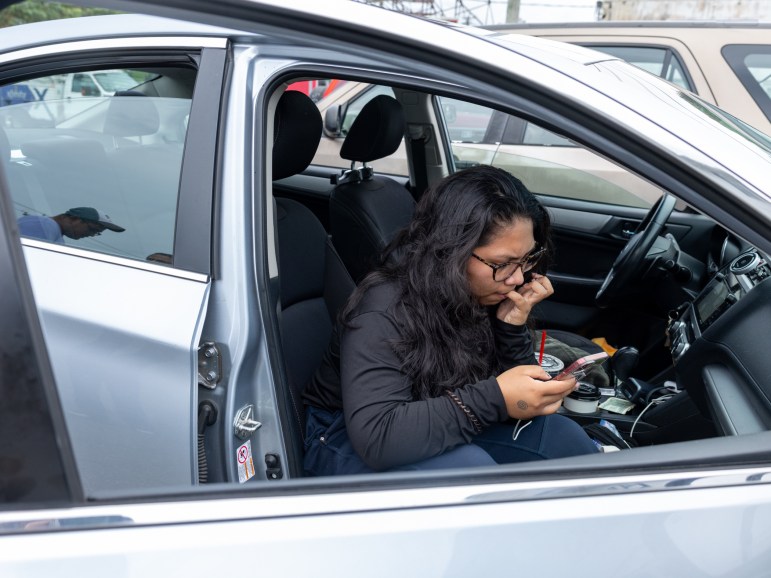
Others continued to patrol the city. Calls and texts came in constantly. They pulled supplies from the back seats and trunks of cars that had turned into second homes in recent days: a different shirt, a bottle of water, a cloth to clean a pair of glasses. At times, the car felt like a mobile command center, with members of the team being dispatched via Signal and quick decisions sending the car into a U-turn.
Hernandez’s father went to the hospital to visit Hernandez’s uncle, but when he approached his room, ICE agents were standing outside, Hernandez said, and an agent stopped his dad from going in.
“There was a guy who told him, ‘He’s OK, he’s under custody, you cannot see him,’” he said.
Members of Danbury Unites for Immigrants were also trying to figure out the man’s condition. Was he lying on the ground in the videos because he had fainted or had he had a heart attack? The group debated if they should alert the media to his presence at the hospital — maybe they’d have a better chance at getting him released to his family if they didn’t shine the spotlight on this moment. They put out calls to Murphy and Alves, hoping they’d make good on the support they voiced at Wednesday’s press conference. They parked out front, trying to see if ICE agents left with the man. The agents would be identifiable, one member of the group said, by their tactical boots.
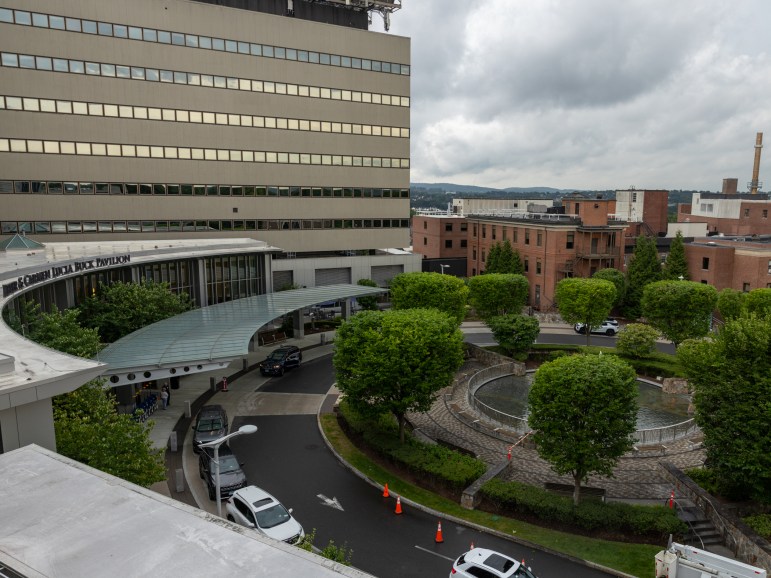
Hernandez said he arrived at the hospital sometime after 11:15 a.m. with an attorney and a few organizers. They checked in with security, where the attorney identified herself and asked to see Hernandez’s uncle. The group was told the hospital had no record of him as a patient and that they should wait.
Then, a hospital employee and several security guards came out. The attorney again asked to see her client and was again told there was no record of him, she said later. The hospital employee then asked them to leave immediately.
Andrea Rynn, a spokesperson for Danbury Hospital, would not address specific questions about Hernandez or his father’s experiences at the hospital.
“Danbury Hospital treats all patients equally, no matter their immigration status, country they come from, or if they are in law enforcement/ICE custody,” Rynn wrote in an emailed statement.
Rynn directed questions about whether a detainee had been admitted to the hospital to ICE. ICE officials did not respond to request for comment.
Danbury, 11 a.m.: Here and gone
It had been a busy two weeks for Mayor Alves. He’d traveled to his native Brazil for his grandmother’s 100th birthday party then flown back, taking Monday off to do some back-to-school shopping for his kids. Scrolling on Facebook, he learned ICE agents were in his city.
“Contrary to what some people think, ICE doesn’t let us know when they’re coming into town. Our police department doesn’t know,” he said. “It’s either we drove by and saw something, or we’re seeing it on social media. That’s how I caught wind of how bad it was.”
By Thursday evening, more than 60 people had been taken by ICE in Danbury, according to CT Students for a Dream, which tracks arrests based on video footage submitted by rapid response teams.
While he was in a staff meeting Thursday morning, Alves got a call from a member of Danbury Unites for Immigrants asking for help: Why were family members and an attorney being denied access to see a relative in the hospital?
“I made a couple calls,” he said. One was to a hospital staffer, who could tell him nothing. Another was to a member of the judicial system — Alves was trying to find out if it was legal for the hospital to deny the family access. By the time he was ready to go to the hospital, he learned the man was already gone, transported to Hartford by ICE.

Danbury, 1:45 p.m.: The whistles
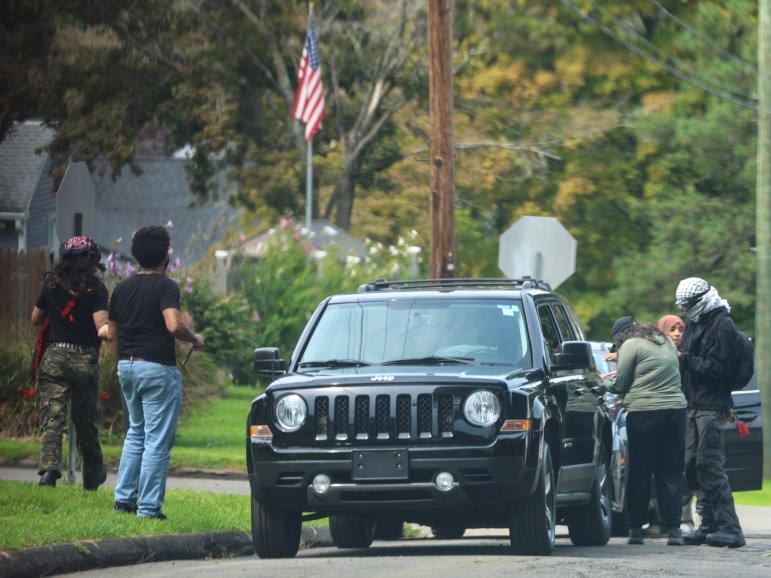
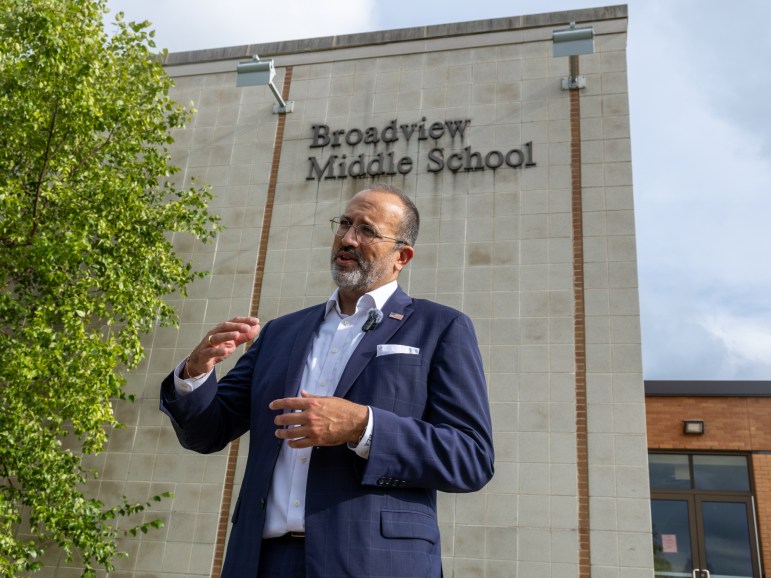
On Fourth Street in front of Broadview Middle School, the rapid response team got out of vehicles and used whistles to alert the neighborhood to the presence of ICE. Some members of the group filmed as others walked up and down the street, masked and wearing goggles.
“Imagine the goggles a mad scientist would wear, with no air vents on the sides,” Garcia said. It was part of the kit of supplies they carried to defend against being pepper-sprayed by agents. Garcia too carried a whistle and kept a jug of water and an N95 mask with her.
Danbury, 2:45 p.m.: Alter ego
As Garcia and J drove away from Fourth Street down Virginia Avenue, they were caught in a sudden storm known as a microburst. Chunks of hail fell from the sky as J struggled to tell volunteers where to go next over the noise. They pulled over. Garcia couldn’t help but giggle: “It’s ICE!” she cried. “God said, ‘Enough!’”
Yellow school buses were beginning to circle town. In the last few days, children had watched ICE through school bus windows — a video was circulating of kids filming from inside of a bus, shocked by the number of vehicles blocking the road. Members of the rapid response team had identified the bus stops as areas to monitor when students were dropped off.
The Danbury superintendent got on the phone, helping the volunteers select a handful of stops where they could dispatch members of their team.
Behind Garcia and J, a car seemed to be tailing closely, with its high beams on. They tried to assess whether it was an ICE agent or just a distracted driver who forgot to turn their headlights off.
Garcia considers herself a quiet person. But when she’s working with the Danbury team, something else takes over.
“It feels almost like an alter ego,” she said. “Whatever qualms you have — comfort zones, you don’t want to do this, or you’re tired one day — you just have to get over it and you enter, I guess you could say in a way, a dissociative state where this is your priority. And sure it’s upsetting, but you have to do what you have to do.”

Danbury, 4:30 p.m.: ‘It breaks my heart‘
Mayor Alves was touring the storm damage from the microburst that afternoon. Roots of trees were torn clean out of the ground in the neighborhood in front of Broadview Middle School, on streets ICE vehicles had patrolled earlier in the day. Chainsaws whirred, already cleaning up the damage. Alves took a moment to talk about the experience he’d had over the past week — and the past year — as the issue of immigration enforcement had divided hearts and minds in the community where he grew up. Back then, Alves was undocumented, brought at 5 years old by his family from Brazil. It was a decision he was grateful for. But it also took a toll.
“I talk to kids all the time with tears in their eyes, like literally tears in their eyes, when I’ve gone to schools. Because they’re asking like, ‘Hey, what do we do? How do we plan for this? Do you think immigration is going to be here today? What happens if my mom is gone?’” he said. “It breaks my heart.”
Normally, Alves tries to keep it together and doesn’t let the emotion take over. He said it’s a more complex issue to navigate than meets the eye. As the leader of Danbury and a former undocumented immigrant, he could easily become a symbol of the resistance. And that is a risk, he said, that could put Danbury in the crosshairs as the federal government chooses targets. Business owners here have urged him to keep his head down, he said.
The terror Alves feels about immigration enforcement runs deep. He said he remembers his childhood as a time of anxiety when he was saddled with responsibilities beyond his years.
“It was tough, because you mature a lot faster,” he said. By third grade, Alves was the first in his household to speak English. “I’m going to translate at IRS offices in third grade, and I’m still in ESL, right? So I was very scared then, and I was always worried.” What if his parents were taken? What would happen to his siblings, to him?
“You live with that, and you live that forever, and you see it in these kids’ eyes,” he said. Alves says that some of the people most frustrated with what’s going on lack that lived experience. “When I was undocumented, nobody knew I was. Everybody knew there was a big presence here, but it wasn’t as open to talk about it as it is now. Which I’m happy it is, because it’s great for those kids. That was a weight on our shoulders that we carried all the time,” he said.
Over the past week, he has faced criticism from members of the community who say elected officials haven’t done enough to stop ICE. At Wednesday’s press conference, before he could begin his speech, a member of the crowd yelled: “Are you here to sell a false sense of security, or you actually going to do something this time?”
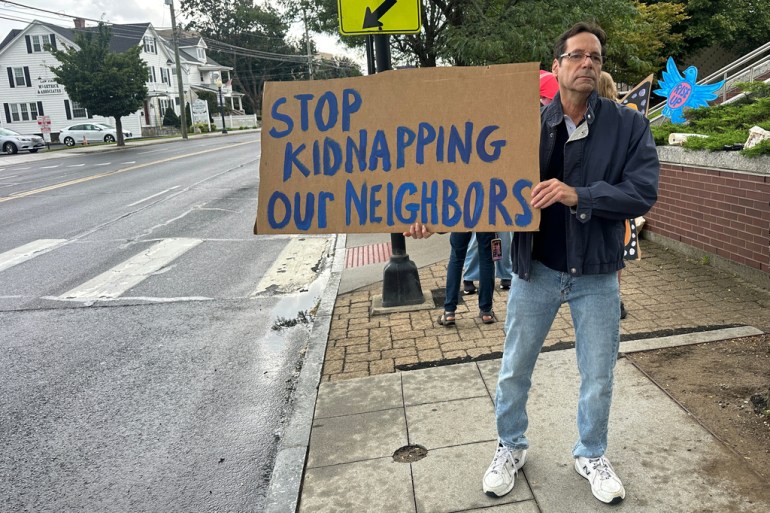
On Thursday, Alves said that, in managing the situation, he’s tried to maintain a critical balance: keeping people safe without drawing attention to the city, risking deportation for more of its residents.
“I am a formerly undocumented mayor who is the head of the opposing political party for those in power in D.C.,” Alves said. “There’s folks who want us to be more aggressive. I think they want our police department arresting ICE agents. We can’t.”
More than anything, the trauma being experienced by Danbury children is what gets to him.
“It’s just the stuff that happens in front of kids, right? They’re too innocent. They don’t deserve this, and kids had no choice on what their parents did.”
5 p.m.: System of a Down
The calls had stopped coming in. It was time for Garcia to drive home to Hartford. On the way to Danbury that morning, she had listened to the audio of an episode of “Abbott Elementary,” a sitcom she knew practically by heart. The world of the show isn’t perfect, but its characters are kind in the face of obstacles, and each half-hour arc bends reassuringly toward justice. It was a soundtrack that kept her calm and distracted as she began her day.
Her day in Danbury had felt nothing like the show.
“It’s all so surreal and unbelievable,” she said. “Sometimes I think that maybe this is just a really long nightmare. Like a really long nightmare.”
On the way back to Hartford, she listened to the thrash metal band System of a Down. At home, she collapsed into bed. She’d need to sleep before her 4:30 a.m. wake up call the next day.
Danbury, 10 p.m.
Hernandez had spent the afternoon and evening searching for his uncle’s medical records, information his family and their attorney hoped would help his uncle remain in Connecticut. Hernandez went to his uncle’s house trying to find the papers but couldn’t get what he needed.
Hernandez was struck by how unfailingly kind the attorneys were.
“They treat us so nice. They offered coupons for food if we need it,” he said. “They also offer some extra money if we need it, for expenses.”
At 10:30 p.m., Hernandez talked to his dad. They made a plan for the next day and how they’d try to track down his uncle’s health records.
Hernandez had barely eaten anything all day. Though he usually tries to eat healthy, he wasn’t in the mood tonight. He ordered a cheeseburger and fries, and finally ate at 11 p.m. Exhausted, it was time to end the day.