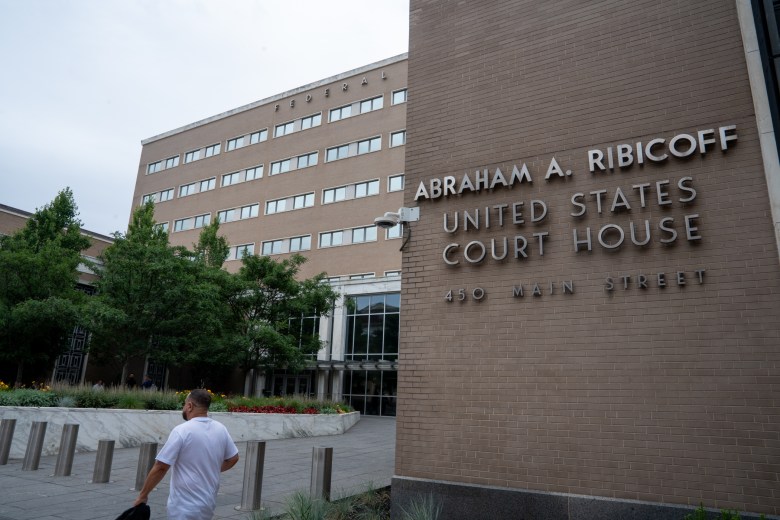
The Connecticut chapter of the American Civil Liberties Union, or ACLU-CT, filed a federal lawsuit on Wednesday alleging that the Hartford immigration court is withholding access to “basic immigration court records.”
The lawsuit names U.S. Attorney General Todd Blanche and the chief immigration judge for the Hartford court, Angela Munson.
According to the suit, ACLU-CT requested all docket numbers and case captions — a line at the top of a court document that identifies basic information like the names of the parties involved — for May 2026 through July 2026. It also requested all “in absentia” removal orders, which are the orders of deportation made when people with pending immigration cases do not show up for court. The organization said it requested the information twice and did not receive a response.
The ACLU-CT claims in the legal complaint that such information should be available under the First Amendment of the U.S. Constitution and should not require going through the Freedom of Information Act process to obtain.
The FOIA request process gives the government the right to withhold certain information for a variety of reasons. It can take a state or federal department months to comply with a request. Part of the purpose of the lawsuit, according to ACLU-CT, is to get such information contemporaneously to see what is happening inside the courts in close to real time, rather than waiting for months.
Dan Barrett, legal director for the ACLU-CT, said that while the public can attend court hearings and see the day’s docket, that is not a practical way for people to access that information and get a broad picture of what’s going on. For example, when people are being removed in absentia or to a third country, what are the details of their cases and why are they being removed?
The lawsuit seeks a declaration from the United States District Court that “the Immigration Court is bound by the First Amendment right of public access,” and seeks to prohibit Blanche and Munson from blocking the ACLU’s records requests.
Information such as full names is not normally provided via FOIA, according to Barrett. Such information is usually denied on the grounds of privacy.
A request for comment from the Department of Justice was not immediately returned.
The case has the potential to set legal precedent, which could have an impact elsewhere in the country, Barrett said.
The request, had it been satisfied, might have provided the ACLU with a comprehensive look at who is going through the immigration court system at a time when caseloads are growing astronomically.
But release of the data could also raise a number of questions about privacy and safety, issues that have been top of mind for Connecticut officials. Late last year, state lawmakers passed a bill that prevents public agencies, including schools, from sharing an individual’s address, hours of work, public agency appointments or “any other information that provides the date, time or place where such individual may be located.” The bill was in response to federal officials’ requests for state-level data related to programs like the Supplemental Nutrition Assistance Program and the potential for its use for U.S. Immigration and Customs Enforcement action.
Also, some immigration cases involve people seeking asylum because they are being persecuted by a foreign government and releasing a person’s full name could be considered sensitive or even dangerous.
Barrett said the group isn’t seeking for information about individuals in immigration court to be proactively published in a database, the way information for criminal cases can be accessed via online databases. He said rather that the ACLU-CT is arguing Americans should have the right to request and quickly receive such information without a FOIA request.
He said that, as in a judicial court, anyone with concerns about their safety could move to seal relevant information. “Even better, a court rule could presumptively seal certain things automatically. Both the state and federal trial courts have such rules — for example, names of minors, and birthdates or SSNs of anyone. Those rules would be just fine from the First Amendment’s perspective.”
Barrett said that he expected that should a ruling allow for access to such information, the immigration court will adopt a practice of automatically sealing the names of asylum applicants and other sensitive information.
U.S. Sen. Richard Blumenthal, D-Conn., on Tuesday tried to drive attention to the issue of in absentia orders by speaking with media after attending immigration court in Hartford. Blumenthal said he attended court to get a “snapshot of what seems to be purposeful chaos in the immigration court.”
Blumenthal said many people failed to appear for court on Monday, in some cases likely because they were not given adequate notice. If they fail to appear in court they can be ordered removed from the country “in absentia.”
“It is purposeful because it is due to lack of staff, reduction in numbers of judges, a system that is running amok and doing injustice,” he said. “And it is intentional injustice designed to deport as many people as possible as quickly as the system is able to do it, regardless of the merits of these cases.”
Currently, case-level immigration court information is available through the Executive Office for Immigration Review, a division of the Department of Justice that releases data regularly. While the releases do not include identifying information like the respondent’s name, the information released on the case itself is robust. These datasets include, among dozens of other fields, case outcome, respondent birth year, nationality and primary language, relief applied for, and if the most recent proceeding was an in absentia hearing.
This year, more than 99.8% of cases decided in Hartford with in absentia rulings have resulted in a removal order, according to immigration court data requested by the Deportation Data Project.
A CT Mirror analysis Hartford immigration court data found that both this year and especially this summer, a higher percentage of cases were closed in absentia, where the respondent did not show up to their final court date. This almost always end in a removal order, according to the analysis.
In May alone, respondents in more than 90% of cases closed that month did not show up to their court date.
On the whole, fewer people are showing up to Hartford’s immigration court this year. From January to August 1, more than 79% of cases out of the court were marked in absentia at a final hearing. And 2025 saw the next-highest in absentia rate in at least 10 years, second to 2026, with 41% of respondents not showing up to their last court date in Hartford.
“All too often, we have focused on the detention of people, the seizure of people, which needs attention,” Blumenthal said, “but there’s also a kind of behind-the-scenes set of procedures here that also deserves attention. The basic infrastructure of the justice system is failing, and it is intentional and purposeful, designed to simply achieve deportations as quickly as possible, regardless of what evidence there may be to support people staying here.”