



I can’t vote on November 3rd. I’m 17, a junior in high school. But the first ballot I ever saw was at North Street School in Greenwich, when my mom took me with her to vote. What I remember is her phone as she stood in the small booth, looking up the candidates one by one.
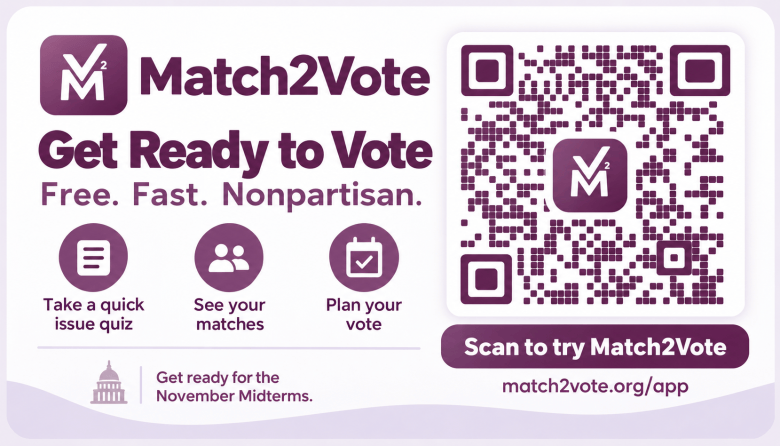
What my mom needed that morning did exist. The voting records, campaign pages, local news stories are all available but scattered. I wanted to help and make it easier for people like her, so this summer I built Match2Vote, a free voter guide, paid for with earnings from my summer job.
You answer ten questions about issues and the app compares your priorities with candidates’ documented positions. In Connecticut, its current coverage includes the governor’s race and all five congressional districts. Every documented position is linked to its source which can be a voter records, a news reports, or a statement on the candidate’s own site. Party affiliation never enters the matching; it only appears at the end for identification. At this time, the app does not cover the whole ballot. Candidates farthest down are still the hardest to research. But this is the part I could finish in time and stand behind.

When I worked in the U.S. Senate as a page, what surprised me most were the acts of simple friendliness. Over many instances during votes on the Senate floor, I watched Senator Katie Britt, a Republican from Alabama, and Senator Brian Schatz, a Democrat from Hawaii, chat like friends and talk about their families. I can tell you that those are the moments that inspired me to finish this app, in the hope that we can all be as friendly even when we disagree.
People assume the code was the hard part. It was actually the fast part. AI coding tools wrote much of it under my direction. I chose the ten issues and set the rules for sourcing and matching. I also used AI to help locate candidate statements. I set up a second AI system that checks the sources and flags possible discrepancies. It caught several votes recorded backward in the app’s data. I review every flagged item against the original sources because the checker can be wrong too.
The League of Women Voters of Connecticut’s VOTE411 guide lets voters read candidates’ answers to questions about the issues. In its review of the 2024 election, the League reported that 108 of 334 invited General Assembly candidates and 10 out of 16 federal candidates participated. A missing response to that questionnaire doesn’t necessarily mean a candidate has never stated a position. It means someone has to go find it.
For one candidate in this year’s congressional races, I couldn’t find a documented position on taxes. I went through news coverage and podcast transcripts before finding WTNH’s coverage of his campaign launch, which finally quoted him on it. Most of the time I start at the campaign site and follow the primary sources that AI helps me retrieve, like roll-call votes or sponsored bills. When nothing surfaces anywhere, I email the campaign and cite the reply as the source. And when even that fails, the app says, “Not stated,” which means my research found no position, not that the candidate never took one.
Here is one mistake I was glad to catch. In one race, I had seven documented positions for each candidate, but only four issues in common. Their match percentages looked comparable even though they were built on different questions, and showing “seven out of ten” under both scores didn’t fix that. I changed the app to rank candidates using shared issues, show how many issues support each result, and flag when the information is too limited. I learned that having the same amount of information about two people is not the same as being able to compare them.
Tools like this are used across Europe. Germany’s official guide, Wahl-O-Mat, recorded 26 million uses before its 2025 election. A field experiment during Germany’s 2017 election, published in Public Opinion Quarterly, found that the guide’s use produced a measurable, meaningful improvement in people’s political knowledge. That is exactly the kind of benefit I hope to offer by helping people understand where candidates stand, with access to the sources to verify for themselves.
Early voting in Connecticut runs October 19 through November 1; Election Day is November 3. Match2Vote quiz takes just a few minutes. Answers stay on the user’s own device. It also asks nothing of the voter: no account, no login, no email address, no ads, and no tracking. The app is a place to start looking, and it’s intentionally short and fun!
I hope it gets you interested in the future of our democracy.
Kiki Taylor is a junior at Greenwich Academy.