



On August 7, Gov. Ned Lamont released a letter to the Connecticut Police Officers Standards and Training Council concerning the use of Automated License Plate Readers (ALPRs) in Connecticut. Among other things, the governor acknowledged that “many residents are justifiably concerned about the privacy issues.” Shortly afterward, the Connecticut Police Chiefs Association’s Legislative Committee sent a letter to local newspapers strongly advocating for ALPRs.
The governor and citizens’ concerns are more than just well founded. Connecticut residents and law enforcement share an interest in retrieving stolen vehicles, but ALPRs in your town carry a multitude of unwanted issues.
In Connecticut, based on data from transparency portals for towns who make them available, 99.5% of ALPR data is innocent residents minding their own business. Data retention period for every town is 30 days, giving opportunity for profiling every resident with a car. Nevertheless, WFSB and CTInsider investigations were able to get data for a year or more. Furthermore, ALPR data is subject to both abuse and error by law enforcement at every level, and technology is not infallible. Many times, the abuse is only uncovered by journalists’ investigation.
A family in Aurora Colorado with children, were handcuffed by police and put face-down on the pavement at gunpoint. The police who stopped them relied on an ALPR alerting them the license plate matched a stolen vehicle, except that the stolen vehicle was a motorcycle with an out-of-state plate and not the SUV the family was driving. In San Diego, an innocent man spent nearly a month in jail. In Florida, it was 13 days. In other cases, it is stalking romantic interests, journalists, protesters, those seeking reproductive care, and others. ALPR data is increasingly used for other purposes such as school residency verification, background checks, and even noise complaints.
A CTInsider investigation showed more than 7,000 searches explicitly related to immigration investigations in 2025 across all six Connecticut police departments who provided data. Searches came from out of state law enforcement and federal agencies in line with their own policies. No doubt the actual number is significantly higher since such searches are easily disguised by providing unrelated reasons, or no reason at all. A WFSB investigation earlier this year found more than 46,000 searches of Cheshire and Avon data by the Houston Police in January alone. While many jurisdictions restrict searches to local access, sometimes all it takes is a friendly local officer to undermine this restriction.
Flock Safety dominates the ALPR market nationwide and provides cameras to Glastonbury and other towns in Connecticut. It is a private, for-profit company, founded in Atlanta in 2017. In April, its website claimed over 20 billion license plate reads per month. Recently it was “billions per month.” Such statistics no longer appear on the Flock website. The company also markets neighborhood and private video surveillance. It recently has been pitching Uber and Lyft to put mobile ALPR surveillance on their cars. Home Depot and Lowes quietly rolled out ALPR surveillance. ALPRs are even on tow trucks and trash trucks.
Flock and its CEO Garrett Langley has largely disdained public opposition and plans to extend mass surveillance as widely as possible. They acquired a drone producer for aerial surveillance. In May 2025, Flock announced Nova to extend ALPRs to persons by integrating public records, data from brokers and even data breaches (they have since recanted use of data breaches). Nova allows police and government to go from “LPR to persons” to track people around the country — without a warrant.
Just recently, Wired analyzed code for a newer and more powerful AI Flock tool for police called OS Investigate. That tool combines the massive ALPR database with many other databases containing names, addresses, Social Security numbers, arrest records and other data. OS Investigate allows police to enter prompts without a specific plate, searching based on any of that data, associates of people in that data, potential witnesses who might have been in the area of crime, patterns of behavior and other factors.
Flock says police departments own ALPR data but it is stored and controlled by Flock, and contracts often grant Flock perpetual license to the data for training or other purposes. In May last year, Flock created a pilot program cooperating with Customs and Border Control and ICE, ostensibly to help combat human trafficking and fentanyl distribution. The program was paused in August because of immigration abuses.
The FBI has plans to use ALPR data. Flock was planning integration with Amazon’s Ring doorbell cameras but that was canceled less than a week after an alarmed public realized Ring’s Superbowl ad about finding lost pets could also be used for human surveillance. Flock claims it does not use facial recognition but that would have been required in order to deploy the Ring search feature, and the claim rings hollow given their ambition and arrogance.
With bipartisan support, Americans across the county and in Connecticut are showing they do not accept mass surveillance and searches without warrants. Protest has moved to civil disobedience. ALPRs are being destroyed, damaged or incapacitated across the country, including in Connecticut.
Town meetings are being disrupted across Connecticut and elsewhere. A statewide campaign through Surveillance Off Our Streets (SOS) is active and working hard to remove ALPRs in Connecticut entirely. Numerous websites such as deflock.org, EyesOnFlock.com, HaveIBeenFlocked.com and others help anyone look up or report on ALPRs, or find out if their license plate has been searched. Cities are terminating contracts with Flock at a record pace, including two in Connecticut.
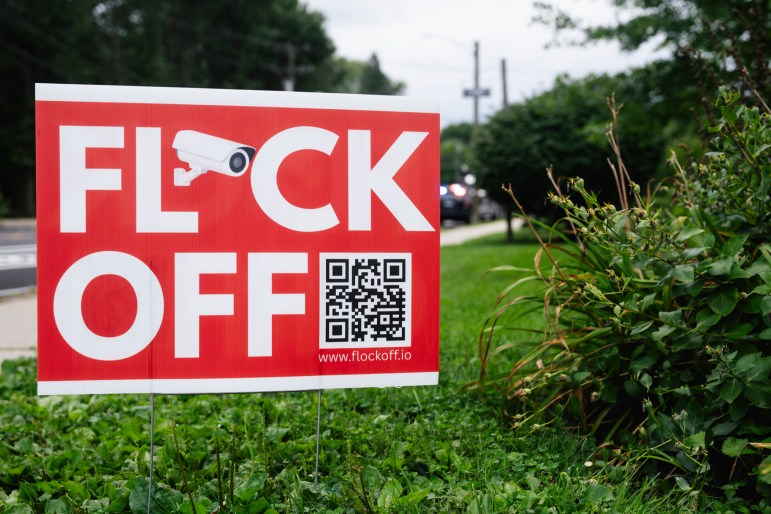
Flock’s public arrogance has toned down recently in response to this nationwide uproar. They announced a reduction in the recommended retention period from 30 days to seven and introduced new filters and audits. But these are just company policies and Flock has not been friendly to public concerns in the past, even to the point of calling privacy activists “domestic terrorists.”
“We should not be letting companies decide how much privacy we deserve.” observes Matthew Guariglia in his article on the announcement by Flock. Flock has earned our distrust.
That said, Flock is not the only ALPR company, just the most visible one, largely because of its tone-deaf relationship with the public. However, Axon and Motorola (Vigilante) are two big ALPR competitors both serving the larger law enforcement market. Hartford police use Axis Communications, Motorola, Bosch, and Flock.
With capabilities becoming increasingly powerful, the ACLU recommends that ALPRs be deeply limited. That cannot be left to law enforcement policy or contract terms. It must be enshrined in law. Nor must we forget to address increasingly invasive private use of ALPRs such as those used by Home Owners Associations, Home Depot and Lowes.
A Connecticut Police Chiefs letter is not reassuring. It says they are mindful of the civil liberties concerns and support transparency. But few towns held public discussion before installing ALPRs, most today have no transparency portal, retention periods are too long and searches are done without a warrant. Police chiefs in their letters are not going to be keeping the public aware they have creepy new surveillance capability. They will just continue saying they solve crimes and find your lost uncle with dementia.
Abuse is not even possible when the data does not exist. Civil liberties are protected when the data does not exist. We appreciate our police keeping us safe, and we all have common interest in recovering stolen cars and Amber alerts, and that is possible without mass surveillance.
Last legislative session, the Connecticut legislature got a good start on dealing with ALPRs by passing SB 397, now Public Act 26-14. That act was limited to law enforcement, restricted data retention to 21 days, and placed certain controls over how that data is accessed. However, given the national and local concern about privacy with these devices, and the record of abuse, it is clear more is needed.
For the next legislative session, here are some additional measures that could be considered:
- Restricting the data retention period further. New Hampshire restricts that period to three minutes.
- Extending regulation to private use as well.
- Prohibiting collection without a warrant for areas in addition to those providing reproductive health care such as areas with groups exercising first amendment rights, synagogues, mosques, or other sensitive locations.
- Spelling out penalties for violation.
- Reviewing contracts for objectionable terms and conditions. Despite specified data retention limits, some contracts were found granting the provider a perpetual license to the data.
- Reviewing where ALPR data can be stored. Data is now typically stored by the provider and under its control, but that has resulted in unintended uses.
- Requiring public notice and opportunity to comment before localities consider installing ALPRs.
- Prohibiting law enforcement from purchasing ALPR data. This closes a potential loophole favored at the federal level restricting collection and data retention.
Florida just became the first state to ban ALPRs on state roads altogether. Courts ruled Massachusetts must be transparent where ALPRs are and what they are recording. Whether Connecticut joins Florida or Massachusetts, or accommodates Connecticut citizens’ strong objection to mass surveillance is a question for the coming legislative session.
One thing is clear, the risk of misuse of mass surveillance far outweighs the justification for its use.
Scott Chandler lives in Glastonbury. Josh Elliott represents the 88th District in the Connecticut House of Representatives.