



Our governor will be joining other New England governors in a “summit” today to push for more nuclear power. Supposedly there’s a crisis, a need for lots more electricity for data centers so they can embrace the wonders of AI.
There’s a crisis, all right, but it’s not some desperate need for AI. Instead, it’s the fires, droughts, glacier breakdowns and extreme weather all over the world –symptoms of collapsing climates.
Over the last year the CT Department of Energy and Environmental Protection held four webinars to encourage building nuclear power plants in Connecticut. Their pitch was that new “advanced” reactors are much safer, that smaller ones can be built rapidly and that nuclear waste is not an immediate problem. The legislature set aside $5 million to foster sites all over Connecticut.
The supposed advance is the SMR, the “small modular reactor,” a uranium-power fission plant that is lots smaller than giants like Millstone or the closed Indian Point facility. SMR boosters say assembly line construction of SMRs will save lots of money and that they are so fail-safe they need little or no safety areas around them.
The problem is corporations planning to build SMRs are mostly start-up companies that have had no experience in nuclear power at all, which have no orders, no revenue, no profit, and no actual reactors. Not a single SMR has been built in the U.S. If fact, there are only three in the whole world. Nuclear power has an impressive track record of being incredibly slow to bring online (17 years on average) and has a consistent record of being many times more expensive than initially planned.
Take the example of NuScale Energy. It began as a university research project. In 2020 it was the first (and only) SMR to receive U.S. Nuclear Regulatory Commission (NRC) design approval. It received $600 million from the U.S. Department of Energy. NuScale planned to build reactors in Idaho and go online in 2030. But costs started to skyrocket, partners pulled out and the whole project was cancelled. Its stock price has gone down over 80% in the last year.
One huge and obvious problem with fission is radioactive waste. In the nuclear power process, radioactive uranium is mined, then enriched and formed into rods, and the uranium goes through a process that splits its atoms and gives off energy. That’s done until the rods are no longer productive. Then they are classified as “spent.” However, spent rods are incredibly radioactive and intensely hot. So these rods are put in cooling ponds of the facility for years. Then they have to be stored indefinitely because there’s no agreed upon way to dispose of them permanently.
Nuclear power waste has been around for more than 80 years, but in all that time there has been no way found to discard it. There was a plan to put 90,000 tons of high-level radioactive waste deep under Yucca Mountain in Nevada, but state leadership became vehemently against it. Nevada’s official position is that the area is “seismically and volcanically active, porous and incapable of geologically containing the waste.” The Yucca Mountain “repository” was cancelled 15 years ago.
The Trump Administration is trying to open “campuses” that would both create nuclear power and take in nuclear waste from all over the country and put it deep underground. Some legislatures support the idea but once the citizenry realizes what they’d be accepting expect tumultuous opposition.
At present the high-level and long-lasting radioactive waste produced by the nation’s civil nuclear power plants remains at the 75 sites — both operating and closed (like those at Indian Point) – where they were created and they’ll stay there forever. They sit in the open air in steel/concrete casks. That’s a risk because as we’ve found out by Russian attacks on Ukraine, regimes may be desperate or cruel enough to target those casks.
Putin forces did just that in June of this year within the Chernobyl exclusionary zone, partially destroying a building used for receiving containers of radioactive waste. There are ways to build facilities holding the casks to a HOSS standard (hardened on-site storage) similar to what is used in building nuclear missile silos, but they’ve never been required in the U.S. So we’re just left with hope — hope that a foreign military or terrorist group won’t one day try to blow up a field of casks.
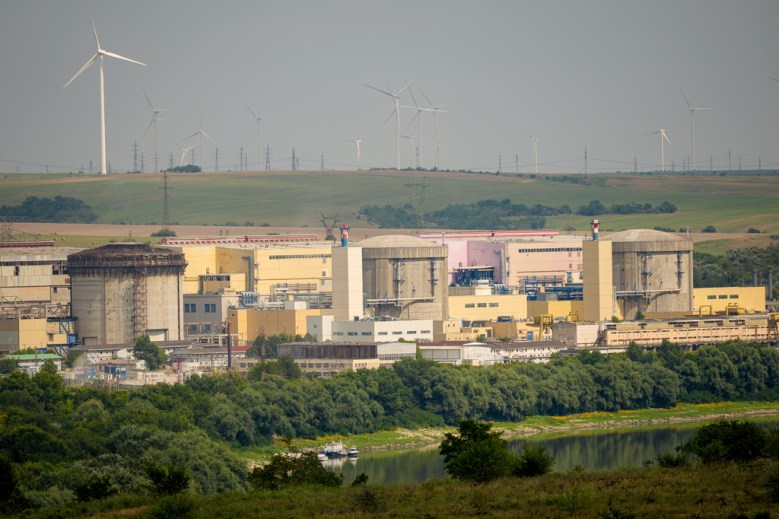
Another problem is that we’re finding that extreme heat can lead to nuclear reactor shutdowns. During heat waves river water levels drop so the water level is too low to be drawn upon for use in the plants. Witness Hungary in August 2026. It had to shut down its nuclear reactors due to low water levels for the first time in its history. Romania shut down its nuclear plant, too.
We don’t need nuclear. What we do need is to stop rushing toward the climate cliff. We know how to do it. Use solar, wind, water, batteries and conservation to meet our electrical needs and swiftly stop burning fossil fuels.
Stanley Heller is Administrator of Promoting Enduring Peace which was founded in New Haven in 1952. He’s also a member of Jewish Voice for Peace.