


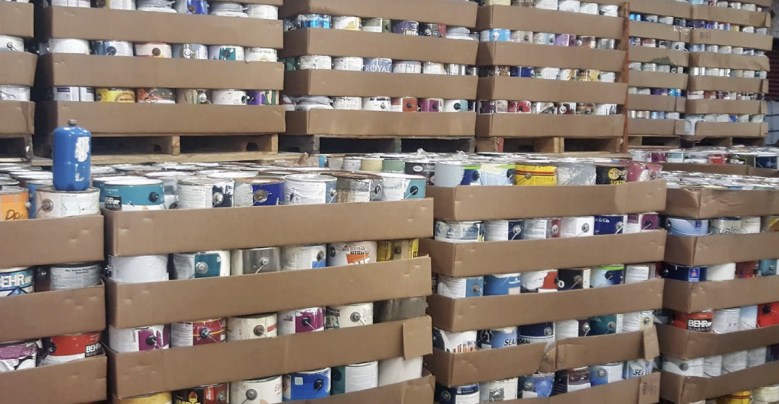
Every year, Americans throw away more than 100 million gallons of paint.
Read that number again and let it sit for a moment. One hundred million gallons. That is enough to fill roughly 150 Olympic swimming pools. And none of it simply disappears.
Instead, it gets poured down drains, tossed into trash cans, and dumped at the curb. From there, it steadily seeps into the soil and, ultimately, into the groundwater that families drink. Research has shown that a single gallon of paint can contaminate up to 250,000 gallons of water. Frankly, we are poisoning our own wells one brushstroke at a time, and most of us never give it a second thought.
I have spent the past 16 years proving there is a better way. In 2010, I founded Global Paint for Charity with a deliberately simple idea. Rescue the paint America throws away, and put it to work where it is needed most. Since then, we have recovered more than 5 million gallons of surplus paint. We have delivered it across 44 countries and underserved communities here at home. And along the way, we have improved more than 15 million lives.
Those numbers, however, only tell half the story. The other half is quieter and, honestly, more moving. Over the years, more than 625,000 volunteer hours have powered this work. Roughly 70 percent of the paint we recover goes to high-need regions around the world, while the remaining 30 percent stays here, donated free to domestic nonprofits, veterans, and families rebuilding their neighborhoods.
Time and again, I have watched what happens when that paint arrives. Take a broken-down classroom in a poor village, for example. The walls go from gray to bright almost overnight. Gradually, the girls studying inside start earning better grades. They show up to school more often. More of them graduate. Meanwhile, their teachers, the same ones who had nearly given up, suddenly feel proud to teach again. Remarkably, a single gallon of paint sets all of this in motion at once. It protects the earth, creates good-paying jobs, saves lives, helps other charities stretch further, and keeps small businesses alive.
On October 1, Connecticut gave this idea the force of law. The state became the first in America to expand its paint stewardship program to aerosol paints, the pressurized spray cans piling up in garages and basements everywhere (Connecticut General Assembly, 2026). Under the new law, every producer selling paint in Connecticut must join the stewardship program and pay its fair share. If a company refuses to participate, its products cannot be sold in the state. It is, quite simply, producer responsibility with teeth.
This matters enormously, and for good reason. Paint is one of the largest hazardous waste streams coming out of American homes. About 10 percent of the roughly 2 billion gallons sold each year goes unused, and latex paint alone makes up nearly 40 percent of hazardous household waste. For years, the handful of states with stewardship programs covered only architectural paint, the gallons in cans. Aerosols were left out, even though they are pressurized, chemical-filled, and nearly impossible to dispose of safely. Connecticut just closed that gap, and consequently it has set the national precedent.
And yet collecting paint is only half the battle. Here is the uncomfortable truth about most stewardship programs today. They are built to collect and recycle, which is genuinely important. But they stop there. They do not get the recovered paint into the hands of the communities that desperately need it. In other words, we have built a system that keeps paint out of landfills but leaves it sitting in warehouses, while millions of families who cannot afford a single gallon watch from the sidelines. The World Health Organization estimates that 80 percent of homes in underserved areas remain unpainted, and 170 million children have never seen a painted classroom. Clearly, collection without redistribution is an unfinished job.
That is precisely why I designed the Nevada Paint Recycling and Community Care Act, known as the NPRCCA. It is the policy proposal at the heart of my doctoral research at the University of Nevada, Las Vegas, and in my view it is the best option America has for leftover paint. The reason is straightforward. The NPRCCA does what existing programs do not. It combines collection, recycling, and redistribution into a single framework.
The proposal calls for a one-time investment of 5 to 10 million dollars, while the status quo already burdens taxpayers with more than 10 million dollars every single year in hazardous waste costs. To put it bluntly, cleaning up contaminated groundwater can cost between 1.7 and 5 million dollars for every 1,000 gallons of water, according to the EPA. Prevention is not merely kinder. It is dramatically cheaper. Recovered paint would flow directly to schools, affordable housing, veteran housing, and neighborhood projects, both statewide and around the world. In short, the act treats paint as what it truly is. Not trash, but a resource.
So here is my call, plain and simple. To state legislators: copy Connecticut, and then go one step further. Add redistribution the way the Nevada law does, so recovered paint reaches people instead of sitting in warehouses. To the paint industry: stewardship is not punishment. It is partnership, and frankly the companies that step up now will be the ones communities remember. To federal policymakers: the states are leading because Washington has not. A national framework would finish the job Connecticut started.
Sixteen years ago, I started with one idea: waste, turned into hope. On October 1, Connecticut turned that idea into law for every kind of paint. The NPRCCA shows how to carry it the rest of the way. The rest of America should follow.
Rony Delgarde is the founder and CEO of Global Paint for Charity and the author of How to PAINT Change.