


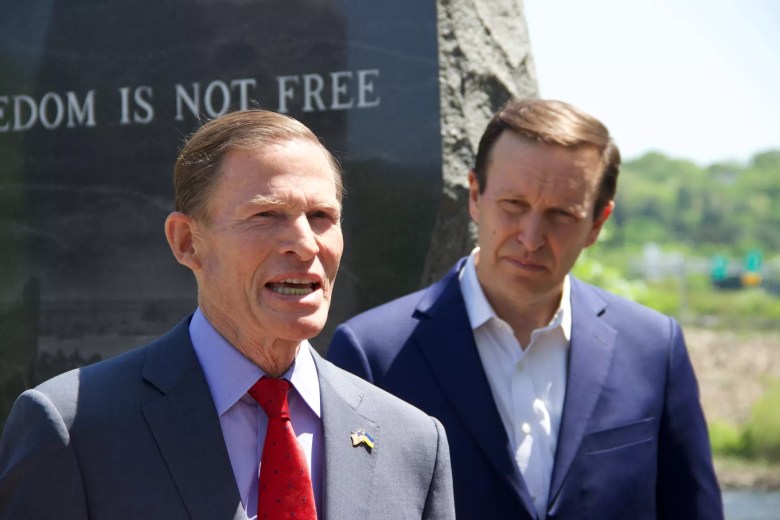
Nine days after U.S. Sen. Chris Murphy suffered a stroke, state Comptroller Sean Scanlon got a call from his old boss and friend. Scanlon picked up from a location he described as “ironic.”
“I said, ‘You’re never going to be believe where I’m at,'” Scanlon said, recounting his conversation with Murphy.
“Where, a hockey rink?” Murphy asked Scanlon, who was indeed watching his son play hockey at the time of the call. Murphy laughed when he confirmed.
Murphy noticed arm numbness while attending his son’s hockey game on Oct. 31 and was subsequently hospitalized for a stroke. Scanlon said Murphy’s humor from the outset of the call gave him reassurance about the senator’s recovery and mindset.
“That was a great sign. That’s his personality,” Scanlon said in an interview. “To hear him making jokes about something that was scary and serious, I think, shows a really healthy place that he’s in.”
Both Scanlon and U.S. Sen. Richard Blumenthal spoke with Murphy by phone on Monday night, some of the first people to speak at length with the senator outside of his family since the stroke.
Blumenthal and Murphy have served together as U.S. senators representing Connecticut since 2013, when Murphy was first elected (Blumenthal was elected two years earlier). Scanlon is a former staffer of Murphy’s, and the two have remained close friends since.
Murphy was hospitalized at Johns Hopkins Hospital after experiencing symptoms and was discharged last Friday. He’s now recovering at a rehabilitation center for several weeks and will miss Senate votes during that time.
“I was diagnosed with a small bleed in the thalamus region of my brain,” Murphy said in a statement released by his office last Friday. “The doctors are very encouraged by the progress I’ve made so far.”
His doctor wrote in a statement that he experienced “a small hemorrhagic stroke.” His physician, Dr. Jose Suarez, the chief of neurosciences critical care at The Johns Hopkins Hospital, said she expects him to make a full recovery following rehabilitation.
Murphy’s office referred back to the statement sent following his release from the hospital when asked about additional updates on his health and recovery.
Since the news broke, Scanlon said people have been reaching out to him daily for updates, given his close relationship to the senator. Scanlon said he didn’t know what to expect on the call but that he was reassured by Murphy’s positive demeanor and his voice.
“I speak for myself and a lot of people that we were really worried about him,” Scanlon said.
“It was really great to be able to talk to him and hear how well he was doing, to hear his voice sound strong and clear, hear him be upbeat and positive,” he added.
Blumenthal separately had a call with his colleague on Monday night, similarly describing Murphy in a positive mood. Blumenthal called it a “heartfelt and meaningful conversation to me.”
“The conversation was very upbeat, and I’m looking forward to his return. We need him in the fight,” Blumenthal said in an interview on Tuesday from the Senate. “There was no discussion about how long it would take, but I urged him to do whatever rest and rehabilitation was required.”
When asked about specifics on his condition and recovery, Scanlon said the call was focused on lighter topics and not about his recovery routine.
But he noted that Murphy’s “got a road ahead” in terms of his recovery. Scanlon said he’s heartened by the progress he’s made so quickly.
“He’s putting the work in every day at the facility down there,” Scanlon said. “He’s got work left to do — the people of Connecticut should know that, but he is doing that work, and he’s getting better and making really serious progress every day.”
Before his stroke, Murphy was a visible presence on the campaign trail. Murphy, who was not on the ballot last week, had been campaigning the past several weeks in Connecticut and a handful of swing states for Democratic candidates. And in early October, Murphy made a trip to the Middle East amid the ongoing war with Iran.
Scanlon said their conversation eventually shifted to politics and the midterm elections.
He said Murphy was aware of the results and Democrats’ overwhelming wins across the country. One of the first things Murphy mentioned, Scanlon said, was his shock that Republicans are down to three seats in Connecticut’s state Senate.
“I wasn’t sure if he was going to be at that level,” Scanlon said. “He was very well-versed on what had happened.”
Murphy won’t be back at the U.S. Capitol for at least several weeks and will miss votes. Scanlon didn’t have a sense of when he might return. Like Murphy’s office noted when he was discharged from the hospital, Scanlon said the senator is getting daily updates from staff on constituent work and other matters.
Scanlon, however, said he and others close to Murphy are urging him to take his time with the recovery.
“He’s got to take the time to do this work,” Scanlon said. “His doctor and family will make the decision of when the right time is to do that and transition again.”
The Connecticut Mirror/Connecticut Public Radio federal policy reporter position is made possible, in part, by funding from the Robert and Margaret Patricelli Family Foundation.
