


“WE LIVE HERE.”
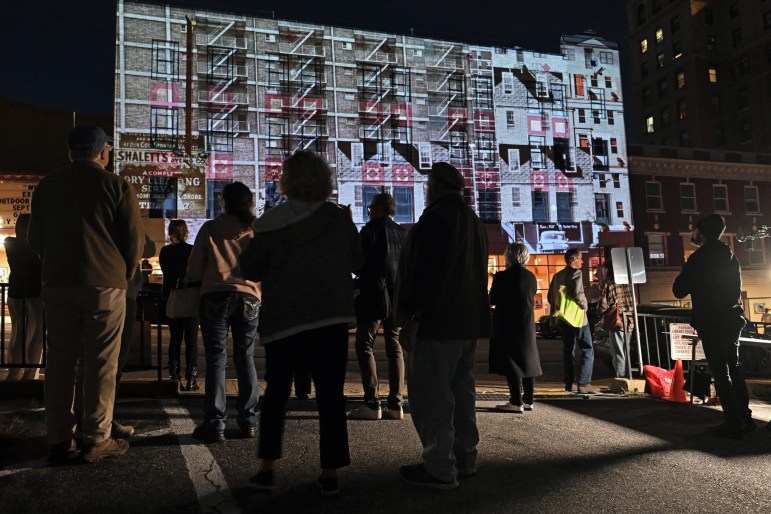
That’s the text on the transom above 305 State St. in downtown New London. The all-caps signage, bold and striking on the Garde Arts Center’s marquee, is visible to pedestrians from a block away.
Wide-ranging and collaborative, the exhibition examines the history and present of housing in southeastern Connecticut, and imagines new potential for the places residents call home.
“We” was the animating idea behind the exhibition. At every stage, decisions large and small were informed by a citizens’ advisory board of 30 community members, bringing together tenants, tenant organizers, activists, advocates, care workers, city officials, and other stakeholders. Curator Anna Vallye, who is an assistant professor of art history and architecture studies at Connecticut College, co-directed the project with Beth Sabilia, director of the Center for Housing Opportunity of Eastern Connecticut.
“Their work is evident throughout the exhibit,” Sabilia said during an interview last week.
The design of the exhibition — shaped with feedback from the citizen’s advisory board — is intended to make visitors feel as if they’re “behind the scenes of a construction site,” Vallye said.
The interior space is divided by plywood sheeting, styled as construction hoarding. The walls are covered in a forest green that evokes vinyl mesh windscreen wrapped around construction fencing. (The color is also a nod to the New London High School Whalers.)
The storefront location was purposeful, too: State Street is one of the city’s main thoroughfares for pedestrians and vehicles, Vallye said, and the team wanted to locate the exhibition where “any passerby” might “encounter” the project. Inside, visitors will find interviews with neighbors, portraits of residents and advocates, infographics and a chronology of housing history. They’ll also see speculative designs for a future New London: parks, markets, buildings and homes that have yet to be built.
Visitors are encouraged to follow a historical timeline, which Vallye described as the exhibition’s “spine.” As it charts twin histories of urban development and housing policy, the timeline allows visitors to “glimpse into how national trends and patterns are reflected in local issues.”
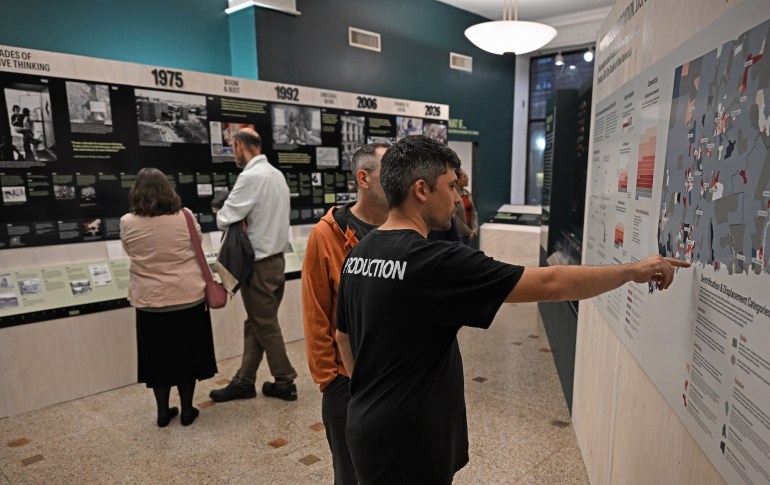
Early in the timeline are photographs of a settlement house in Chicago and images from “How the Other Half Lives” by Jacob Riis, whose muckraking photographs inspired progressive reformers to advocate for better housing in cities around the country, including in New London. As a reporter, Riis accompanied police and health inspectors on tenement raids, where residents — startled, frightened, half-asleep — may not have agreed to be photographed.
There are political cartoons and opinion-editorials from archives of the local newspaper, The Day; maps of redlined neighborhoods; clippings from campaign ads and shelter magazines. There are photographs of the construction and later, the demolition, of the Pruitt-Igoe complex in St. Louis, Missouri.
Comments from visitors, handwritten on postcards, contribute additional insights. One advocates for “modest homes,” a return to the smaller, more efficient housing of previous decades. Another, nestled beneath images of twentieth-century tract housing, reminds visitors that Black veterans were excluded from the GI Bill, which provided housing and college for so many white Americans.
Data visualizations appear throughout the space, documenting the impact of exclusionary zoning, charting the pace of gentrification, and contrasting the mismatch of available housing with household sizes. An interactive map of the New London metropolitan area prompts visitors to pin where they live, using a yellow pin for single-family homes and orange for multi-family housing.
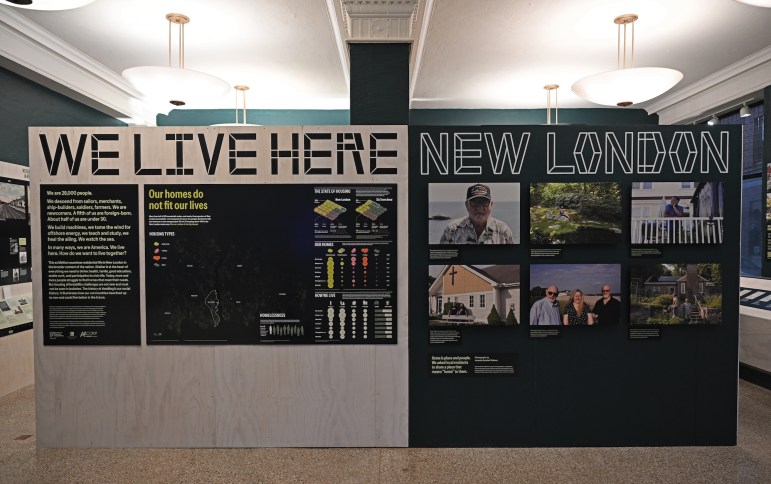
The “overwhelming dominance of the single-family home in Connecticut,” and the impact of restrictive land-use policies, are some of the observations Vallye hopes visitors take from the exhibition. Equally important is a feeling of “place-based solidarity.” For her, it’s no coincidence that crises of affordability and housing have escalated just as participation in civic life has declined.
“We all live somewhere,” Vallye said. “We belong to a specific place, whether we’ve lived there for months or for generations, and organizing for collective action, especially at the local level, can make a real difference in people’s lives.”
“We Live Here” celebrates that collective action. Members of the advisory committee contributed interviews and testimony, and it was their recommendation to feature portraits of “people who are doing the work.” At the exhibition’s entry, a display of large portraits features a pastor and his partner, a couple and their garden, and other members of the New London community.
In one photograph, a man in a U.S. Navy baseball cap faces the camera, daylight glinting from the saltwater and his sunglasses, his back to the ocean. After two tours aboard the SS America, he stepped onto land in New London and knew he was home.
The portraits are Sabilia’s favorite part of the exhibition. Representing the experiences of tenants has a fraught history, one that “We Live Here/New London” carefully navigates. A collection of interviews with residents plays on a loop inside a storefront window. Conducted and edited by Connecticut College students, film major Johanne Wartelle said the videos were shot as dialogues, with each participant level to the camera and with each other.
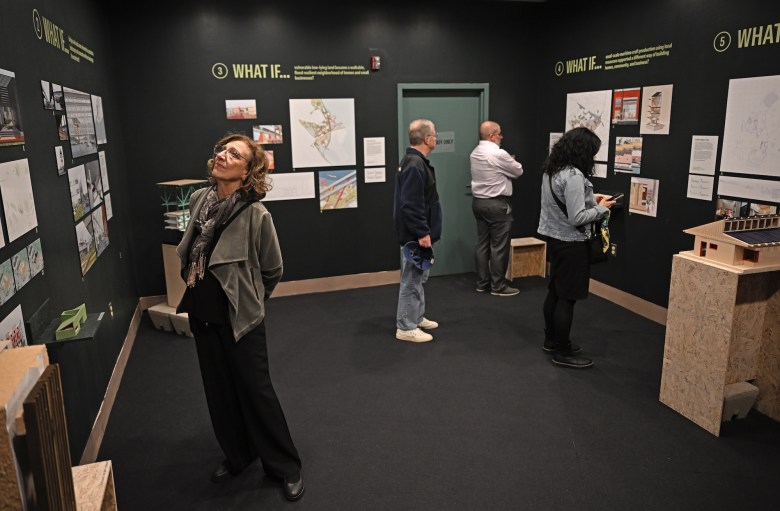
The exhibition’s timeline ends today, in 2026, but around the corner in the next room visitors will find ideas for what New London can be. Architectural models appear atop plywood pedestals, anchored by concrete deck blocks.
In the future New London, buildings in disrepair, underutilized lots, and fixtures of the local economy are rehabilitated with tabby bricks made from salvaged oyster shells. Highways and structures from the urban renewal era are repurposed as multifunctional sites for living and working.
Yesterday’s bridge trusses support tomorrow’s kelp farming. A decommissioned highway deck hosts temporary workers and houses market stalls. Flood-resistant modular housing, constructed as a continuous deck, weaves together neighborhood third spaces with overhead catwalks. A participatory design-a-thon challenges top-down decision-making and encourages residents to determine their own zoning and building regulations.
Exhibitions about housing have long featured designs for newer, better homes. These “speculations” by students at Yale School of Architecture envision better shared lives, co-created alternatives to the present.
The community behind “We Live Here/New London” isn’t waiting to create those alternatives. Guided by the citizens’ advisory committee, the exhibition’s programs have included a block party, organizer trainings by the Connecticut Tenants Union, a panel about housing policies proposed during the most recent legislative session in Hartford, and another on what “moved the needle” for community advocates.
This month, the Southeastern Connecticut Community Land Trust led a two-part film screening and discussion about alternative economies and community control. On December 1, The Day will stage a forum on housing equity, hosted at Connecticut College.
The show suggests that property is power. The relationships at work in “We Live Here/New London” — between photographer and subject, landlord and tenant (or tenant union), mortgage lender and homeowner, town and gown — might be power dynamics that shape our present. Aware of these tensions, the exhibition doesn’t try to design today’s problems away. Instead, it begins construction on a shared future.
“We Live Here/New London” is on view at the Garde Gallery, 305 State St. in New London, through December 18. More information is available here.