

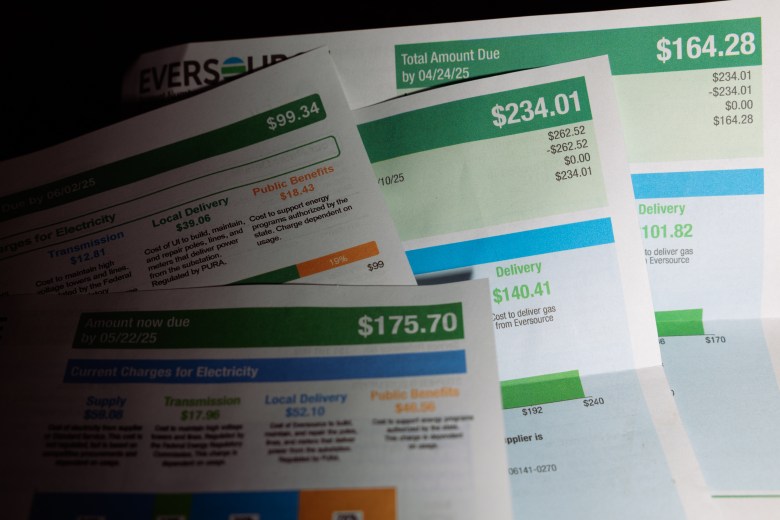
Connecticut’s electricity rates are on track to increase by double digits this winter as part of the latest energy cost-crunch prompted by the war in Iran, the state’s two largest utilities revealed in new filings Tuesday.
In paperwork submitted to the Public Utilities Regulatory Authority, Eversource asked to increase its standard service charge from 11.58 cents per kilowatt hour to 14.93 cents starting on Jan. 1 and lasting through June 30. United Illuminating requested an increase from from 11.94 cents/kWh to 15.69 cents for the same period.
Those increases equate to roughly $23 a month for the typical Eversource residential customer and $26 a month for UI customers, or roughly 13% for both utilities, according to the filings. Separately, Eversource is also requesting a December adjustment in the public benefits charge that will cost the average customer around $6 a month, according to the company’s filings. Actual bill impacts will vary depending on customer class and usage.
While regulators must review and approve any rate increases, they have relatively little control over supply charges — which by law must be passed along to customers without any markup or profit margins.
“We recognize that any increase in energy costs matters to our customers,” UI President and CEO Frank Reynolds said in a statement Wednesday. “Standard Service supply costs are determined through Connecticut’s regulated procurement process and reflect the market cost of electricity purchased on customers’ behalf.”
Supply rates typically go up during winter, when the natural gas that’s used to fuel the majority of New England’s power plants becomes constrained by home heating demands.
This year, that increase has been exacerbated by elevated fuel prices linked to the Iran War, according to experts and utility officials.
In addition to natural gas that is transported via pipeline, New England relies on shipments of liquefied natural gas from the Middle East, where the war has damaged critical infrastructure. During cold snaps, some regional power plants are also designed to run on oil, which has similarly experienced rising prices.
“As is usually the case, significant energy market volatility and the region’s constrained supply continue to have the biggest impact on electric supply prices and bills overall,” Eversource spokeswoman Jamie Ratliff said in a statement. “This volatility is due to several factors, including global events — such as the conflict in Iran — disrupting the energy market and causing costs to surge.”
Within Connecticut’s deregulated energy market, customers do have the option of purchasing power from one of several third-party suppliers, instead of relying on the standard service rates charged by their utility.
But rising energy costs from the war have hit those suppliers as well, reducing the prospect of finding good deals. As of Wednesday, the cheapest third-party offering on Connecticut’s competitive supply marketplace was a 13.49 cents per kilowatt hour — a discount from the proposed winter increases but still more than the current supply rates charged by Eversource and UI.
“As we go into this coming winter, it is the unfortunate reality that those global fuel costs are going to translate into higher electricity prices,” said Dan Dolan, the president of the New England Power Generators Association.
Dolan said that there is likely to be some relief this winter in the form of two large offshore wind farms — Revolution Wind and Vineyard Wind — that have come online in recent months.
Those projects are expected to perform best during the cold, blustery winter months when demand for power is near its peak, offsetting some of the need for additional fuel imports, Dolan said.
Additionally, forecasters are predicting a more mild winter compared to last year, which was one of the coldest in recent history for much of New England.
“To the degree that this winter is more mild, that could provide significant consumer relief,” Dolan said.
The expected increase in supply rates is separate from Eversource’s request for a 18%, $727 million hike in base distribution rates starting next summer. That request, which remains pending before PURA, reflects the cost of building and maintaining the local grid network from which the utility derives the bulk of its profits.