Fewer minors accused of crimes are being referred to Connecticut’s juvenile courts, a trend officials say has emerged from a 2023 effort to push young people towards alternative intervention methods rather than into the juvenile justice system.
The risk assessment model introduced in 2023 analyzes behavior to determine the likelihood that the child will commit another crime. Those determined low-risk are being diverted to community-based programs that provide therapy, mentorship and guidance, leading to fewer young people entering the juvenile justice system.
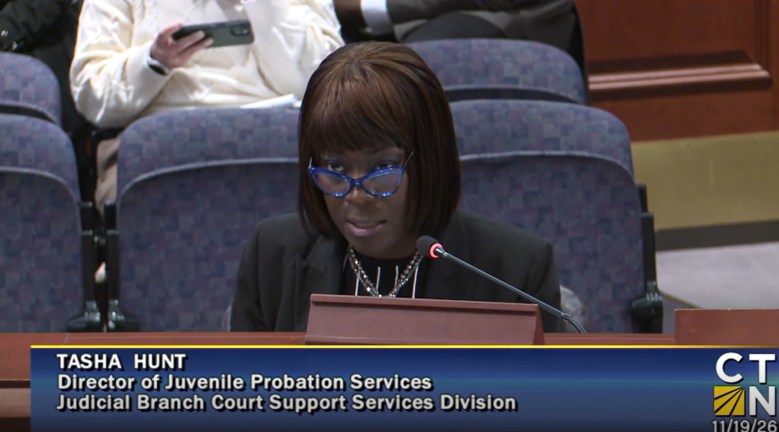
“Back in 2023, we talked a lot about a shift within juvenile probation from looking at referrals and how youths are referred to the court through a different lens, no longer relying on the offense and really looking at the risks and needs of youth, and doing screenings that will allow us to make decisions about how their referrals should be handled based purely on an evidence-based validated screening tool,” Tasha Hunt, the director of Juvenile Probation with Connecticut Support Services Division, said Thursday afternoon at a Juvenile Justice Policy and Oversight Committee meeting.
This year, around 30% of all cases were diverted to community-based interventions, with the rest of cases sent to juvenile court.
The numbers
Last year, there were 4,849 juvenile cases, compared to 9,943 in 2015 and more than 12,000 in 2010. This year, the state estimates it will handle about 4,650 cases, a 4.1% decrease from 2025, according to data compiled by the Tow Youth Justice Institute.
When a case is not taken to court, it can go a few different places. Some are either sent to the Juvenile Review Board, a community-based program that diverts youth away from the system, or are referred to other services in their community.
These services are being added in high-need areas — Connecticut’s biggest cities.
“Slowly but surely, we’re adding the services,” Rep. Toni Walker, D-New Haven, and co-chair of the juvenile justice committee, said Thursday. “I know it’s not fast enough for everybody, but we are trying very hard to continually add more services in different areas.”
Walker said once the need is met in “key areas,” they hope to spread services to other communities.
Additionally, the percentage of children who remain arrest-free throughout their probation supervision is relatively stable — around three-quarters of cases in recent years did not lead to a rearrest.
While the model is working to keep children out of the juvenile justice system, the charges children are facing have changed slightly.
After a spike in 2023, the number of juveniles facing motor vehicle theft charges fell to 192 in the first three quarters of 2025 and to 154 in the same period in 2026.
“We do continue to see a decrease in it,” Hunt said. “However, it is still among the top 10 charges.”
Policy recommendations
Even with the success of the risk-based analysis, the committee heard a number of different recommendations for the upcoming legislative session.
One working group recommended that juvenile records should be automatically erased for cases diverted from the system. This would allow young people who completed their sentence to have their record scrubbed.
“An automatic erasure means the young person does not have to file a petition or hire an attorney to obtain relief,” Rep. Anthony Nolan, D-New London and co-chair of the juvenile justice committee, said. “If we believe that rehabilitation and giving young people a second chance is what we’re doing, then successfully completing a conversion program should mean something. They should not have to have something follow them after they complete a successful program.”
Others recommended that minors aged 15 to 17 should not be held at the two youth correctional facilities, Manson Youth Institution in Cheshire and York Correctional Institution in Niantic.
Walker said land at the former site of the Connecticut Juvenile Training School in Middletown, which shut down in 2018, is one of the only places were the state could build a detention facility for juveniles.
“That’s the only place that has the land, because we want the land, we want space for our kids, and that we own it,” Walker said. “We’re not interested in building a giant detention center. … We want small, and we want personal.”
Other recommendations included eliminating the word “truancy” in the school system and taking steps to support girls in the system who are vulnerable to human trafficking.