



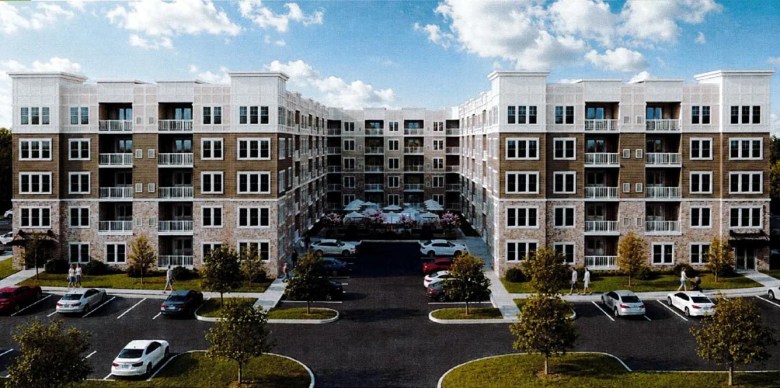
Here are a few of the ways a proposed new apartment building in Oxford has been described on social media. One commenter called it “Soviet-style,” which is odd, since the renderings look pretty much like any other apartment building in Connecticut.
Another called it “Bridgeport-like,” which is not so subtly racist. What do we think this person meant by comparing a suburban multifamily housing development with Bridgeport? It’s a mystery.
Such is the state of housing discussions in Connecticut. Years into a crisis, with every politician putting “affordability” front and center in their platforms, with nearly everyone hit by some form of housing shortage – adult children still living at home being the most common example – and we’re still faced with every proposed solution running into the exact same obstacles.
Logic says to bring down the cost of housing we need to build more of it (supply and demand still holds, one would think), but the unfortunate reality is that most towns still do everything in their power to stop that housing from being built.
It’s quite a conundrum we’ve created for ourselves.
This particular proposal, along Route 67, the main road through town, is likely going to win approval due almost entirely to Connecticut General Statutes §8-30g, the Affordable Housing Appeals Act. This law states that in towns with less than 10 percent of housing deemed affordable, that town has fewer abilities to deny a project with affordable units. In short, the town has to prove there’s a health or safety issue that is more important than the need for affordable housing in that community, which will not be the case here.
Without 8-30g, it’s unthinkable this project would be approved. Too many people hate it, and land-use commissioners are subject to the will of voters. It’s exactly why laws like 8-30g are needed, and not nearly sufficient.
Because the question is not whether we need housing. The demand is obvious. Whenever it’s built, it fills up quickly. The question is why so many people appear to hate it so much.
Let’s dispense with the most commonly stated complaints, the issues that always come up when new apartments are proposed in a Connecticut suburb.
Traffic. There are a lot of cars on Route 67, no question. The thing is, of course, that’s an issue whether these new housing units are built or not. If you think the road needs fixing, the question of new apartments is immaterial. Fix it or don’t, but you can’t blame something that’s not there yet.
Further, we know how much traffic new housing generates, and the answer is, not much. People leave their homes typically once, maybe twice a day, and not all at the same time. Adding hundreds of new units does not meaningfully add to congestion. What does add to traffic is new businesses, like grocery stores, where people come and go all day. Somehow it’s only new homes that get people up in arms about too many cars. There’s also this idea that if housing were to be proposed where traffic is lighter – say, a single-family neighborhood – that opponents would be satisfied. That’s laughable.
Kids in schools. The thought here is that hundreds of new units will mean hundreds of new schoolchildren, all of whom must be educated, and we’ll have to hire new teachers and maybe build new schools and taxes will skyrocket.
None of this is true. First off, school enrollment is stagnant or declining nearly everywhere in Connecticut. Unless we want a wave of school closures, we need more students, not fewer.
Secondly, most apartments, especially one-bedrooms and studios that developers favor, have few if any schoolchildren living in them. Where do most children actually live? Single-family homes.
Finally, there’s the verifiable fact that new development, and new residents, means more tax intake, nearly always far more than the town has to shell out for school costs, police, fire, whatever. Also, there’s this: Do we really want a town that bars kids? What kind of town are we?
This one is related to the first two – sidewalks . There are no sidewalks on this road, people complain, Where are these residents going to go? True enough, but Oxford is an overwhelmingly car-dependent town already. You want to fix that? Who’s stopping you? Don’t blame new apartments for existing problems.
The environment. Here’s a big one. Everyone thinks their groundwater is doomed to pollution if new housing goes in. But it’s worth remembering there are strict laws in this state governing these questions. You can’t just fill in a stream at your convenience. Of course, this is a town that keeps re-electing someone best known for ushering in a gigantic gas-fired power plant in town, so it’s at least possible the environmentalist turn here is more about finding an anti-housing argument that sticks.
Home values. There’s this idea that building apartments makes existing homes less valuable, hurting resales. This has been studied extensively, and guess what, it’s not true. Why would it be? It doesn’t even make sense. Your home’s location and desirability are exactly the same whether new apartments go up or not.
And, finally, crime . Speaking of questions that have been studied extensively, there is no link — none — between building apartments in a suburb and a decline in public safety. If you still think there is, despite all evidence, that says more about you than anything else.
So what are we left with?
People in suburbs around Connecticut are against housing for reasons that are easily disprovable. You don’t want overdevelopment in town? Hopefully you’re out picketing against the new CVS someone wants to build, which is going to affect your town’s “character” far more than a place for people to live.
We need housing, of all types, in every community. The aforementioned 8-30g is helpful, but purely reactive. It only kicks in if someone proposes a development under specific parameters. The housing law Connecticut passed in 2025, known as PA 25-1, provides a framework for housing growth, but we need something much stronger to take on the true affordability challenge this state is facing, something that will hold towns accountable, with real expectations.
The status quo has made it impossible to build housing to keep up with demand in Connecticut. Remember that the next time you wonder why our state economy has stagnated for a generation.
Hugh Bailey lives in Oxford. He is policy director at Open Communities Alliance, a nonprofit focused on housing policy.