


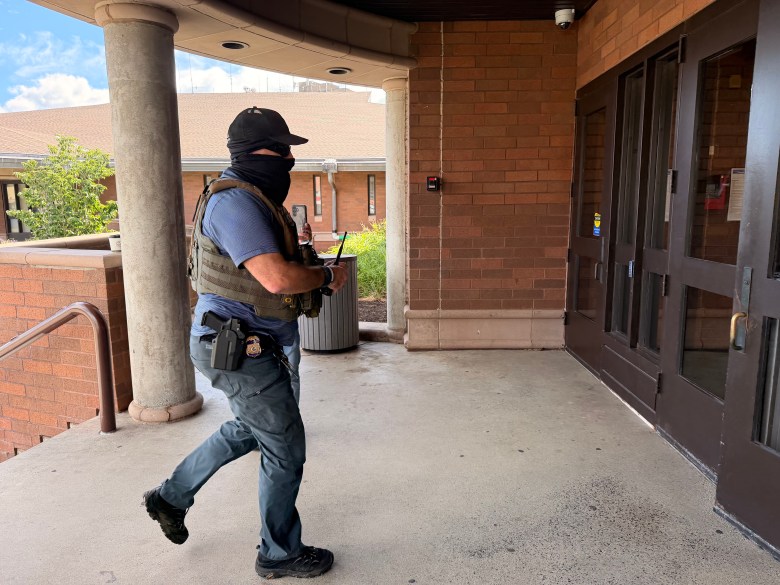
The news last week that four provisions of a law intended to regulate U.S. Immigration and Customs Enforcement action in Connecticut were blocked by a federal judge was “not a surprise” to some immigration advocates. But, they argued, it didn’t erase the impact of state officials’ willingness to take action in the face of President Donald Trump’s immigration crackdown.
“I think it underlines our state, and especially our legislators’ willingness to still pass policies that could be challenged because they were the right thing to do, and send a message to residents — immigrant and non-immigrant — that is is where Connecticut stands,” said Constanza Segovia, organizing director for Connecticut For All and co-founder of Hartford Deportation Defense.
She said when the laws were passed, including the provision that aimed to stop agents from wearing masks or other facial coverings when they interface with the public, advocates were aware there would be pushback.
But Segovia, other advocates and some lawmakers said they are exploring the ways in which the state’s existing laws and new proposals that might come up in the 2027 legislative session can offer residents protection in response to safety concerns related to federal immigration enforcement actions.
In the meantime, though, Carolina Bortolleto, an organizer with Greater Danbury Unites for Immigrants, said the ruling still “leaves Connecticut less safe” because “no one wants masked agents running around neighborhoods.”
Senate Bill 397 was passed in 2026 and quickly was challenged by the U.S. Justice Department. The federal government called the law “blatantly unconstitutional,” saying that the state has no authority to tell federal agents what they can and cannot do. The government also argued that the law goes against the Supremacy Clause of the U.S. Constitution, which says that when state and federal laws clash, federal laws override those of the states. Judge Vernon Oliver agreed.
The state law, Oliver wrote, “plainly imposes conditions on how federal officers must conduct and present themselves during the course of their federal duties, and it subjects them to criminal and civil penalties if they do not abide by those state-imposed conditions.”
“But the Supremacy Clause ensures that federal operations are not chilled by state prosecution and that federal officers are immune from state prosecution when acting within the scope of their federal authority,” he added.
ICE officials did not return a request for comment.
Yet even in the wake of the decision, some immigrant rights advocates like Bortolleto were sounding a note of optimism. A provision of the bill that requires ICE agents to have a warrant in locations like schools, hospitals and places of worship remains in effect.
“I think that’s really important because I think that section of the bill is what goes the longest way to making immigrant folks feel safer,” she said. Bortolleto said that she hoped that during the legislative 2027 session that begins in January, doctors’ offices could be added to the list of protected areas.
Advocates also say that agents have frequently been observed wearing masks in the state even when that portion of the law was in effect.
Miguel Castro, a member of the Meriden Middletown Immigration Alliance and second vice chair of the Connecticut Hispanic Democratic Caucus, noted the injunction is temporary and he still has hope that Connecticut will ultimately succeed.
“Our state still has an opportunity to go back to the court process and challenge this as it is sits today,” he said. “It is a responsibility of the state under the 10th Amendment of the Constitution, using the sovereignty of our state, that it is our duty and fiduciary responsibility to protect the members of our community, and that’s what we intend to do.”
Dealing with masked agents presents a variety of concerns, advocates say.
“It’s a traumatic experience to see someone or a group of people with masks on, and they are carrying weapons, and you are by yourself and you have nothing to defend yourself with,” said Juan Fonseca Tapia, a co-founder of Greater Danbury Unites for Immigrants. “All you’ve got is a phone.” That phone can be used to record agents and provide evidence of abuses, but when those agents are masked, advocates say it can complicate accountability. The bill also sought to make officers wear identification, a provision that was blocked by Friday’s ruling.
Segovia said it would be a priority in 2027 to look for regulatory loopholes that disenfranchise immigrants and people of color, and make sure they are closed.
Supporting working-class immigrants means “supporting expansive healthcare policies that include everybody, regardless of immigration status,” Segovia said. Lawmakers should “make sure that nobody can touch our kids’ ability to go to public schools and public universities, regardless of their immigration status,” along with other key rights like renter protections.
Segovia’s group is among those pressing the Lamont administration to put $10 million toward legal aid and emergency cash assistance for immigrants impacted by ICE enforcement.
House Speaker Matt Ritter, D-Hartford said that he is interested in having that discussion in the new year. Ritter said the attempt to regulate ICE activity was worth pursuing, but ultimately there are “just limits to what the states can do.” He said it’s time for the Democratic majority in Washington to step up.
“It’s not me throwing my hands up in the air saying, ‘we’re going to give up.’ We’re going to do everything we can to be helpful,” he added. “But there’s 259 Democrats in the House and 56 in the Senate, and if they need help learning how to pass bills I’m glad to go down there and try to help them.”
Rep. Steven Stafstrom, D-Bridgeport, a key backer of Connecticut’s law as co-chair of the legislature’s Judiciary Committee, said he was disappointed with the ruling. But “we’re not backing down,” he said.
Stafstrom said there are still legal remedies to holding agents accountable for abuse of use of force.
“One of the things that was blocked was having the inspector general do investigations into abuse of use of force, but just because that piece was inexplicably blocked, doesn’t mean Connecticut won’t continue to enforce state laws, it will just fall to individual states attorneys for the judicial districts to do that,” he said.