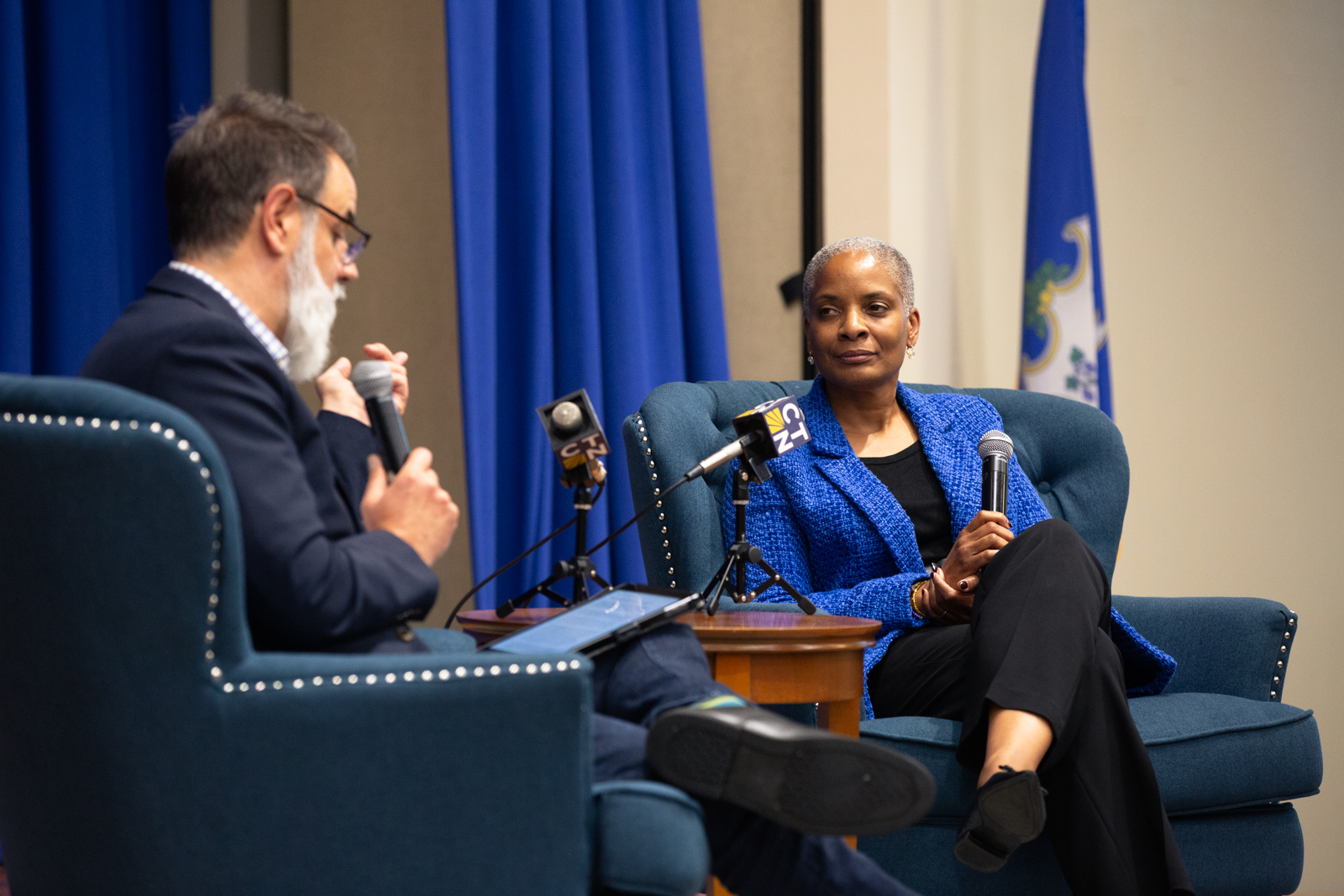
As Connecticut voters prepare to head to the polls for the presidential election, Secretary of the State Stephanie Thomas said many still don’t know that they can vote before Election Day.
Voters in the state authorized the early in-person voting through a ballot measure in 2023, and the state rolled it out for party primaries this year. But few are taking advantage of it, Thomas said while speaking at the Connecticut Mirror’s “In the Room” speaking series.
The state adopted early voting when it passed House Bill 5004 in 2023, sponsored by 41 representatives and five senators.
In the Republican presidential primary, about 12% of the votes were from early ballots. For the Democratic presidential primary, 19% of their votes were from early ballots.
On Tuesday, Thomas discussed the issues surrounding early voting in Connecticut with “In the Room” host John Dankosky.
The main problem her office faces is the lack of public knowledge of early voting, she said.
“A lot of people out there don’t quite know what early voting is. They often say, ‘Oh I can mail in my vote?’ No, that would be absentee voting. Early voting is in-person, two weeks before Election Day,” Thomas said.
Early voting in Connecticut for the general election begins on Monday, Oct. 21, and runs to Sunday, Nov. 3. The Secretary of the State’s website contains information about early voting, along with a list of the designated early voting locations for each town.
Civic engagement
Many don’t know that early voting is an option, Thomas said. Her office has been working to spread the word, but she said she has no money to do so.
“We did not receive a budget, so we’ve been doing a lot of outreach. It’s a small word for an awful lot of legwork we’ve been doing over the last year and a half,” Thomas said. Her team has worked with the Department of Transportation to put flyers at bus stations. Thomas also appeared at halftime of the University of Connecticut football team’s home game last Saturday to spread the word about early voting.
For the first year of its operations, Thomas said, her office requested a budget of $2 million to advertise early voting, later dropped to to $1.5 million. In the end, the office received nothing. The funds would have gone towards advertisements on television, radio and digital platforms, she said.
“This is not a problem unique to Connecticut. Funding in elections has always been slim, and civic engagement is fairly non-existent,” she said.
Absentee ballots
A question regarding absentee voting will be on the ballot, Thomas said, asking whether the General Assembly should investigate ways to expand absentee voting.
The current law allows voters to use an absentee ballot if they are unable to appear at their town’s polling place on Election Day due to absence, sickness or physical disability (not necessarily their own), active service in the military, religious tenets or their duties as an election official place them at a polling place other than their own.
The question on the ballot in November would loosen those rules to allow anyone to request an absentee ballot and to vote by mail, even if they do not fall into those categories.
“Once you allow for universal access [to absentee voting], we would have to change the system. Passing the ballot measure would allow us to open that up and change some things,” Thomas said.
The state changed the rules for absentee voting in the past. During the COVID-19 pandemic, the state issued an emergency executive order allowing every voter to use absentee ballots regardless of the reason. Even for absentee ballots, Thomas said there are more effective ways to count the votes.
Other states have successfully implemented universal absentee voting, she said.
“What they have found is that most people vote by absentee ballot, then early voting, then Election Day,” Thomas said. “It’s an order of convenience. One random Tuesday in November is the least convenient.”
Connecticut differs from other states in its polling locations as well. Other states hold their elections on the county level, while Connecticut holds them in each town. With a lack of funding, Thomas’ office is unable to reach the public as effectively as other political organizations, she said.
Thomas has consistently advocated for more money to perform voter outreach and improve civic education.
“All of the information communicated to the public is almost exclusively done by political parties and candidates,” Thomas said. “I would rather see a nonpartisan entity like our office insert themselves into that process instead.”
She said the state should switch to a system with more absentee ballot access due to the complications and costs of the current system.
“The states that have shifted to all-mail voting primarily have done it because of the cost,” Thomas said. “We have so many polling places in Connecticut. The cost to run them, we’re seeing now with the early voting, is quite high.”
Voter security
The fears and concerns surrounding absentee ballots are primarily based on the fear of election fraud. Yet Thomas said election fraud is not as significant as other issues her office faces.
“The other major body of work that we’re in charge of is the business registry,” she said. “Business fraud is actually a global problem that many entities are tackling to solve, and it impacts a lot of hard-working business owners. Election fraud has not risen to that level. In every study, every parameter has shown 0.00001%. It’s not the problem we should be talking about.”
Rather than focus on the low levels of election fraud, Thomas wants to divert attention toward funding for election processes and toward the problem of interference from nations such as China, Russia and Iran.
The proliferation of social media and disinformation has made Thomas worry about the public’s knowledge of the upcoming election.
“I worry about AI and the proliferation of fake news sites that is also being perpetuated by those same nations. There are real things to worry about election fraud, so-called election fraud.”
False information and stories have affected her office as well. Thomas said she’s received calls and emails due to stories about Democrats being lax on border control to “import voters.” This was due to a post Elon Musk made on X, one of many instances where he’s spread this idea.
“We are fortunate to live in a country with First Amendment rights, with the freedom of speech, but we have to remember, just because it’s said doesn’t mean it’s true.”