


All it took was an executive order from President Donald Trump to align Gov. Ned Lamont with the legislators and housing advocates who are still angry at the governor’s veto of an omnibus housing bill.
They shared a disdain Monday of Trump’s order pushing cities to combat homelessness not by creating housing but with involuntary commitments for drug and mental health treatment.
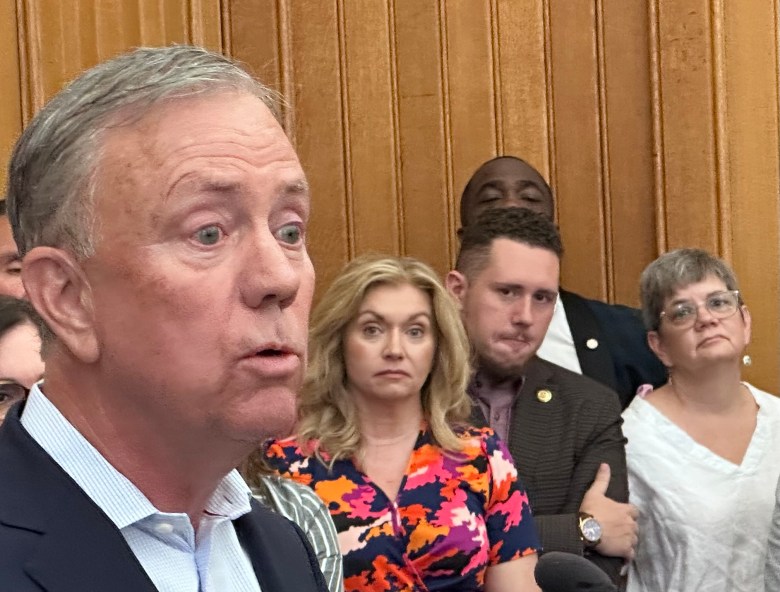
“President Trump, homelessness is not a crime, not here in Connecticut and not in America,” Lamont said, addressing advocates at the state Capitol. “These folks need help, not handcuffs. These folks need housing, not handcuffs.”
Lamont, a Democrat who has hinted he will seek a third term next year, was rewarded with applause, whoops and a few hard looks from lawmakers who believed the governor fumbled an opportunity to put those words into action.
“We had a bill that did that,” said Rep. Antonio Felipe, D-Bridgeport, the co-chair of the Housing Committee. Felipe said he was optimistic of eventually finding a version acceptable to Lamont.
With his veto in June of House Bill 5002, Lamont sided with suburban opponents and Republican legislators who had urged a veto of the measure as an intrusion into local zoning.
HB 5002 was drawn to address a critical housing shortage by requiring municipalities to set “fair share” goals for affordable housing, prioritizing state aid to communities that build housing, and streamlining approval for so-called “middle housing,” defined as a building with two to nine units.
Lamont said Monday that talks are continuing on a revised version that he hopes could be adopted in a special session anticipated for the fall.
“I want a bill that we can all get behind,” Lamont said. “We’re working on that every day, and we’re going to get a really good housing bill that has the support of all the people in this room.”
Lamont was among a dozen speakers at a press conference his staff organized Monday in opposition to an executive order signed July 24 by Trump that was cast more as tough law-and-order measure than a solution to root causes of homelessness. Its title: “Ending Crime and Disorder on America’s Streets”
“Endemic vagrancy, disorderly behavior, sudden confrontations, and violent attacks have made our cities unsafe,” Trump wrote. “The number of individuals living on the streets in the United States on a single night during the last year of the previous administration — 274,224 — was the highest ever recorded.”
The order cites no specific authority for a president to order local police or state agencies to break up homeless encampments or take homeless off the streets.
It states vaguely that the administration will seek “the reversal of Federal or State judicial precedents and the termination of consent decrees that impede the United States’ policy of encouraging civil commitment of individuals with mental illness who pose risks to themselves or the public or are living on the streets and cannot care for themselves in appropriate facilities for appropriate periods of time.”
While the Trump administration has slashed spending for drug treatment and is considering more cuts, the executive order promises “technical guidance, grants, or other legally available means, for the identification, adoption, and implementation of maximally flexible civil commitment, institutional treatment, and ‘step-down’ treatment standards.”
State officials and advocates in Connecticut see the order as a dramatic shift from “housing-first” approaches to homelessness popularized during the Obama administration and continued by Trump during his first term, coupled with the availability of support services.
“The executive order would effectively criminalize homelessness and reduce support for incredibly effective programs that use a housing-first model. This does nothing less than suggest lessons from history, science and basic human compassion have been forgotten,” said Nancy Navarretta, the state commissioner of mental health and addiction services.
Jennifer Paradis, the executive director of an anti-poverty program in Milford and co-chair of CT CAN End Homelessness, suggested there was more to the issue than denouncing Trump.
“Homelessness is not criminal. Seeking community is not criminal. Poverty is not a crime. But let me be clear: Connecticut can do better, and we will,” Paradis said.
“We have led our country in this work for many, many years, and now it is time to do it again, compassionately and collaboratively.”
Paradis, who glanced over her shoulder at Lamont at one point during her remarks, said relief to homelessness is in state hands.
“This is the moment in which we must maximize leverage for decriminalizing homelessness and funding services —”
Applause drowned out the rest of her sentence.
“To me, moments like this are not the work, all right? But it sets the tone for how we work moving forward,” Paradis said. “We know what we need. We know that homeless services are impactful but sorely under resourced. We know that housing ends homelessness, and we know that we will not stand for the slander, hateful and harmful policy that is this executive order.”
Thomas Burr, a Connecticut representative of the National Alliance on Mental Illness, said the state has been a leader on fighting homelessness and providing mental health services.
“The previous administration of Gov. [Dannel P. ] Malloy, specifically, made significant investments in supportive housing, which was really a great thing to do, and we certainly celebrate that,” Burr said. “We celebrate the fact that Connecticut, back in 2015, was the first state to end chronic homelessness for veterans. That was huge.”
Burr, the father of a son who was homeless long ago as a consequence of mental illness, counseled against the president’s push for a greater reliance on involuntary treatment.
“Coercive treatment of any form is often traumatizing and counterproductive,” Burr said. “My son experienced this, and I have talked to more people who have had mental health and/or substance use issues who have found forced treatment to absolutely sour them on a medical model of treatment that has just delayed their paths of recovery.”
U.S. Reps. John B. Larson, D-1st District, and Joe Courtney, D-2nd District, and U.S. Sen. Richard Blumenthal also attended, emphasizing the immediate threat was from funding cuts that Trump can impose, not a directive to detain the homeless.
“This executive order is not law,” Blumenthal said. “It’s an edict from a lawless president.”
CT Mirror reporter Ginny Monk contributed to this report.
