



For the first time since the highly-invasive aquatic weed hydrilla appeared on the Connecticut River in 2016, officials say they’ve begun to turn the tide in their long-running fight against it.
In a handful of locations along the river where the weed once grew in thick mats, attacks with chemical herbicides have reduced its prevalence to a few isolated clumps.
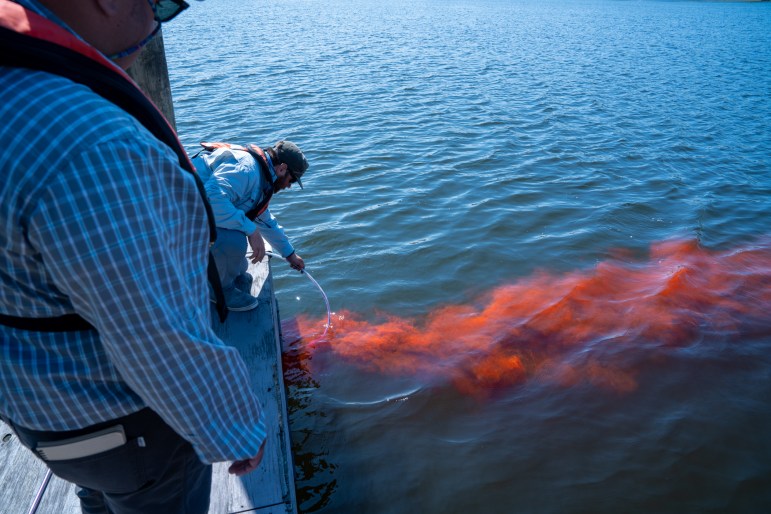
In other areas, researchers with the United States Army Corps of Engineers are already planning for their next offensive — tentatively scheduled for next summer — by using tracer dyes to track the flow of water and determine precisely how much herbicide they need to use to target the weed while minimizing harm to other, native species of plants.
“It’s going to take time to control hydrilla, it’s not going to be like a one-and-done kind of treatment and then you walk away,” said Keith Hannon, the project manager for the Army Corps’ New England District.
“There is reduced regrowth compared to previous years, but it is growing back,” Hannon added. “That’s why the work we’re doing here is going to be, hopefully, used to inform a larger management plan.” Hannon said local and state officials would then be able to deploy the plan to manage regrowth over the long term.
In order for the work to continue, however, Hannon said the Army Corps would need to receive additional funding that’s currently awaiting approval from Congress.
Researchers were forced to scale back their efforts earlier this year after lawmakers failed to include money for the Connecticut River hydrilla project in the latest government funding bill. U.S. Sen. Richard Blumenthal, D-Conn., has since requested an additional $5.5 million in funding for project as part of a cost-sharing program with state governments.
Blumenthal said Friday that he is seeking to include the money in the Senate’s annual Energy and Water Development bill, which is currently being held up amid a dispute over funding for clean energy programs.
“I have very strong hopes,” that the funding will be approved, Blumenthal said. “I’m optimistic because it’s a program that makes eminent good sense from an environmental and economic standpoint, and obviously it has strong support among the states most deeply affected.”


The project also faced a period of tumult this summer when a sudden controversy arose around one of the herbicides being used by researchers: diquat dibromide.
In a series of social media posts that quickly racked up thousands of views, opponents spread inaccurate information about diquat — a common herbicide that is widely used in aquatic applications — and accused officials of deceit despite several public meetings that were held to raise awareness about the project. Some of the posts leveled attacks against the researchers themselves, accusing of them of trying to “poison” the river.
As as result of that pushback, the Army Corps ended up extending delaying its work by several weeks in order to solicit more feedback from the public.
When the work resumed in August, officials said there was only enough time and federal funding available to apply herbicides in two locations along the river: the Chester Boat Basin and Selden Cove in Lyme.

Hydrilla is native to Eurasia, but has already spread across much of the Eastern Seaboard since it was spotted in Florida in the 1950s. The strain found in the Connecticut River, however, is genetically distinct from other varieties and is known to spread vigorously through fragments carried by currents, boats and boat trailers.
Officials said they believe the plant may have been introduced to the river near Agawam, Mass., and spread south to the mouth of Long Island Sound as well as in several lakes and ponds.
The purpose of the Army Corps’ project is not to eradicate hydrilla from the river, but instead to gain a better understanding of which chemicals and methods work best at combating the strain so that those results may be replicated in other regions to stop it from spreading.
“If you don’t take care of it when it’s in a pond, next thing you know it’s in millions of acres,” said Ben Sperry, a Army Corps research biologist based in Gainesville, Florida, who traveled to Connecticut to oversee the project’s field work. “That’s the big concern if this thing starts to spread south. It has the capacity to replace other species.”
In addition to the Army Corps, the Connecticut Agricultural Experiment Station has also provided support for the project.
The Connecticut Department of Energy and Environmental Protection, while not directly involved in the team’s research, is in charge of reviewing and issuing the permits necessary to apply herbicides within the state’s waterways.
“Generally speaking, DEEP supports efforts to curb the negative impacts of hydrilla and to educate the public about the ways they can assist in those efforts,” DEEP spokesman Will Healey said in a statement.
Early one sunny morning in late August, Sperry’s team of Army Corps researchers — including others who had traveled from as far away as Mississippi and the Great Lakes — arrived in Chester for the first day of treatments.
The team quickly got to work setting up several machines resembling the Star Wars droid R2-D2. Inside each of the machines was a revolving set of tubes to sample water in the basin every hour for up to a day to monitor for nutrients that are released by the plants as they begin to die and decompose.
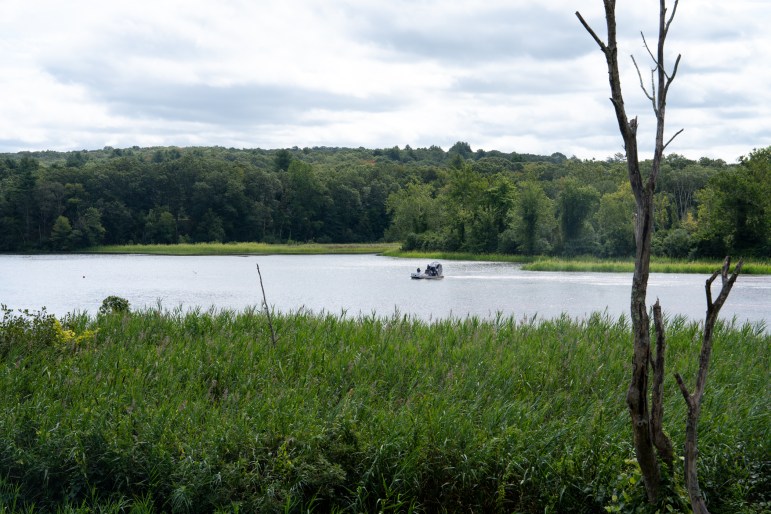
Meanwhile, contractors for Solitude Lake Management, a private aquatic-management company based in Shrewsbury, Massachusetts, began making back-and-forth sweeps across the basin, applying a diluted mixture of herbicides, including diquat, through hoses lowered underneath the surface.
The day after treating the boat basin, the team conducted similar work with another chemical herbicide, endothall, at Selden Cove. Sperry said researchers stayed in the area for several days to monitor the effects of the herbicide. After that, he said they’ll come back once a month — except when the river is frozen in the winter — for up to a year to conduct vegetation surveys.
During an online public meeting last month, the Corps reported the results from its vegetation surveys at four locations treated with herbicides in 2024, which showed large drop-offs in the amount of hydrilla and another invasive species, water chestnut.
Chester Basin, which was treated with a combination of endothall and diquat last year, saw a reduction in hydrilla while native plants pickerelweed, wild rice, and eelgrass were unaffected. The invasive plant cabomba, which is present at the site, is also resistant to diquat and would need to be managed by other methods, Sperry said.
Alicea Charamut, the executive director of the Rivers Alliance of Connecticut, a nonprofit conservation group, said that boaters in areas treated by the Army Corps have also reported clearer waterways — though she cautioned that “several years” of further data is needed to develop an effective management plan.
“Conditions change from year to year,” Charamut said. “I don’t think people truly understand how dynamic river systems are, especially tidal river systems like the Connecticut River… and to be able to understand, we need to have that consistent monitoring and data from year to year, to see how management, how effective it is.”
The final phase of the Army Corps’ work this summer involved a series of “practice runs” using inert dyes that mimic the spread of herbicide through a particular stretch of water.

During one such test at Portland Boat Works earlier this month, researchers set up seven data buoys along more than a mile of river to track the spread of the diluted dye being slowly released from a 60-gallon tank.
Portland was one of four locations in Connecticut and Massachusetts where the dye studies are scheduled to take place through Sept. 19.
The location was also one of several where the Army Corps applied herbicides to combat hydrilla in 2024, but Sperry said that swift currents in the area prevented the chemicals from settling on the plants. “We didn’t get the level of control we were hoping for,” he said.
Armed with more data, he added, the team hoped to be able to tweak their methods and try again next summer.