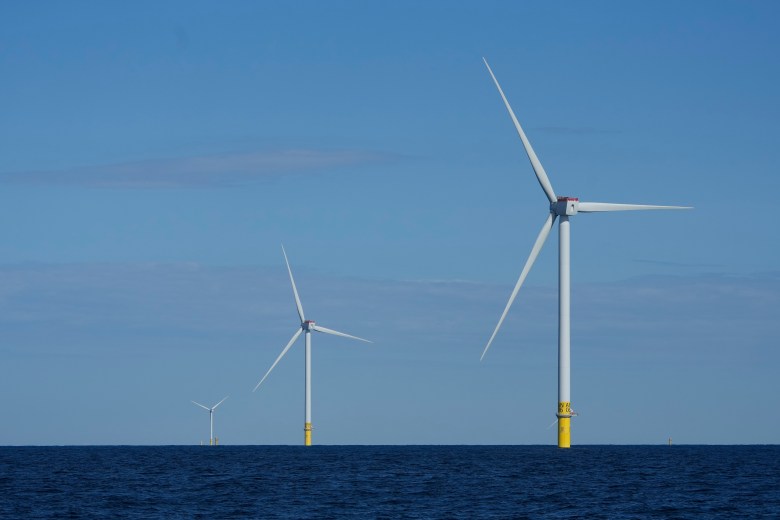
WASHINGTON (AP) — A federal judge on Monday struck down President Donald Trump’s executive order blocking wind energy projects, saying the effort to halt virtually all leasing of wind farms on federal lands and waters was “arbitrary and capricious” and violates U.S. law.
Judge Patti Saris of the U.S. District Court for the District of Massachusetts vacated Trump’s Jan. 20 executive order blocking wind energy projects and declared it unlawful.
Saris ruled in favor of a coalition of state attorneys general from 17 states and Washington, D.C., led by New York Attorney General Letitia James, that challenged Trump’s Day One order that paused leasing and permitting for wind energy projects.
Trump has been hostile to renewable energy, particularly offshore wind, and prioritizes fossil fuels to produce electricity.
The ruling comes on the heels of another court battle over the fate of Revolution Wind, the 704-megawatt offshore wind farm being launched from the State Pier in New London.
The Trump administration ordered a halt to construction on the project in August, at which point work was already 80% complete.
The project’s developers sued along with Connecticut Attorney General William Tong and his counterpart in Rhode Island. The developers’ lawsuit succeeded in lifting the stop work order, while Tong’s lawsuit remains pending.
In a statement Tuesday, in response to the court ruling on the president’s wind moratorium, Tong said, “Trump’s erratic attacks on wind energy and his bizarre rants about windmills never made any sense.”
The attorney general added, “[Trump] was going to jack up energy costs for American families and businesses, further our reliance on fossil fuels and foreign oil, and throw workers off good jobs. We sued, we won, and I’m going to keep fighting to protect Connecticut’s ability to secure our own energy future that makes sense for our costs and climate.”
New York Attorney General James said she was grateful the court stepped in “to block the administration’s reckless and unlawful crusade against clean energy.”
“As New Yorkers face rising energy costs, we need more energy sources, not fewer,” James said. “Wind energy is good for our environment, our economy, and our communities.”
White House spokesperson Taylor Rogers said Monday night that offshore wind projects were given unfair, preferential treatment during the Biden administration while the rest of the energy industry was hindered by burdensome regulations.
“President Trump has ended Joe Biden’s war on American energy and unleashed America’s energy dominance to protect our economic and national security,” Rogers said in a statement to The Associated Press.
The coalition that opposed Trump’s order argued that Trump doesn’t have the authority to halt project permitting, and that doing so jeopardizes the states’ economies, energy mix, public health and climate goals.
The coalition includes Arizona, California, Colorado, Connecticut, Delaware, Illinois, Maine, Maryland, Massachusetts, Michigan, Minnesota, New Jersey, New Mexico, New York, Oregon, Rhode Island, Washington state and Washington, D.C. They say they’ve invested hundreds of millions of dollars collectively to develop wind energy and even more on upgrading transmission lines to bring wind energy to the electrical grid.
The government argued that the states’ claims amount to nothing more than a policy disagreement over preferences for wind versus fossil fuel energy development that is outside the federal court’s jurisdiction. Justice Department lawyer Michael Robertson said in court that the wind order paused permitting, but didn’t halt it, while Interior Secretary Doug Burgum reviews the environmental impact of wind projects.
The executive order said there were “alleged legal deficiencies underlying the federal government’s leasing and permitting” of wind projects under the Biden administration.
A previous judge in the case allowed it to proceed against Burgum, but dismissed an action against Trump and other Cabinet secretaries. Judge William Young allowed the states to proceed with claims that blocking permits for wind energy projects violates the Administrative Procedure Act, which outlines a detailed process for enacting regulations, but not the Constitution.
Wind is the United States’ largest source of renewable energy, providing about 10% of the electricity generated in the nation, according to the American Clean Power Association.
Marguerite Wells, executive director of the Alliance for Clean Energy New York, said wind energy is a key component of powering the nation’s electric grid.
Wind “is currently one of the most cost-effective ways to generate power and is being used successfully not only in the United States, but across the world,” she said. “With this ruling behind us, projects can now be judged on their merits. We thank the attorneys general who helped us get this case over the finish line.”
Kit Kennedy of the Natural Resources Defense Council called the decision a win for consumers, union workers, U.S. businesses, clean air and the climate.
“From the beginning of its time in office, the Trump administration put a halt to the wind energy projects that are needed to keep utility bills in check and the grid reliable,” Kennedy said.
The wind order “has been a devastating blow to workers, electricity customers, and the reliability of the power grid,” she said, adding that the Trump administration “should use this (ruling) as a wake-up call, stop its illegal actions and get out of the way of the expansion of renewable energy.”