



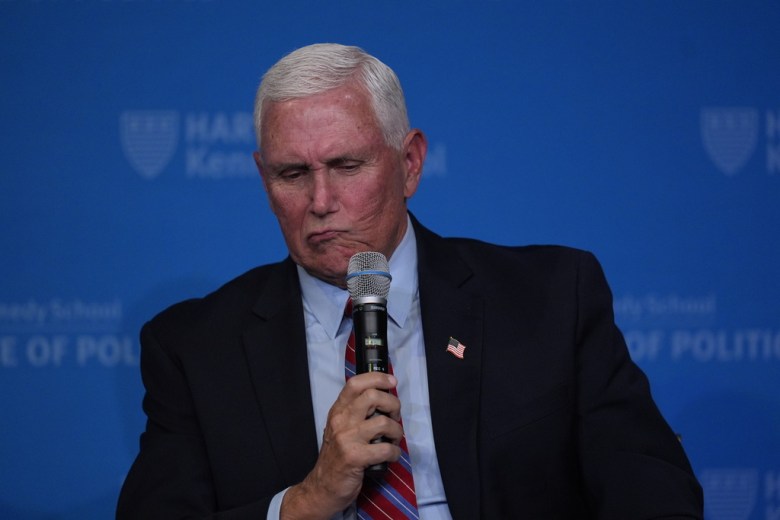
Before he denounced Harvard as “woke” and began ending the Pentagon’s association with the university, Defense Secretary Pete Hegseth received a Master in Public Policy degree from its Kennedy School of Government —as did I.
With my class’s 25th reunion nearing, I’m reflecting on our Harvard Kennedy School (HKS) experience, and how it belies Secretary Hegseth’s characterization of the faculty, curriculum, and students.
While Hegseth alleges that Harvard promotes “globalist and radical ideologies,” this is a caricature. It’s a gross exaggeration of elements of antisemitism and fringe views that exist at many campuses —and that have extreme right-wing counterparts.
My sense of HKS —from 1999 to 2001— was of an exuberant yet earnest, evidence-based and, yes, international hub of learning: global, not globalist. Four in ten students were from outside the U.S., from every continent, with interests from energy and technology to health, economic and human development. Our instructors and curricula were hardly “radical,” with coursework in economics, statistics, budgeting, accounting, leadership, and communications.
I met faculty from Roger Porter —a professor of business and government who embraced conservative values while welcoming students of all stripes— to Jay Walder (CFO of New York’s MTA before teaching budgeting) to Christine Letts, with years in the private sector before focusing on nonprofits.
I learned in seminars from Paul Reville, a former school principal who pioneered education reform in Massachusetts before becoming a national leader in that realm, and Ronald Ferguson, who applied his MIT Ph.D. in economics to teach us to analyze youth and education policy with rigor. Later, Ron Ferguson would launch The Basics, to advance the early childhood field and parent-child learning.
Hegseth hails a narrow “warrior” ethos, but there is also value in the approach of Richard Weissbourd, who has gone on to lead Harvard’s “Making Caring Common” project, which can benefit anyone’s ethical compass.
Other notable faculty included Elaine Kamarck (a proponent of “reinventing government”) and security specialists Graham Allison and Ashton Carter (who eventually preceded Hegseth as U.S. Defense Secretary) —figures more technocratic than ideological. A veteran of three Republican administrations, David Gergen headed the Center for Public Leadership. Robert Stavins documented, for example, that climate change was real —and that it should be addressed cost effectively.
Our dean was the late Joseph Nye, a political moderate known for articulating “soft power” and “smart power,” the virtues of building alliances and integrating nations’ economic interests and security priorities through respect, rather than sheer intimidation.
Like the HKS faculty, my fellow students were not radicals —or elites, in that most had middle-class backgrounds and were striving to give back to the society that had provided them social mobility. Some were first-generation college graduates, and many received financial aid. Then and since, my HKS classmates proved to be public servants in the broad sense, making government, nonprofits, and their communities better. Several classmates had military experience, earning esteem while embarking on careers that employed discipline and organizational skills.
There are too many accomplished classmates to recognize more than a handful, but examples include:
- Erika Alvarez Werner, executive director of City Year Greater Boston;
- Sinan Aral, MIT professor acclaimed as a top “digital thinker”;
- Jean-Martin Bauer, author and humanitarian leader of World Food Program missions;
- Julie Kashen, expert on work and family policy;
- Dr. Raul Ruiz, who also received a Harvard M.D. and M.P.H and became an ER doctor before his election to Congress;
- Michelle Sauve, a leader of the Indian Health Service;
- Doug Shipman, who helped found a national civil rights center and now leads South Arts in Atlanta;
- Rev. Adam Russell Taylor, Baptist minister, author, and president of Sojourners.
My own HKS years included a summer with the start-up New Leaders, which has since helped prepare principals of public schools around the country. That informed my recent role launching an affiliate of a nonprofit that engages volunteer advocates for children.
Like other institutions from the University of Connecticut to Yale, Harvard and HKS specifically are imperfect. On balance, though, they are engines of uplift and illumination, including scientific and medical research. They are forces for good.
Assessment of universities should be guided by facts, not myths or distortion. Harvard’s motto is veritas —truth— something we should all pursue.
Josiah H. Brown received a Master in Public Policy degree from the Harvard Kennedy School in 2001. He has worked in education and child welfare and served in several volunteer roles in his hometown, New Haven.