



The state keeps whitewashing race out of “equity” and the Fiscal Year 2027 budget shows how.
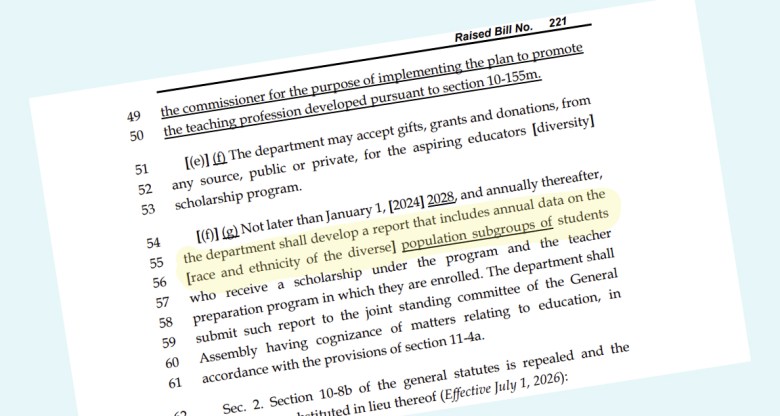
Senate Bill 221’s semantics alongside a $12 million breakfast program expansion paid for with a $12 million magnet/Regional Educational Service Center cut illustrate how Connecticut’s “equity” language can hide racially disparate policy outcomes.
Connecticut’s education inequities are not new. They are measurable, repeatable, and racial. Yet state policy too often substitutes platitudes for accountability.
Start with the state’s own rhetoric. Connecticut loved to say “equity.” But institutions keep practicing the exact opposite. If we can no longer tolerate naming the problem, we will keep choosing policies that preserve institutional racism.
Two current actions, one statutory, one budgetary, expose the pattern:
- Whitewashed ethics vocabulary in Raised Bill 221. The bill revises an educator scholarship program by stripping explicit “diversity” language and explicitly shifts reporting language away from naming race. Instead of direct racial categories, the bill uses Trump safe language such as “population subgroups.” This is a governance choice. When the state evades vocabulary, it evades responsibility.
- A regressive, line‑item trade dollar for dollar trade off in the FY 2027 budget revisions put forth by Gov. Ned Lamont. The state expands universal free school breakfast. On it’s face that is good policy. But the funding mechanism matters: the same revisions also remove $12 million tied to RESC‑operated magnet school, shifting risk and cost back onto the districts that rely on shared services.
Here is the budget’s own math:
Line 17046, School Breakfast Program: $2,158,900 → $14,158,900 (+$12 million).
Line 17057, Magnet Schools: $344,345,603 → $332,345,603 (−$12 million).
In the narrative accompanying the revisions, the $12 million magnet reduction is described as eliminating funds earmarked for RESC‑operated magnet schools and replacing that support with authority for tuition/rate increases shifted to sending districts.
That is not a neutral swap. It is regressive. Universal benefits (already provided to the majority of those who need it) distributed across all districts, including those with the wealthiest families now qualifying for government assistance and shifts the costs onto RESC sending districts which fall hardest on high‑need communities with limited ability to absorb the increased operating costs.
The predictable result is disparate impact. In Connecticut, municipal wealth and race are tightly linked through housing, zoning, and district boundaries. When state policy shifts costs away from targeted infrastructure and toward local capacity, it predictably burdens districts serving disproportionate numbers of Black and Brown students.
This is what the Education Cost Sharing (ECS) formula, was created to fix, but still fails to address the nearly $1 billion yearly racial funding gap. The ECS foundation amount, the per‑pupil baseline used in the formula is $11,525 per student has remained unchanged since 2013. The state can say ‘full funding,’ but ‘full funding’ of a frozen foundation is not an adequate remedy.
A frozen foundation plus insufficient need weights plus a segregated tax bases equals the same outcome: the state claims progress while racially unequal opportunity remains stable.
Connecticut’s history makes the pattern clear. In 1831, New Haven rejected the proposed Black college by a vote of 700–4, many tied to Yale, and violence followed. Two years later, legislators enacted the ‘Black Law’ targeting the education of out‑of‑state Black students unless towns granted permission. Denial was institutional, and it was legalized.
Modern policy rarely uses that language. Instead, it relies on administrative neutrality—while producing outcomes that remain racially predictable.
If Connecticut is serious about equity, the next steps are straightforward and measurable:
1) Restore and protect RESC capacity; do not use it to pay for election year gimmick that hide behind propaganda.
2) Fix. The. Formula. Update ECS by updating the foundation amount to $17,000 and increase the need weights so the formula explicitly closes documented racial funding gaps.
3) Require racial impact accountability for major education and housing decisions; publish the racial effects of each major budget action.
4) Pair school equity policy with fair‑share housing and zoning reform, because housing segregation drives school segregation.
Connecticut cannot fix racial injustice in education finance while refusing to name race in its statutes and while financing universal “wins”by weakening programming targeted for the low income. The state doesn’t need new language. It needs new values.
Joseph Sokolovic is Vice Chair of the Bridgeport Board of Education but writes as an individual. His opinions are his alone.