


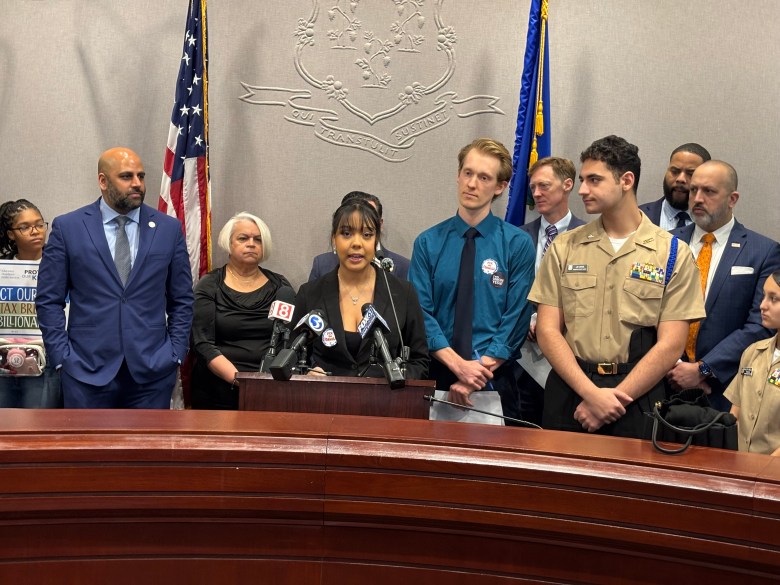
High schoolers from across Connecticut crowded into the state’s Capitol Wednesday to demand legislators act to raise school funding.
Joining them were numerous municipal leaders, teachers and school administrators, as well as Senate President Pro Tem Martin Looney, D-New Haven, and Senate Majority Leader Bob Duff, D-Norwalk. All rallied behind two bills now before the Education Committee, House Bill 5002 and Senate Bill 7, that would raise the state’s Education Cost Sharing grant formula foundation for the first time since 2013.
That formula is how Connecticut decides how much money it should pay individual districts to ensure every student in the state can access a quality education. It’s all built around one number — the estimated cost of educating one student, not including special needs. That estimate was carved in stone in 2013 and has not changed since, even as the real costs for schools have risen drastically.
It’s not the easiest topic to understand, but the students at the Capitol had clearly done their homework.
“Right now, the state’s ECS foundation claims that it costs $11,525 to educate one student. This amount is not based on current data and it does not reflect the real cost of educating a child in Connecticut today,” Danbury senior Zuzana Barnovsky told legislators at an Education Committee hearing Wednesday.
The result, students and other advocates said, is over a decade of financial bleeding. With a static ECS grant, state funding has largely ignored the march of inflation, and towns have had to pick up the slack — either by raising property taxes or capping school budgets. Class sizes in many districts have grown, support services have dwindled and buildings have decayed.
Education leaders have already warned legislators that this year is a breaking point, with some districts saying they have to ask for budgets that could raise local property taxes by 7% or more. Now students are joining the chorus.
“Our classrooms cannot wait another year. Our teachers cannot wait another year. And students like me should not have to graduate wondering why our education wasn’t worth the investment,” Barnovsky said.
She wasn’t the only student who felt that way.
“Many of our school buildings are falling apart. Leaky roofs are dripping into classrooms. Heating systems break in the winter, unreliable air conditioning in the summer, and hallways with ceiling tiles stained or sagging from water damage inside the classroom,” said New Haven senior Diana Robles at a press conference before Wednesday’s hearing.
“These conditions make it harder to learn, harder to focus, and hard to feel like our education is being taken seriously,” she said.
New Haven student Abdelah Ally told legislators that $11,525 in 2013 is equivalent to about $16,000 today. That leaves a blind spot of about $4,500 per student in the state’s ECS calculations.
“Several thousand dollars per student can translate into tens of millions of dollars in operating costs that districts still must manage. Those costs don’t just disappear,” Ally said. As a result, he added, districts have to increase class sizes, delay infrastructure improvements and cut classroom support services.
Danbury Mayor Roberto Alves told legislators the impact of inadequate state funding is clear in his city. Danbury classrooms, he said, often have 25 students or more to a single teacher. By contrast, suburbs are able to keep class sizes under 20.
“You can’t hire more paras (paraeducators) without the funding. You can’t hire more teachers, you can’t hire folks with the expertise to teach the (multi-language) learners like so many of our communities have, without the funding,” Alves said.
Alves, who immigrated to the U.S. from Brazil as a child, offered some personal insight into the impact of instruction for multi-language learners.
“English is my second language, and the reason I speak here like this and nobody would realize that is because we had more resources in the early 90s in Danbury to do these things than we do now, and when you invest in these students, what you get is maybe a future mayor or a future state rep,” Alves said.
He said he has been advocating for changes to Connecticut’s school funding since before he became a mayor. He said this year, the legislature seems to be “closer than I’ve ever seen” to getting the ECS grant updated.

The two bills now before the committee differ slightly in how they would approach the issue.
Under H.B. 5002, the foundation amount — that $11,525 — would be tied to inflation going forward. The bill also phases in additional funding to magnet schools, charter schools and AgriScience programs and eliminates the tuition local districts pay when students enroll in regional schools.
By contrast, S.B. 7 would phase in a fixed increase to the foundation amount before tying it to inflation. It would rise to $12,500 in fiscal year 2027 and $15,500 by 2030, at which point the yearly inflationary adjustment would kick in.
At a press conference, Looney said this is the same approach the state took with minimum wage increases. Doing so is necessary, Looney said, to account for all the years the foundation amount has remained stagnant. He put the cost for fiscal year 2027 at $58 million.
House Republican Leader Vincent Candelora, R-North Branford, and Education Committee ranking member Rep. Lezlye Zupkus, R-Prospect, sent out a press release with their own proposed changes to ECS funding Wednesday afternoon. Their proposal, House Bill 5093, would increase the foundation to $18,581 by 2031, then tie it to inflation. They also want to allow municipalities to lower property taxes as their state funding rises.
It remains to be seen whether Gov. Ned Lamont will support any of the ECS bills. His budget proposal for fiscal year 2027 did not include any changes to the foundation amount, instead proposing the creation of a Blue Ribbon Panel to investigate potential reforms to school funding overall. His veto of certain line items in the recently-passed Senate Bill 298 drew the ire of Senate Democrats this week.
However, Looney said at the press conference that the relationship between the governor and the Democratic caucus was “excellent.”
Duff told reporters ECS will remain a priority this session. “I have a feeling the governor [will] see it our way on this,” he said.
