



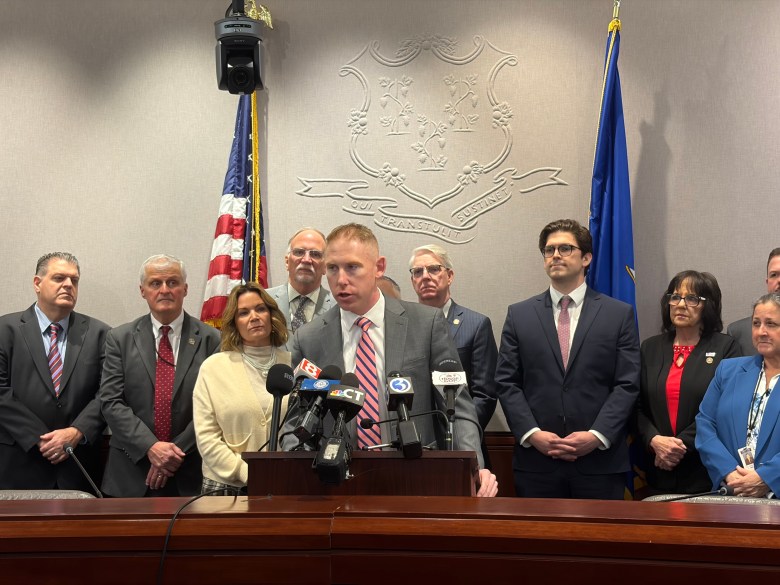
Even in the state with among the highest childhood vaccine uptake in the country, a pair of bills aiming to expand Connecticut’s authority over immunizations drew a swell of opposition at the state Capitol.
A public hearing on the proposals held Wednesday had over 500 people signed up to speak. Several hours into the hearing, the vast majority of those who testified were opposed the measures, calling them examples of government overreach and erosion of religious freedom.
Both bills — one of which, H.B. 5044, came from the desk of Gov. Ned Lamont — would expand the power of Connecticut’s Public Health Commissioner to establish vaccine recommendations, guarantee insurance coverage of recommended shots and purchase doses from sources other than the Centers for Disease Control and Prevention.
Lamont said he aims “to speak clearly on the importance of vaccines” amidst “mixed messages” from the U.S. Department of Health and Human Services under the leadership of vaccine skeptic Robert F. Kennedy, Jr.
“We are going with the traditional vaccination schedule. It’s been endorsed by all those medical groups. No politics. Let’s follow the lead of medical science,” Lamont said during an interview with The Connecticut Mirror.
Connecticut had the highest MMR, or measles, mumps and rubella, vaccination rates in the nation among kindergarteners for the 2024-25 school year.
Earlier this year, the CDC issued a new, tiered recommendation schedule for childhood vaccines, grouping them into three buckets: shots recommended for all children, those recommended for certain high-risk groups and those where decisions should be left up to “shared clinical decision-making,” or conversations between people and their doctors.
As recently as the end of 2024, the vaccine schedule had recommended 17 immunizations for all children. The updated schedule reduced the number of immunizations recommended broadly for all children from 17 to 11. Among the vaccines the CDC no longer recommends for all children are flu, hepatitis A and hepatitis B.
The federal changes have led many states to seek increased authority over their own vaccine recommendations.
As of this January, 28 states, including Connecticut, had announced they would not follow the updated childhood vaccine recommendations from the CDC “for at least some childhood vaccines, instead relying on prior recommendations, state recommendations, and/or those of external entities,” according to a report by health policy research organization KFF.
The bills discussed in the state Capitol Wednesday are another step in that direction for Connecticut.
The state DPH commissioner currently has authority to issue vaccine recommendations — or a “standard of care” — for children. The proposals seek to extend that authority to also include recommendations for adults.
The proposals would also amend the current statute, which only allows the state to purchase vaccines from the CDC, to allow for procurement from other sources. Another major provision would guarantee that state-regulated insurers would cover the cost of any vaccines included in the DPH commissioner’s “standard of care.”
Critics of the proposals who spoke on Wednesday said that even establishing a “standard of care” that doesn’t include vaccine mandates could make it difficult for someone who doesn’t want to get all the recommended vaccines to find a doctor or keep a job. They also see a “standard of care” as a slippery slope toward full-blown mandates.
Republicans and Democrats historically held similar views concerning vaccines. But since the pandemic, trust in vaccinations has eroded along party lines.
As of 2025, upwards of 85% of Democrats agreed with public school vaccine requirements, but only roughly half of Republicans reported the same, down from 79% in October 2019, according to a survey from Pew Research Center.
“I think COVID changed a lot of things for people,” Colchester resident Amber Webster, who is part of the group Connecticut Residents Against Medical Mandates, said. “People just want choice. People want more information. They don’t want to feel like they’re being forced into anything.”
A measure related to religious exemptions for vaccines included in the Public Health Committee Bill, S.B. 450, that’s not included in the governor’s bill, also drew broad criticism.
In 2021, the legislature voted to eliminate religious exemptions from vaccines in schools. But, a state law on the books could pose a potential conflict to that move. The proposal under consideration seeks to clarify Connecticut’s stance against religious exemptions to vaccine mandates in public schools.
“The Connecticut Religious Freedom Restoration Act could be interpreted to reinsert a religious exemption despite the legislature’s clear action in 2021,” Public Health Committee co-Chair Sen. Saud Anwar said.