



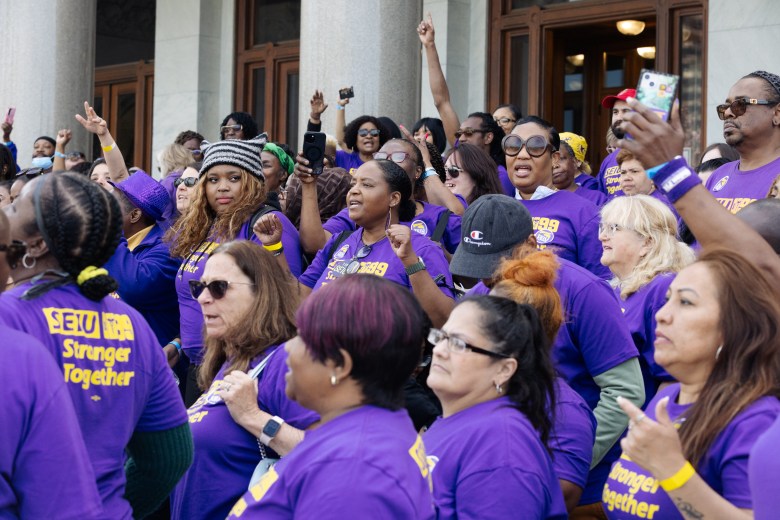
Gov. Ned Lamont recently took a big step toward closing a rift with unionized state employees, reaching tentative deals for raises with 10 more unions.
But with more than half of state government’s 35 bargaining units still eight months overdue for raises and counting, time is running out for Lamont to settle with a key part of his political base.
Union members were scheduled to gather at the Capitol complex late Thursday to remind the governor that the clock is ticking.
“We are not coming out to Capitol tonight to celebrate” the State Employees Bargaining Agent Coalition wrote in a statement.
Members are appealing to the Lamont administration and others that negotiate with state employee unions — such as governing boards for public colleges and universities — to reach “honorable and fair contracts for all state workers that address our need to recruit, retain and reinvest,” the coalition added.
Union leaders and some state agency heads have said it has become increasingly difficult to attract workers to the public sector. Major concessions packages in the 2010s froze wages and weakened health and retirement benefits. The state also shrank its Executive Branch workforce by 10% in that decade, a downsizing that continues to trigger mandatory overtime in certain key agencies.
Minority Republicans in the General Assembly have criticized Lamont, a Democrat, saying the raises he’s negotiated since 2021 have been at or close to 4.5% per year in value and exceed those typically granted in the private sector.
But Local 478 of the International Union of Operating Engineers and the Connecticut Construction Industry Association and recently announced a four-year deal that grants 4.25% annual raises to about 3,000 operating engineers and mechanics.
The administration recently reached tentative, four-year agreements with 10 units that collectively represent nearly 20,000 state employees. The proposed contracts, which are retroactive to last July 1, would grant a yearly 2.5% cost-of-living hike and a step increase for all but the most senior workers. A step typically adds about 2 percentage points to the raise’s value.
Among those workers affected by these tentative deals, which still must be ratified by rank-and-file members and by the General Assembly, are: mid-level administration, clerical, correction officers and their front-line supervisors, vocational and technical teachers, other education professionals, accountants and other fiscal staff, transportation planners, child welfare social workers, and non-teaching professional staff at the University of Connecticut and UConn Health in Farmington.
Lamont also struck a tentative four-year deal two months ago for matching raises with a 4,000-member maintenance union.
And three Judicial Branch bargaining units, representing probation officers, marshals and other staff, won a one-year 2.5% cost-of-living raise and a step hike through arbitration that ended in December.
The governor and the General Assembly back in May awarded a 2.5% cost-of-living raise and a step hike to state police troopers for the current fiscal year. The trooper’s union is the one major bargaining unit not in the State Employees Bargaining Agent Coalition.
Still, more than half the state’s bargaining units still work under wage agreements that expired last July 1.
Lamont, a fiscal moderate, has been pressing unions to modify remote work rules agreed upon during the early years of the pandemic.
But the governor has said several times over the past year all workers will receive good raises, and he also wants agencies and departments to be as productive and as possible.
“The Lamont administration remains engaged in good‑faith negotiations with our labor partners to secure a wage agreement that reflects the commitment of our hardworking state employees,” Lamont’s budget spokesman, Chris Collibee, said Thursday. “Because these negotiations are still underway, we are unable to provide additional comment.”
Legal agreements defining remote work rules for unionized state workers don’t expire for another year, and labor officials say they improve efficiency and should be preserved.
Lamont is seeking reelection this November to a third term. And if he hopes to secure legislative approval of raises for all unions before the campaign shifts into high gear this summer, he likely must present tentative deals to lawmakers before their regular session closes May 6. Legislators traditionally don’t call special sessions in the summer and fall of even-numbered years when most members are campaigning for reelection as well.
