


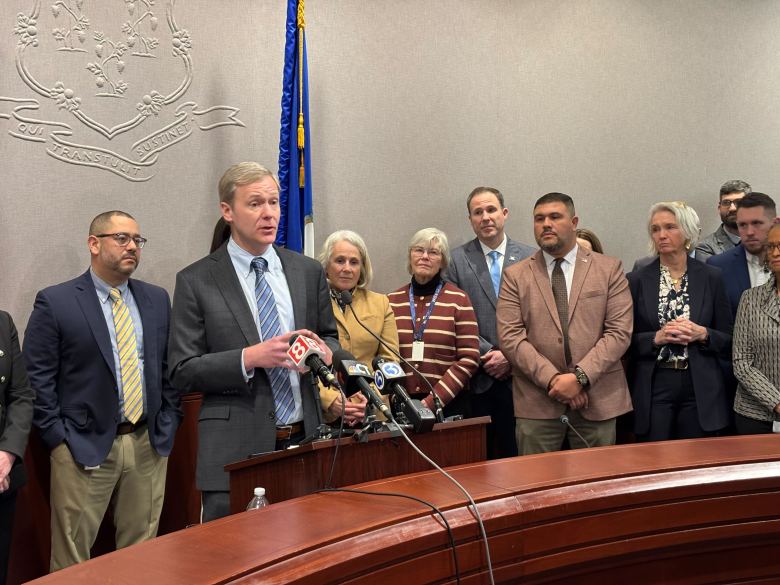
With school districts statewide grimly predicting steep property tax hikes and massive program cuts, House Democrats on Monday proposed $100 million to $150 million in “stabilization” aid.
But while municipal grant increases traditionally enjoy broad-based support, the plan’s fate remains uncertain for one reason: it could shrink Gov. Ned Lamont’s proposed $200-per-person tax rebate this fall by as much as 30%.
That rebate would cost $500 million, and House Democrats say the extra education aid should come from that pool of funds.
“When you don’t give municipalities the support they need, when you don’t get school systems the support they need, their only way to raise revenue is to raise the property tax,” House Speaker Matt Ritter, D-Hartford, said during a late-morning press conference in the Legislative Office Building.
Connecticut is wrapping up a multiyear effort to bolster its $2.5 billion Education Cost Sharing program, the state’s chief operating grant to local school districts. But advocates for education and municipalities say more is needed and complain the program hasn’t kept pace with inflation for more than a decade, costing cities and towns hundreds of millions annually.
That slippage partly stems from an aggressive savings program the state has followed for nearly nine years now. Budget caps force unprecedented surpluses, which the governor and legislature then used to pay down pension debt and bolster reserves.
Critics of this savings effort, including many of Lamont’s fellow Democrats in the House and Senate majorities, say it siphons too much from municipal aid and other core programs including higher education, health care and social services.
“We are at a turning point economically, not just in Connecticut but all over the country,” said Rep. Toni E. Walker, D-New Haven, co-chairwoman of the Appropriations Committee. “And we have to change direction and look at what we’re doing and how we’re going to meet those needs out there.”
Lamont, a fiscal moderate, has been reluctant to tamper with those budget caps.
But he opened the door to change in February when he proposed sharing $500 million from this fiscal year’s projected $1.9 billion surplus with roughly 2.2 million residents. Individuals making less than $200,000 per year would receive $200 and couples earning shy of $400,000 would get $400.
The governor, who hopes to win a third term this November, wants the checks issued in late October, prompting charges from Republicans that the rebate is an election-year stunt.
Still, if the governor can tap the surplus to help low- and middle-income households, House Democrats say they can redirect some of those unspent dollars to help local school districts protect classrooms and avoid property tax hikes.
House Democrats “are committed to working with the administration to find ways to send checks to people, to give real, meaningful reform to middle class and lower income families in the state of Connecticut,” Ritter said.
But whether that involves sharing the full $500 million as Lamont proposed — or through some combination of efforts — remains unclear.
Lamont’s budget spokesman, Chris Collibee, said the governor has prioritized local school aid since he first took office seven years ago and “looks forward to working collaboratively with legislators, local leaders, educators, parents and students on solutions that strengthen our schools, promote greater equity, and ease pressure on property taxpayers.”
The governor himself first suggested scaling back his rebate proposal last week, when he floated the idea of diverting $40 million from the program to finance a one-month suspension of the state’s retail taxes on regular gasoline and diesel fuel. Legislative leaders haven’t acted on that idea to date.
But the administration also isn’t expected to abandon its rebate proposal. If it does support increased funding for school grants, it could ask legislators to shrink the $200 rebate, send it to a smaller pool of taxpayers or both.
Still, preserving funds for some degree of rebate isn’t the only challenge House Democrats face to compromise with Lamont and increase education aid next fiscal year.
The preliminary $28.6 billion budget lawmakers adopted last spring for the fiscal year that begins this July 1 could increase only by about $70 million before exceeding a budget cap that keeps most growth in line with household income and inflation.
The legislature would be in “an impossible position” if it had to cut core services to assist local schools, Ritter said.
Lawmakers could create a fund outside of the budget (and therefore outside the cap system) to deliver this stabilization aid next fiscal year, an accounting gimmick they used last year to increase special education grants to local school districts.
And though officials didn’t outline exactly how they would deal with the cap issue, Rep. Maria Horn, D-Salisbury, co-chairwoman of the Finance, Revenue and Bonding Committee, said the goal is not only to provide extra aid starting July 1 but then to maintain it in future years.
“I want to be able to look people in the eye and say, ‘this is what you can count on going forward,’” she added.
Democratic Rep. Chris Rosario of Bridgeport, one of the state’s poorest cities, said too many districts have already cut their budgets close to the bone.
“We cannot cut anymore,” he said. It’s just pure amputation at this point.”
House Minority Leader Vincent J. Candelora, R-North Branford, offered initial support for the stabilization grants following Monday’s press conference.
“The property tax crisis has reached a fever pitch in communities across Connecticut, and we agree with our House Democratic colleagues that state education funding is at the heart of the matter,” he said. “We’re ready and willing to work across the aisle on solutions that will help municipal leaders deliver quality education in a manner taxpayers can afford.”
Joe DeLong, executive director of the Connecticut Conference of Municipalities, said after Monday’s press conference that “I appreciate the recognition of the seriousness of this issue” by House Democrats.
But while adding $150 million to education aid would be appreciated, it “doesn’t even scratch the surface of the problem,” DeLong added. “Honestly, they should be taking the whole $500 million and putting it into ECS.”
These stabilization grants would be offered in addition to existing bills Democratic lawmakers already have increased to enhance the Education Cost Sharing program further.