2026 is the year of the “Connecticut option.”
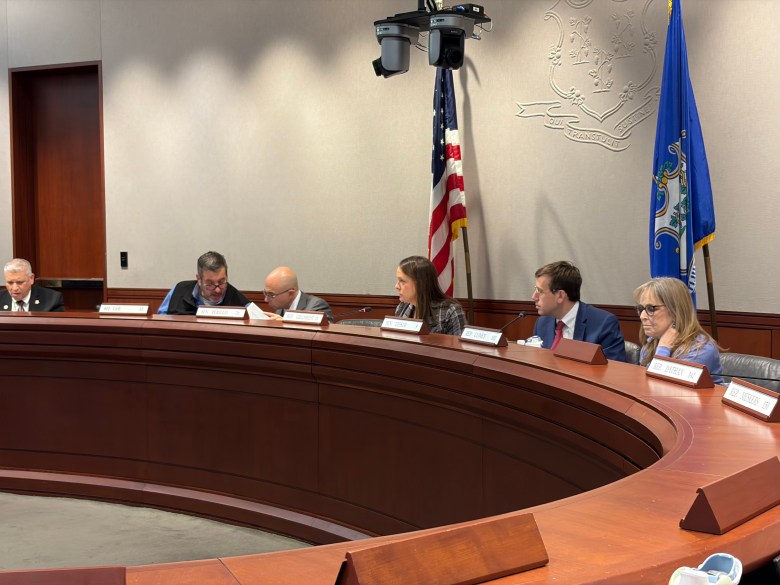
On Thursday, the Human Services Committee passed a Connecticut option proposal put forth by Senate Democrats — separate from the policy proposal by the same name that Gov. Ned Lamont has been touting on the campaign trail and mentioned in his State of the State address in February.
Senate Democrats said the legislation, which comes with a $200 million price tag, is their response to federal cuts to Medicaid and the expiration of financial assistance for ObamaCare health plans.
“This bill talks about expanding health care,” Senate Majority Leader Bob Duff, D-Norwalk, said during a Thursday morning press conference. “Contrast that to what’s happening in Washington D.C., where we see health care being stripped away for millions of Americans.”
This version of the Connecticut option, included as part of a broad Senate Democrat priority bill — Senate Bill 3 — to address health care affordability, would, in the near-term, replace ACA subsidies in full to residents earning up to 600% of the federal poverty level through December 2027.
But the bill also directs state agencies to study long-term solutions to the affordability crisis, including a Medicaid buy-in option, Sen. Matt Lesser, D-Middletown, co-chair of the Human Services Committee, said.
“The bill is trying to solve some short-term issues and then open the door to a conversation around longer term health reform,” Lesser said.
Legislators pitched funding the “Connecticut option,” including the subsidies and other measures identified by the study that win legislative approval, by drawing $200 million from the state’s $500 million Federal Cuts Response Fund, created in November to bolster social services programs threatened by federal government shutdowns and cuts included as part of the One Big Beautiful Bill Act, or H.R. 1.
The Senate Dems’ “Connecticut option” builds on work Lamont has already done or is looking to do, but goes further.
Lamont pledged $115 million in state funding last December to replace expiring federal subsidies entirely for lower-income residents and partially for those earning between 400% and 500% of the federal poverty level, who were set to lose all financial assistance. S.B. 3 would replace subsidies entirely to anyone earning up to 600% of the FPL.
The governor’s proposal this session directs the state Office of Policy and Management to study the feasibility of a “Connecticut option.” Unlike the Senate Democrats’ proposal, the governor has clearly stated that the plan would be designed by the state, but run by private insurers — not a traditional “public option,” where the government administers the plan and bears the financial risk.
Rep. Jillian Gilchrest, D-West Hartford, said she expects that the governor and legislators will spend the remainder of session working through how to bring the two proposals together.
“It’s clear Connecticut needs to take action on health care,” Gilchrest said. “We currently have two proposals on the table — one from the governor, one from the Senate Democrats — which we will negotiate throughout the remainder of the session to ensure we can move this important issue forward.”
In addition to the far-reaching Connecticut option measures, the Senate bill would also establish a “basic health plan” for low-income residents who earn a bit too much to qualify for Medicaid and make use of a previously untapped source of federal funds for hospitals, in return for the facilities limiting out-of-pocket costs and aggressive collection practices for low-income residents.
The proposal was criticized by committee Republicans, who called it a complex solution to a simple problem: The state underpays providers to treat patients with Medicaid, so they are forced to raise costs for privately insured residents to make up the difference.
“Our Medicaid reimbursement rates are among the lowest in the country,” Sen. Jason Perillo, R-Shelton, said. “That is the groundwork around which we need to have this discussion if we are truly going to be intellectually honest about a conversation about affordability.”
For years, physicians and legislators have been sounding the alarm that prevailing Medicaid reimbursement rates are too low, making it unaffordable for health care providers to treat patients with Medicaid coverage, thus decreasing access to care for those residents.
Despite bipartisan support, Lamont has been reluctant to fund broad reimbursement increases.
Last year, he proposed spending $35.4 million to boost rates over the biennium, much lower than the Human Services Committee’s proposal and also less than a House Republican proposal to spend $138 million over the same time period.
The approved budget ultimately allocated $60 million over fiscal years 2026 and 2027 to boost rates for most providers.