



For over 150 years, the Connecticut Agricultural Experiment Station has conducted scientific research and experiments to help farmers diagnose and solve problems with their plants and soil, invasive insects and more.
Now, as the climate warms and farmers face new challenges on all fronts, the state is investing nearly $40 million to update and expand one of the agency’s laboratories in Windsor.
“If you pick an agricultural crop, there’s 10 or 20 different diseases or stresses that will make it difficult to take that crop to yield, and the changes in the climate are making things even worse,” said Jason White, director of CAES.
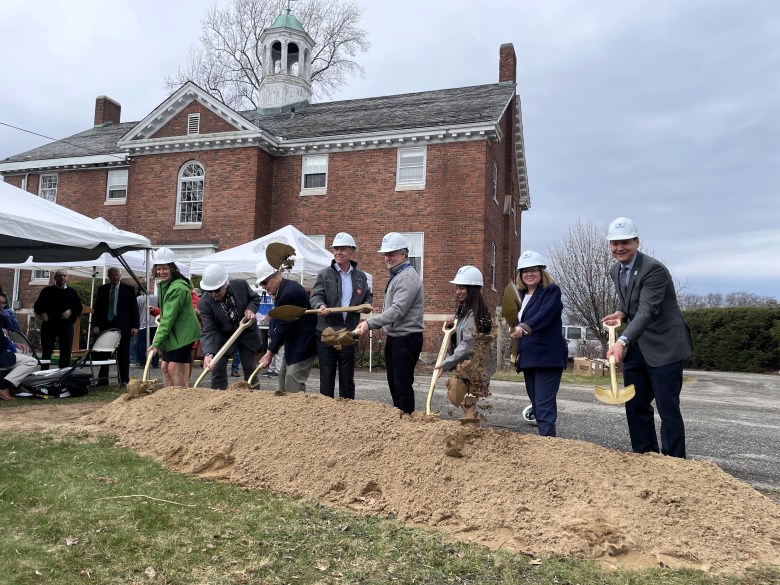
White was speaking at a groundbreaking event Tuesday at the agency’s Anderson-Magnarelli Valley Laboratory in Windsor, where the major renovations will begin later this month.
“The current state of the laboratory really couldn’t support many of the advanced scientific technologies that that have developed and that we need to be doing to support the state, and that includes everything from indoor air quality to agricultural pests and vector borne disease,” White said.
The 87-year-old brick building, crowned with a cupola, lacks the electrical infrastructure and air filtration system required in modern labs, and scientists there have been contending with leaking roofs and mold.
The $37.9 million project includes updates to the original building — including thermal hoods for molecular research and energy efficiency improvements — as well as a 3-story addition of nearly 25,000 square feet of laboratory and administrative space. Modular greenhouses will also be installed.
“This reminds us how hard work farming is, and it’s getting more complicated every year,” Gov. Ned Lamont said at Tuesday’s groundbreaking event.
“We’re trying to do everything we can, being thoughtful and smart, to make sure our farmers have a better chance of staying ahead of the curve,” he said.

The need for scientists
While farming has always been difficult, the changing climate and invasive species have made it increasingly so for Connecticut’s agricultural community.
Many farmers turn to CAES for help when new challenges come up. Each year, the lab’s scientists analyze roughly 6,000 plants and 5,000 soil samples from farmers.
“This is where the agricultural community comes in the northern half of the state,” White said. “Farmers walk in during the day, saying, ‘What’s wrong with my tomato?'”
Terry Jones, of Jones Family Farms in Shelton, is one of those farmers — and serves as one of the station’s board members. Recently, he has dealt with a fungal disease known as anthracnose crown rot in his strawberry fields. “It’s been more of a southern disease, and with the gradual warming, it’s moved up,” he said.
Jones also faces problems with Cryptomeria Scale insects, originating from Asia, which have been feeding on his Christmas trees — causing them to turn yellow and drop their needles. And increasing cycles of drought followed by extreme rain have saturated the soil on his farm, making the trees more susceptible to what’s known as “root rot.”
To address some of those problems, Jones has sought the help of the scientists at Valley Station.
Richard Cowles, one of the station’s agricultural scientists, works with fellow researchers to find solutions. In some cases, other plant species can help.
“One of the activities that we’ve had at the Valley Lab has been to try growing other species of trees that are found in other parts of the world that would have a natural ability to tolerate these cycles of drought or flooding and have much lower susceptibility to fight off the root rot,” he said.
Cowles has also tried intercropping, planting other species, such as asparagus, in between the trees, to improve resistance to disease, and enriching the soil with nontoxic minerals like calcium.
The governor on Tuesday acknowledged that farming amid a changing climate isn’t easy.
“I see an awful lot of drought, an awful lot of flooding and how complex that is for our farmers, doing everything they can in terms of resilience,” Lamont said.
“My heart goes out because it’s a very thin margin for error for a lot of our farms.”
