


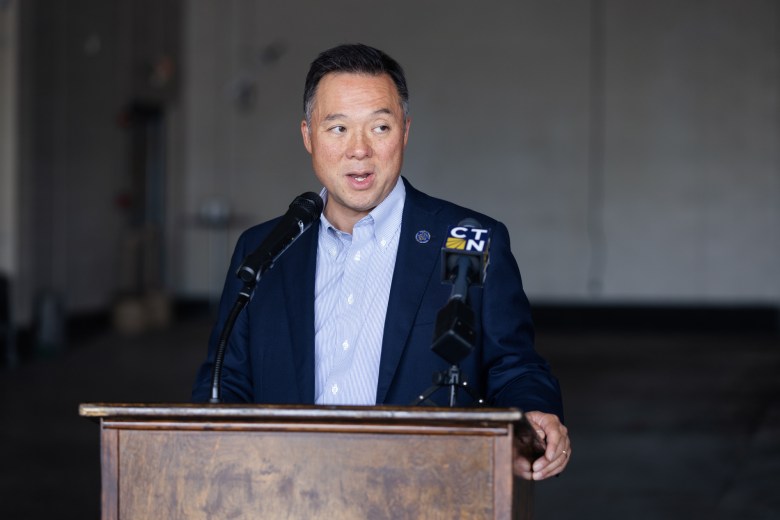
Attorney General William Tong joined a federal lawsuit on Tuesday against the U.S. Department of Education over new limits to student loan borrowing.
Tong argued that the limits could have implications for those looking to pursue certain careers in healthcare such as advanced nursing degrees.
The lawsuit challenges a final rule that sets the definition of professional degrees exempt from tighter loan caps around 11 fields: pharmacy, dentistry, veterinary medicine, chiropractic, law, medicine, optometry, osteopathic medicine, podiatry, theology and clinical psychology. Some of the qualifications stipulate that the degree is a doctoral level with at least six years of academic coursework and requires professional licensure to practice the job.
Those who aren’t covered under the designation — like nurses, social workers and physical and occupational therapists — will be subject to stricter federal student loan caps that will be implemented in July.
The Department of Education argues that Congress tasked the agency “to use a narrow and limited definition” for which advanced degree programs can qualify for higher loan limits. And officials say no program “lost its professional degree classification” under the finalized rule.
Connecticut is one of more than two dozen states suing the department and the Secretary of Education Linda McMahon in U.S. District Court in Maryland. The latest lawsuit is one of a litany of actions against the Trump administration that Tong has joined or initiated over the past year and a half.
Tong and the other plaintiffs argue the final rule published on May 1 unlawfully excludes advanced degree programs that they believe qualify under federal law.
Changes to student loan programs emanate from H.R. 1, congressional Republicans’ tax and spending package commonly referred to as the “big beautiful bill.” The legislation, among other things, imposed limits to federal student loan programs for a range of graduate students and parent borrowers.
Many of these provisions will go into effect on July 1. The Grad PLUS loan program will end after two decades, which currently allows borrowers to take out loans to cover the full cost of tuition regardless of the amount.
New caps will apply to those who want to take out loans to attend graduate school: a $20,500 annual cap and a lifetime cap of $100,000 for a master’s degree. For professional degrees to practice things like law and medicine, there will be a $50,000 annual cap and a $200,000 lifetime cap.
The Education Department finalized a rule earlier this month about how those new caps will apply to students pursuing certain advanced degrees that aren’t covered under the “professional” definition.
Tong believes it will stymie the excluded fields and lead to more worker shortages if borrowers are limited in the federal assistance they can receive.
“We need more nurses, therapists and social workers, and our federal government should be supporting their studies, not defunding them,” Tong said in a statement. “The Trump/McMahon plan to magically drive down education costs by barring student loans defies Congress, defies the law, defies reality, and will do real damage to Connecticut students and workers. We are suing to restore common sense and to force Trump and McMahon to follow the law.”
The Department of Education has defended its new rule and student loan changes, arguing that it will help students not be burdened by significant amounts of debt and will streamline the borrowing process. And the classifications for professional students “do not express a value judgment about the importance of any occupation or field,” according to the final rule.
Officials with the agency framed their push as a way to help lower the costs of college, a departure from the prior administration’s efforts to forgive student loan debt, which was ultimately struck down by the U.S. Supreme Court in 2023.
“After decades of unchecked student loan borrowing that gave schools no reason to control costs, these commonsense loan caps — created by Congress — are already incentivizing colleges and universities to lower tuition,” Undersecretary of Education Nicholas Kent said in a statement. “Clearly, these Democratic governors and attorneys general are more concerned about institutions’ bottom line rather than American students and families’ ability to access affordable postsecondary education.”
Members of Connecticut’s congressional delegation, especially those who sit on committees overseeing education, have taken issue with the imminent student loan changes.
U.S. Rep. Joe Courtney, D-2nd District, who sits on the House Committee on Education and the Workforce, called the exclusion of certain degrees like nursing “one of the most insulting, tone-deaf messages.”
U.S. Rep. Jahana Hayes, D-5th District, a former teacher who sits on the same committee, argued it will affect students who can’t afford such degrees the most, “not the colleges, not the universities, not the board of directors, not the top 1%.”
At a hearing last week before their committee, McMahon sought to address these concerns about the shifts in student loan programs. In regards to the nursing profession, she said an overwhelming majority of those seeking such degrees don’t surpass the new caps that’ll go into place in the next two months.
Reporting from States Newsroom is included in this story.
The Connecticut Mirror/Connecticut Public Radio federal policy reporter position is made possible, in part, by funding from the Robert and Margaret Patricelli Family Foundation.
