




This story has been updated.
On a cool evening in April, a team of high schoolers gathered at the Enfield Town Annex for practice. Bright yellow uniforms in different patterns lined one wall, and banners and awards hung from the ceiling — a record of the local Enfield High School team’s accomplishments over the past three decades.
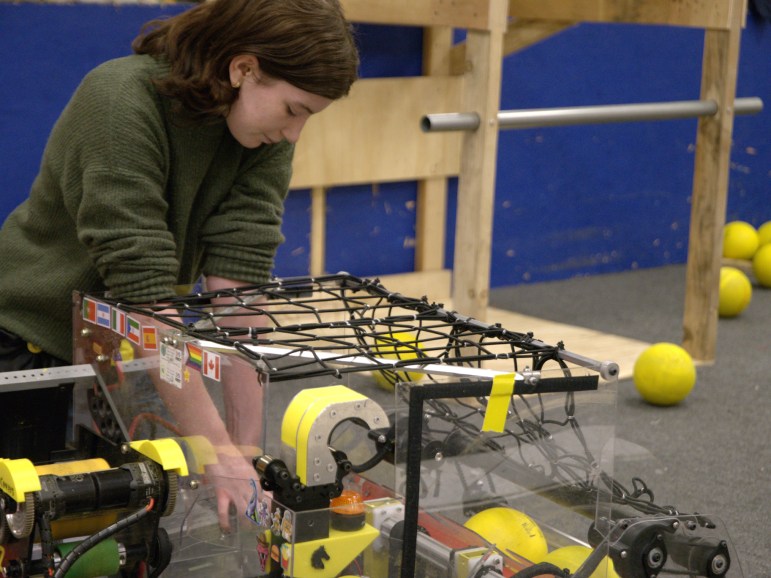
At one end of the field, junior Addison Szczesiul watched as a ball flew towards the goal. But as her team tested out a new shooting technique, Szczesiul wasn’t thinking about her kicking angle or jump shot timing. With a controller device in hand and her teammate scrolling displays on a computer, Szczesiul guided a robot down the field as it fired yellow balls towards a goal.
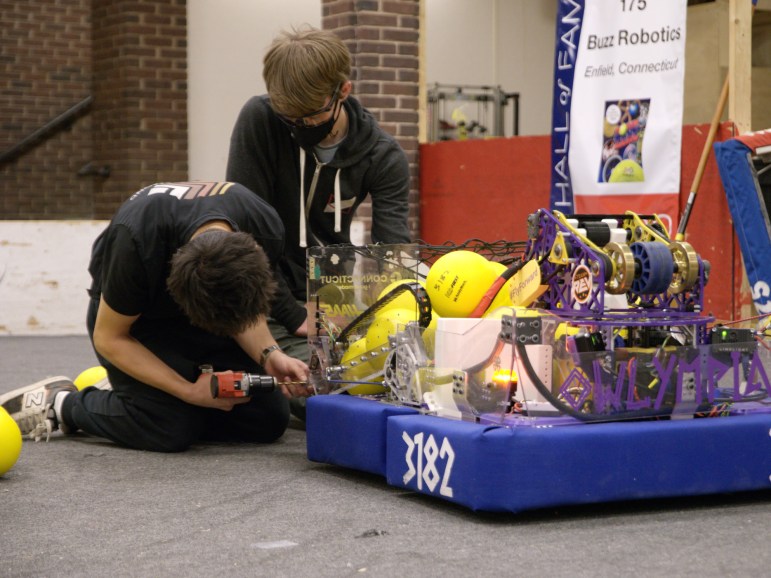
Since her freshman year, Szczesiul has been a member of Buzz Robotics at Enfield High School. She works as the team’s electrical lead, helping with electrical wiring and batteries during robot construction then troubleshoots issues that emerge during assembly. An aspiring electrician, she said joining the team has provided valuable experience.
“I’ve learned how things run and knowing what’s good and what’s bad,” Szczesiul, who also works as a coach for the students who operate the robot during matches, said. “Going into college and knowing I want to major in electrical engineering, this experience is definitely something that I know is gonna help.”
Buzz Robotics, also known as FRC Team 175, is one of hundreds of youth robotics teams currently competing in Connecticut.
The Enfield program has been active since 1996 and is affiliated with the FIRST Robotics Competition, an international high school robotics league that sees thousands of student teams build industrial-size robots, which go head-to-head in a themed game during a competition season every spring.
Youth robotics programs have existed in the state for decades, providing students as young as 5 with the chance to learn engineering, software programming and design skills before they finish high school.
And the programs are growing, supported by new investments from the Connecticut Office of Manufacturing, a division of the state’s Department of Economic and Community Development. Since 2024, the state has put more than $6 million into statewide robotics programming, an effort to build a talent pipeline that can funnel the next generation into the state’s prominent — but somewhat stagnant — advanced manufacturing sector.
“We have a substantial number of engineers in Connecticut compared to other states, and part of that is the very nature of the really complex kind of manufacturing that we do here,” said Michelle Hall, director of the Connecticut Office of Manufacturing. “So we desperately need a steady pipeline of people that are interested in engineering.”
When it comes to developing that pipeline, “I always feel like the earlier the better,” Hall said.
State officials hope the investment in youth robotics will help support the next generation of thinkers and builders in Connecticut and sustain an industry that accounts for more than a tenth of the state’s GDP. At competitions and practices, during matches and in the stands, supporters of the programs point to students — covered in face paint, sporting team uniforms, and full of energy during events — as the future lifeblood of this key industry.
Students, parents and team mentors say robotics programs also meet more fundamental needs.
“They’re learning about leadership, they’re learning about collaboration, they’re learning about communication,” said Michael Fantom, executive director for NE FIRST, one of the organizations that has partnered with the state. “We talk about the robots quite a lot, but it’s way more than the robots. They’re getting something that they might not be getting in other parts of their education.”

For many teams, becoming viable boils down to overcoming two challenges: cost and membership.
Registration to compete in the robotics programs can range from a few hundred dollars to more than $6,000 a season, with travel costs, equipment and other expenses adding thousands to that total. Competitive teams in the region usually spend more, and many established groups have private funders and sponsorships.
Teams also need a steady flow of students to ensure that programs are able to stick around every year. While many teams in the state are school-based, several FIRST teams are community groups, allowing a mix of students from different schools, including homeschooled students, to join. A handful of teams in the state operate under the UConn Extension 4-H youth development program, with students balancing their robotics work with other community engagement efforts.
The state invested in youth robotics programs beginning in 2024, with a second round of funding set to offer support in 2026 and 2027.
“What I found in the first two years with this grant was that as we worked with schools to start new teams — and looked for teachers to stay after school, coach the team and go to competition on a Saturday — I was finding barriers,” said Lisa Nollman, the program manager for CT robotics initiatives for ReadyCT, a nonprofit that works to connect students with career-oriented programs and workforce development opportunities. “It was hard.”
ReadyCT has largely been tasked with managing the robotics initiative in the state, working as a liaison and support organization for teams, schools and interested industry groups. The organization is also in the early stages of a pilot program that would support robotics curriculum programming in a handful of schools in the coming school year.
Nollman says the organization is prioritizing expanding robotics in Connecticut’s underserved communities, a category that includes some of the state’s most populated cities and some of its more isolated rural areas. There are currently 36 such communities, known as “Alliance Districts,” across the state, which educate some 44% of Connecticut’s public school students.
The state has also worked to increase the availability of things like team practice space, ensuring that teams across Connecticut can test their robots before competition.
“Our goal is to get as much exposure as possible to robotics and just STEM technology in general,” Hall said, adding that the state wants to ensure that access is not an issue for any student. “And then to the extent that those students continue to feed their interest in engineering-type careers or pathways, obviously that would be ideal.”
A timely state investment
In February, the Connecticut Office of Manufacturing announced that it was investing $4.8 million into youth robotics and manufacturing programming. Over the next two years, $4.2 million of that money — which comes from the Manufacturing Innovation Fund — will support current robotics teams by covering registration and some competition costs and will also help launch dozens of new programs around the state, providing additional support for robotics curricula and professional development for teachers.
“Robotics education is more than an engaging classroom tool — it is preparing students to excel in the next generation of engineering, manufacturing and technology and providing them with the skills needed to thrive and obtain careers in growing industries,” Gov. Ned Lamont said in a statement announcing the latest investment.
This is the second round of funding for robotics efforts. The Manufacturing Innovation Fund’s initial round of funding dedicated $2.3 million to robotics programming in 2024 and 2025.
The first commitment came after persistent advocacy from members of the state’s Manufacturing Innovation Fund Advisory Board, which is tasked with overseeing the $130 million fund to support advanced manufacturing. Workforce pipeline development and early career awareness efforts are a key part of this work; The MIF is also putting money towards the state’s Manufacturing Career Roadshow for schools and various career and technical education events aimed at students.
The robotics push was largely led by MIF board member Mark Burzynski. While working at the Arthur G. Russell Company, a manufacturer of automated assembly equipment, Burzynski learned about FIRST, which provides interactive STEM education to students years before they step into a college engineering course.
AGR went on to offer practice space and company mentors to a local FIRST Robotics team, known as FRC Team 3461 Operation P.E.A.C.C.E., during the 2010s. A founding student member of the team worked for AGR after graduating college, becoming a mentor for the team.
That provided a “full circle moment” as Burzynski, now retired, recently put it. He said after observing student robotics for years, he was impressed by “the level of skills and the technology that the kids are learning at the high school level.”
Burzynski encouraged the MIF board and then-state chief manufacturing officer Paul Lavoie to offer additional support to the effort. The first round of robotics funding supported multiple new FIRST teams in the state, expanding the program to communities less able to afford competition and registration expenses on their own.
State funding has also gone toward RECF, which includes an in-school curriculum component and is structured for smaller student robotics teams. This past season, RECF supported VEX Robotics competitions in the state, but is launching a new RECF Robotics competition league starting in the 2026-2027 season.
A technical challenge
Two competitive robotics programs have expanded rapidly across New England in the last 30 years.
There’s FIRST, also known as For Inspiration and Recognition of Science and Technology, which was founded in 1989 as a way to support students interested in engineering and the sciences. Started in New Hampshire and inspired by mechanical engineering courses at MIT, Connecticut teams have been part of it since the program’s inception.
The global program currently has around 3,500 competitive high school teams. A few dozen of those are in Connecticut.
FIRST also supports elementary and middle school programming in the state through the FIRST LEGO League, for the youngest students, and the FIRST Tech Challenge, a middle and high school division which focuses on smaller robots. In total, there are close to 300 FIRST-affiliated teams in the state.
Leaders say FIRST is less about building specific math and science skills than it is about helping students to become versatile members of the workforce. The program largely revolves around teamwork and the organizational mantra of “gracious professionalism,” with students regularly navigating cooperation and competition in tandem, building robots in teams and then competing in an alliance vs. alliance format.
“I view ourselves as a robotics mentorship program,” says Fantom, of NE FIRST, the organization that coordinates FIRST programming across New England.
It’s also a good deal for schools, he said. “One of my pitches is: I can bring 700 to 800 high-schoolers to your campus, all with interest in science and technology.”
Where FIRST largely exists as an afterschool program, RECF instead brings robotics into the classroom, with students building and rebuilding their robots over much of the school year. Robots and teams are also much smaller, with the average RECF team having somewhere between three and six students — compared to FIRST teams, which can be as large as 30 students.
There are roughly 350 RECF-supported teams in Connecticut, supporting hundreds of students from elementary through high school. Schools often host multiple teams at once, and students can use a standard parts kit to build their robots, making the program cheaper and easier to start than its older counterpart.
“They’re both looking for the same result, looking for those future engineers, looking for those future machinists,” said William McDonough, the statewide coordinator for the program in Connecticut and a coach for several middle and high school teams in Monroe.
McDonough, a computer science, robotics and engineering design teacher at Masuk High School and a member of the Connecticut Technology & Engineering Education Association, mentored local FIRST teams before pivoting to a different competition program, VEX Robotics, years later. He says that both programs care about developing “our next generation in engineering and manufacturing.”
For Connecticut officials looking to deepen the pool of talent in the state, both approaches are needed. Connecticut’s manufacturing workforce shrunk by more than 140,000 jobs between 1990 and 2024.
Still, marketing the industry to young people can be difficult, as outdated imagery of factory workers and assembly lines still dominate popular depictions of the field. Promoting a revamped image of an industry that now includes robotics, artificial intelligence, and emerging technologies like quantum computing alongside engineering — a new form of manufacturing known as “Industry 4.0” — has faced hurdles.
In 2024, a report presented to state legislators found that the local advanced manufacturing workforce was declining considerably compared to other states, as the workforce aged with fewer young workers to replace them.
A more recent report from the CBIA Foundation argues that one key problem facing young workers is Connecticut’s lack of strong career pathways preparing high school students for the workforce. As the state launches new initiatives, including a career pathways commission to address the effort, youth robotics supporters say their programs can also help.

Engineering as sport
In February, middle and high school students from 30 different FIRST teams gathered at the University of Connecticut for the CT FIRST Tech Challenge State Championship, a chance to compete against one another in this year’s archeology-themed game, called DECODE. The game, which is built for robots no larger than 18 inches, sees students navigate their robots around a small field, using them to score points by depositing balls in various goals and in a certain sequence.
The competition included several rookie teams that received support from the Manufacturing Innovation Fund, and the event served as a culmination of their first year.
“It’s been an invaluable resource, and I would definitely say dollars well spent,” said Julia Cronin, a science teacher and the mentor of FTC Team 31639, Rose City Robotics, a rookie middle school team from Norwich’s Integrated Day Charter School.
Cronin said that the team started after students wanted to work on an old Naval robot that had been donated to the school. Their curiosity about robotics led to Cronin reaching out to ReadyCT for funding support.
The state provided more than money, connecting her with training and development opportunities for coaches. Rose City Robotics currently has around 10 students, and the school is exploring launching a robotics curriculum in the coming months.
“Without the enthusiasm and the interest of the kids, none of this would have happened,” Cronin said.
Students said being on the robotics team offered them a chance to dive headfirst into engineering and design, things that several team members wanted to explore but did not have easy access to.
“I wanted to kind of just mess around with robots, and I just love driving stuff,” said Aaron Santor, a seventh-grader who works as part of the drive team responsible for operating the robot during matches.
Other robotics participants joined new teams after aging out of programs for younger students.
“I did FIRST LEGO League, and then was on a different FTC team, but it kind of fell apart,” said Daniel Hryn, an eighth-grader who now participates on FTC Team 30393, LumensCubed, a rookie community team for students attending schools in southeastern Connecticut. The team, led by a robotics program alum, qualified for the global FIRST Championship this year.
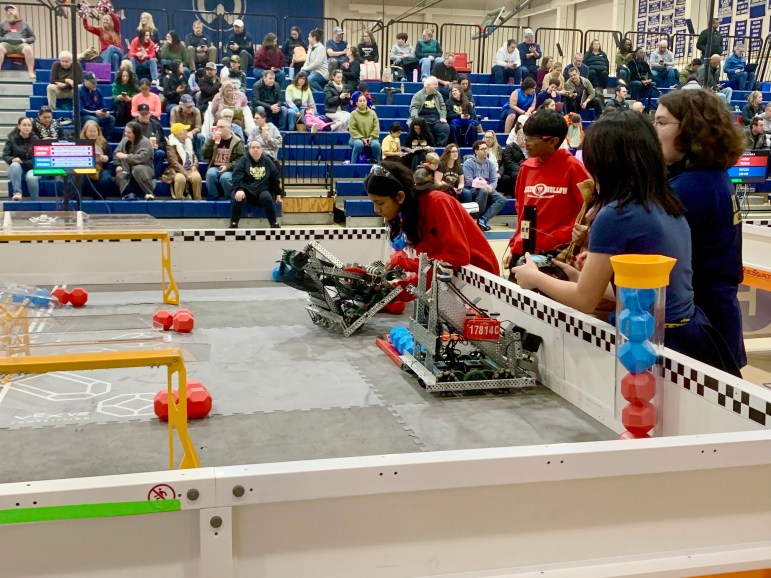
Students competing in the March VEX V5 State Championships in Wilton played a game called “Push Back,” where teams worked in alliances to score different types of goals while strategizing to prevent their opponents from doing the same.
Before running to her team’s next match, Ella Torres, a sixth grader from Simsbury, said she was “really inspired” to join a middle school robotics team after watching her older sister participate in FIRST Robotics programs. Torres is on a 4-H team, the Granby G-4’s.
Many students start competing in robotics at Torres’ age, often staying on through high school.
“Starting from such a young age has introduced us to the thought of robotics and being able to engineer and design over time,” said Ishan Vijay, a Masuk High School freshman who has participated in robotics for three years and is currently a member of one of his school’s teams. “We know that we like this field, that we find it entertaining. It helped me figure out that this is the career I wanted to pursue.”
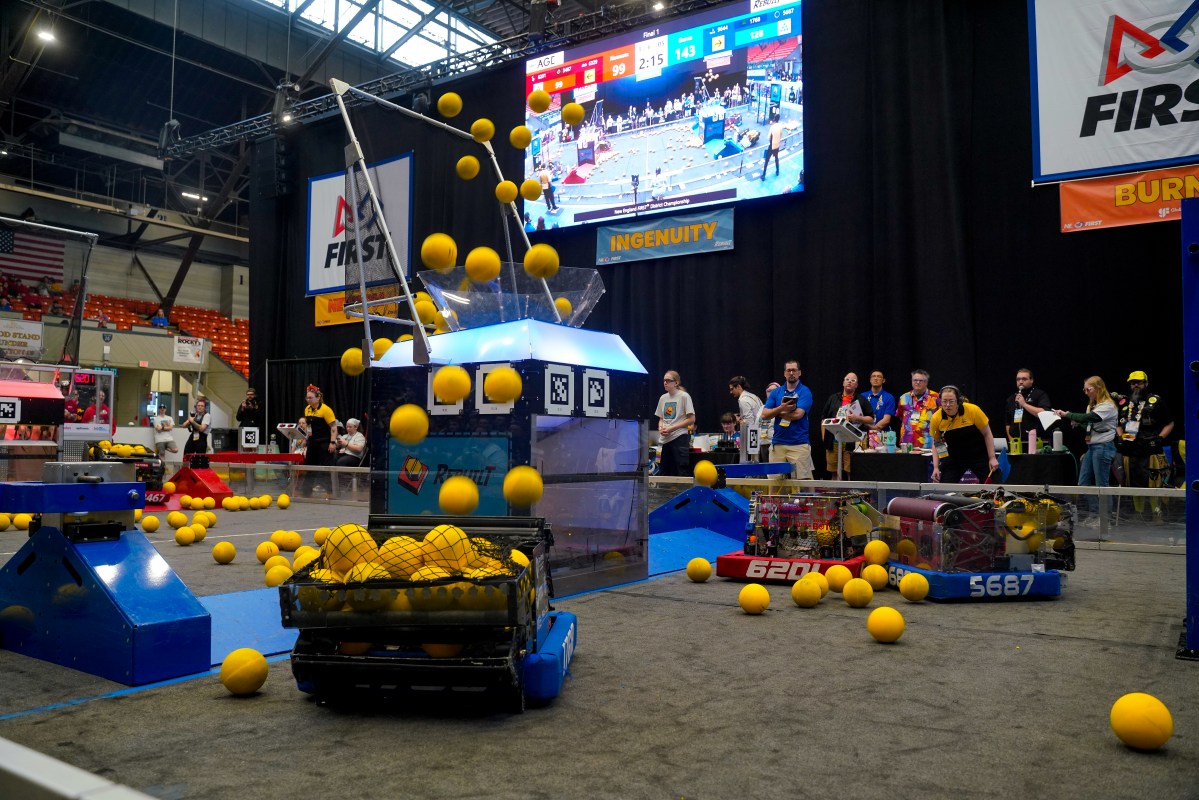
Weeks later in Hartford, hundreds of students gathered for a FIRST Robotics Competition event. The robots this year played a game called REBUILT, with alliances working to score balls in massive goal towers, alternating between offensive and defensive play over the course of the match.
“I can say I found my passion with this,” said Evan Sohn, a junior at Hall High School in West Hartford, and a recent semi-finalist for the FIRST Leadership Award, the organization’s highest honor for individual students. “I don’t think there’s many things in life that I can just lose track of time with, but this is one of them.” He intends to study engineering in college and was named to the CT All-State Robotics Team.
Sohn competes as a member of FRC Team 3182 Athena’s Warriors, a 4-H team based in Hartford. The team includes 28 students from various schools in the Hartford area, and does considerable community outreach, including mentoring a LEGO League team and teaching workshops at the Connecticut Science Center.
One of the team’s mentors, Jerry Bristow, said he’s watched the program transform students over the years, giving them skills that go beyond engineering knowledge, with some team members choosing to focus on graphic design, business and marketing, and community engagement work.
“The quiet one that comes in their freshman years, they go on to lead and do different things,” Bristow, an employee for aerospace manufacturer Pratt & Whitney and the parent of two FIRST alumni, said. “They end up challenging themselves and everybody else.”
For supporters, it’s not about the robots
Other mentors, many of them parents of current or former robotics participants, agreed with Bristow’s assessment, saying they’re inspired by the curiosity and skills they watch students develop through the programs.
“On any given day, you’re going to be competing against and competing with other students, so they’re building relationships across the state,” said Jeff Giordano, a software engineer and the parent of several robotics alums. During the recent competition season, he worked as a judge and judge advisor for local VEX Robotics competitions.
Terry Carllo, the mother of two FIRST alumni from Buzz Robotics, remained active even after her daughters graduated. She helps with fundraising efforts by taking students to community events to drum up support for travel and equipment and by crafting earrings and keychains that the team gives away to other students during competitions.
“I stay because these kids are amazing. They have taught me so much, and I hope that I’ve taught them something, too,” she said.
That sentiment is shared by Art Colling, a Buzz Robotics mentor who has been with the team since the 1990s. Colling lives in Massachusetts, but that hasn’t deterred him from supporting a team one state over. During the season, he drives straight to team practices in Enfield after his work at Collins Aerospace.
“I do this not to build a robot,” he said. “It’s fun, it’s fun to see the results, and if you have some success, that’s great. But it’s the kids I’m here for, the transition from a freshman to a senior. That growth is pretty amazing.”
The mentorship aspect of the robotics programs has also become a valuable way for alumni to give back, with many joining teams as mentors and coaches years after they went through the program.
For Sam Spain, a FIRST alum and the lead mentor of Athena’s Warriors, coming back to support a team has been deeply rewarding. Her involvement with FIRST as an organization has also continued — after stints as a volunteer webmaster and social media manager, Spain joined NE FIRST as its Director of Communications and Advancement.
The additional funding support from the state, she said, has made the program even stronger.
“I think Connecticut has already had that belief that this is important,” she said. “Now they’re putting the funding in to prove it.”
Smells like team spirit
In April, the 100 top FRC teams in New England gathered at the Big E Fairgrounds in Massachusetts for the NE FIRST District Championship, the last in-season competition event held in the region for the year. Teams competed to qualify for the FIRST Championship, a multi-day event held in Houston in May.
The environment was almost indistinguishable from a major sports event. On the second day of the competition, hundreds of high school students milled about in team gear as parents and mentors mingled in the stands, waving pompoms or holding banners to celebrate when student robot operators took to the field. Some students entered with coordinated dances as their teammates cheered from the sidelines.
In a “pit” area, teams hovered around their robots, making last minute adjustments or repairing components that were damaged during a previous match. Members of Athena’s Warriors were easy to spot in the team’s purple outfits, coordinated to match Owlympia, the team’s robot.
For Buzz Robotics, the day was hectic. Students worked in their trademark bright yellow, leaving the stands to adjust components and programming as needed.
During a quiet moment in the pit, Buzz senior Joseph Capasso paused his work to discuss why he was spending the day — which fell during spring break for most Connecticut students — focused on the team’s robot.
Capasso, the team’s CAD lead and a student driver during the recent season, joined the team his junior year. He has long been interested in engineering but wanted to get more hands-on experience. In two seasons, Capasso has been able to do just that, gaining proficiency in computer-aided design, CNC machining and working with tools that he would never be able to access at home.
The team has also provided valuable support to Capasso during his college application process as he weighs what he wants to study.
“I knew I wanted to do engineering in college, and I just heard that robotics was like a good extracurricular activity outside of school, to get experience similar to what I might do in the real world,” he said. He plans to go to UConn and study mechanical engineering.
His team qualified for the division playoffs at the event.
In the coming years, leaders at Connecticut’s Office of Manufacturing hope that more students will be in Capasso’s position. The numbers are on their side: Both FIRST and RECF report that an overwhelming majority, more than 80%, of their participants go on to study STEM majors in college — and a high number pursue careers in a STEM-related field.
The number of FIRST alumni attending UConn is so great that the school has a club for them.
But for ReadyCT’s Nollman, the goal is much deeper than just a job. It’s about expanding access and ensuring that, as the jobs of the future become the jobs of the present, the state has done all it can to get students prepared. And that goes beyond skills.
“Every student I meet is into what they’re doing. They’re excited about it,” she said. “Even if there’s differences in the platforms being used in the state, we are helping students build confidence.”
While the recent robotics season has ended, students are already gearing up for the next one, participating in offseason events and other projects in the coming months. RECF Robotics will begin its inaugural 2026-27 season in the next few weeks, and VEX Robotics, which previously worked with RECF, is also expected to begin its season soon.
FIRST, meanwhile, will start its upcoming biodiversity-themed season later in the summer, with the FIRST LEGO League kicking off in August. The FIRST Tech Challenge will begin in September, and the FIRST Robotics Competition will begin its season in early 2027.
When that happens, students across Connecticut will dive into the latest challenge, ready to build again.
Education reporter Theo Peck-Suzuki contributed reporting.
Correction:
An earlier version of this piece stated an incorrect figure for the size of the Manufacturing Innovation Fund. The fund is currently $130 million, not $75 million.
