



Standing in the lobby of New Haven’s newest workforce development center, Erik Clemons couldn’t help but think about the long legacy of economic self-determination forged in Dixwell, one of the city’s historic Black neighborhoods.
There was the Monterey Club, a local jazz joint that hosted Duke Ellington, Billie Holiday and John Coltrane before closing in the 1990s. Unique Boutique provided clothes and beauty supplies. Dixwell Plaza, an outdoor mall, gave shoppers the ability to pick from a variety of stores all in one place.
At one point, the strip along Dixwell Avenue served as a one-stop-shop, an economic center that covered a variety of community needs.
But in recent decades, that once thriving corridor, just a short distance from the Yale University campus, has been hollowed out, replaced by empty buildings and vacant lots. The last pieces of the former Dixwell Plaza were demolished in 2023.
“I can only imagine how it feels to have such areas of blight here and then look down the street a couple of blocks and see one of the most powerful institutions in the world as a neighbor,” Clemons said.
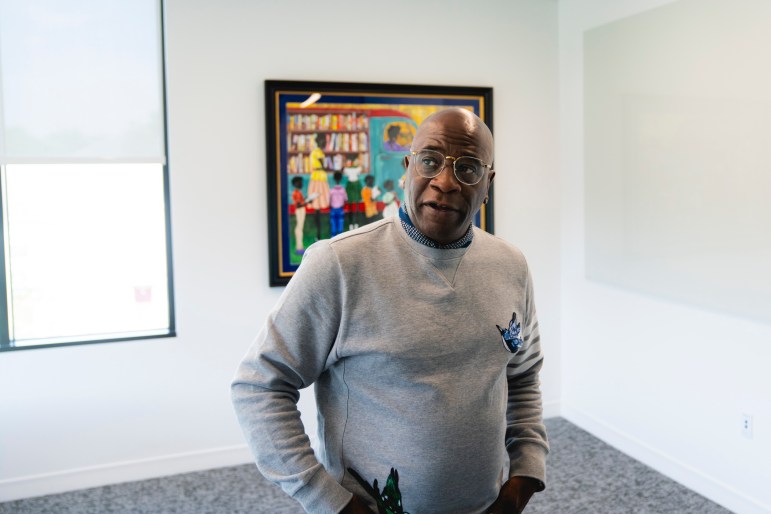
Clemons is the founder and longtime leader of the Connecticut Center for Arts and Technology, or ConnCAT, a nonprofit focused on job training and workforce development. The organization trains residents in New Haven’s historically Black neighborhoods in a variety of skills, ranging from bioscience to culinary arts, phlebotomy and construction.
The programs are no-cost for accepted participants, allowing them to enter with nothing more than a willingness to learn, exiting months later with job skills and certifications alongside a renewed sense of self.
“The work that we’re doing in the community and with the community is addressing poverty while at the same time trying to harvest dignity,” Clemons said.
That push to bring dignity to the community has reached a new phase. For years, Clemons, leader of both ConnCAT and ConnCORP — a sister for-profit organization focused on economic development and business support — has worked to reignite economic engines in the Dixwell and Newhallville neighborhoods. He’s currently at the forefront of an ambitious $200 million redevelopment project spanning roughly 8 acres along Dixwell Avenue, much of it on the former Dixwell Plaza site that includes the new building.
The ConnCORP-led project, known as First HAVEN in Dixwell, would establish a mixed-use development including retail and grocery space, apartments, a performing arts center and a workforce development hub. The project is also expected to bring more than 100 jobs to the area as construction and development work continues.

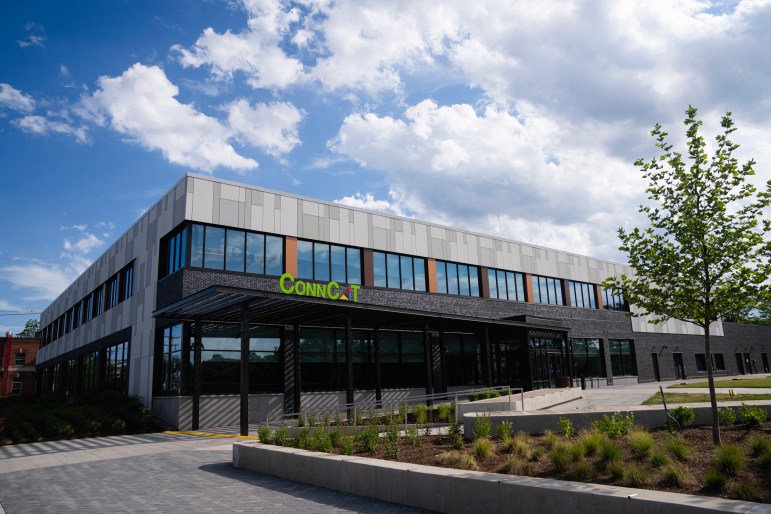
More than six years after it was first announced, the project hit its biggest milestone yet on June 19: the opening of ConnCAT’s new 65,000 square foot headquarters, home to the project’s workforce and youth development programming.
The $65 million building, which also includes space for additional tenants including a childcare center and a health clinic, is part of the first phase of construction project that will see a number of new properties built along Dixwell Avenue.
Before the facility opened, Clemons and other members of the ConnCAT and ConnCORP staff involved in the project told the CT Mirror that the headquarters would help expand the organization’s efforts to rebuild the block and recenter a historically Black community that, despite its resilience, has faced gentrification, disinvestment and limited economic opportunities.
And as the redevelopment project continues, the hope is that ConnCAT, already a community beacon, can become an even stronger hub for the neighborhood around it.
Empowering a community one job at a time
Modeled after the Manchester Bidwell Corporation in Pittsburgh and opened in the early 2010s, ConnCAT has used job training to spur economic empowerment, launching a variety of programs and projects to further build self-reliance and skills.
More than 1,000 people have graduated from its phlebotomy program, with many finding work at the nearby Yale New Haven Hospital. Its culinary graduates start catering businesses and work in local restaurants. And its construction participants have gone on to lead their own projects and pursue their studies further after receiving scholarships.
ConnCAT’s leaders say that the organization focuses on feasibility, tailoring its programs to fields where there is a clear demand for new workers.
In other cases, the training leads to a different type of job offer.
“Some of our graduates finish the training programs, come back and are now employed here,” said Opal Harmon, ConnCAT’s chief administrative officer.

The new facility includes spaces that support this work further, from an industrial kitchen to a bioscience lab that houses BioLaunch, a collaboration between ConnCAT and a Yale University professor. A space for the phlebotomy program includes an area where students can practice needle sticks on dummy arms meant to resemble patients of different ages, skin tones and body types. A recording studio offers a newer opportunity for the organization, giving program participants the chance to create music and shows for the community.
The programming goes beyond job training. In rooms dedicated to youth activities, young people will be able to use a brightly colored studio for performing arts rehearsals and dance practices. A few steps away, a computer lab equipped with new iMac desktops offers a chance to work with newer computers and equipment.
It is a facility meant to support development at various stages, from youth in need of after-school programming to recent graduates trying to find their first job to adults looking to make a career pivot or pull themselves out of unemployment.
But even more importantly to those at ConnCAT, it is a space where people can dream bigger, connecting with not only each other but with the history and culture of the neighborhood around them.
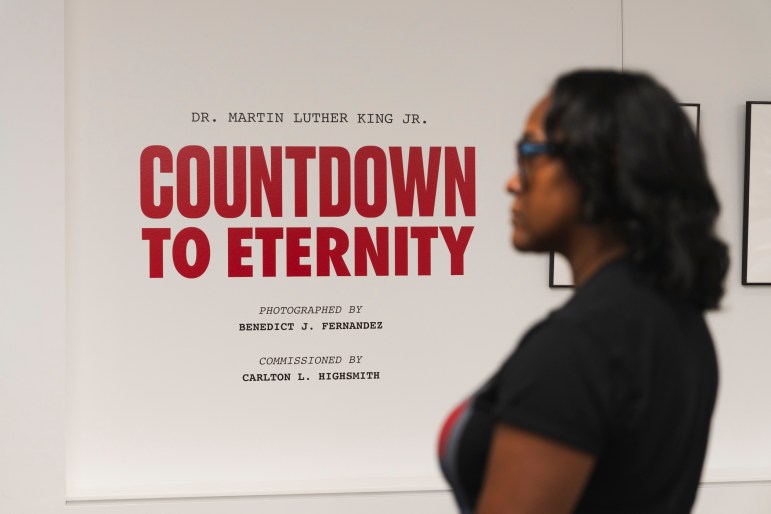
That’s why the space also includes things like “Countdown to Eternity,” a 60-item photo exhibit that depicts the final year of Martin Luther King Jr.’s life leading up to his 1968 assassination. A temporary exhibit in the lobby area depicts the history of the local Dixwell neighborhood. Artwork throughout the building showcases the talent of various Black artists from New Haven and Connecticut more broadly, with contributions from former ConnCAT participants mixed in across the facility.
The point, Clemons says, is to center the community.
“These folks allowed us to come here and do this work in tandem with them, and so at all times we want to honor them,” he said.
A powerful investment
Through its work, the organization is trying to revitalize a part of New Haven that once served as the city’s “Black Main Street” — a mecca for entrepreneurs, community leaders and working professionals.
As factory jobs left the region in the 1970s and 1980s, the neighborhood fell into decline, with businesses moving away or closing down entirely. In recent decades, Dixwell Avenue has been overtaken by blight, and developers were known to buy properties for cheap, not to restore the local community but to turn a profit by reselling spaces when the market swung upward.
That extraction has led to frustration. When Clemons first started on the redevelopment project, a persistent anxiety voiced in the neighborhood was that whatever was constructed wouldn’t be meant for the people there.
“They thought this was a sure threat of gentrification,” Clemons said. “They thought that we were agents of Yale University and that Yale was using these Black people to come and buy properties.”

With the new headquarters and the larger redevelopment initiative, the organization is looking to build something that pumps resources and funding into the community. When fully completed, the project will include a number of retail spaces alongside close to 200 apartments, 20% of them being offered as affordable housing.
The project has been funded by a mix of sources, including private capital, public funding, loans, federal money and grants.
The community has had input about what the constructed buildings will house, with ConnCAT and ConnCORP staffers regularly interacting with residents at meetings and events. And they’ve incorporated feedback into their plans for the development in an effort to keep the community on board.
“We said that if we’re going to make a real impact that’s transformative and powerful, we should start with the Dixwell Plaza,” said Paul McCraven, ConnCORP’s chief operating officer. “We wanted to create something that’s going to be restorative within the Black community.”

But even more than that, Harmon says, is the energy and spirit of service brought by ConnCAT’s work. Like many other staffers, she came to the organization as a volunteer. After leaving the corporate world, Harmon climbed through the ranks, working as Clemons’ executive assistant before pivoting to handling human resource operations. Now in her role as chief administrative officer, she works alongside Clemons to keep the organization running.
“We’re just really excited to see what’s next for Dixwell as a result of this project and us being able to offer more programs,” she said.
That work never stops. ConnCAT and ConnCORP are both involved in finding solutions to some of the biggest economic issues facing marginalized communities in the state, from finding ways to get Black communities connected to Connecticut’s fledgling tech economy and quantum ecosystem, to highlighting the ongoing needs of Connecticut’s Black business owners and testing a pilot for the state’s baby bonds program.
At a time when national policy changes are encouraging a shift away from minority-centered work, supporters say that projects like First Haven stand as examples of continued investments into economic and community development.
“Being a Black-led organization, I think makes a statement that we can do it,” McCraven said. “We can do it if we put the right pieces together.”

Pushing Dixwell into the future, while honoring its past
On Juneteenth, hundreds of people poured into the new building for its grand opening, the community’s first chance to fully explore the facility. Food was served out of the building’s kitchen as culinary graduates prepared hors d’oeuvres for the crowd. Students danced in the studio, and other ConnCAT participants waited across the building, ready to explain how the center had changed their lives.
During the ribbon cutting ceremony, elected officials and neighborhood residents stood side-by-side to commemorate the new space, pointing to the redevelopment project as part of a deeper shift in the community.
“In order for our communities to thrive … we need to build power as a community,” said state Treasurer Erick Russell, a New Haven native. “And that power comes from building wealth over time.”

It’s a point that Clemons agrees with. And as the community redevelopment project moves into its next phase, the CEO hopes that more than anything, Dixwell residents are able to connect with a space that was designed with their needs in mind.
“I think we have been called to build and maintain this space, this building,” he said. “It is an offering to this community.”
