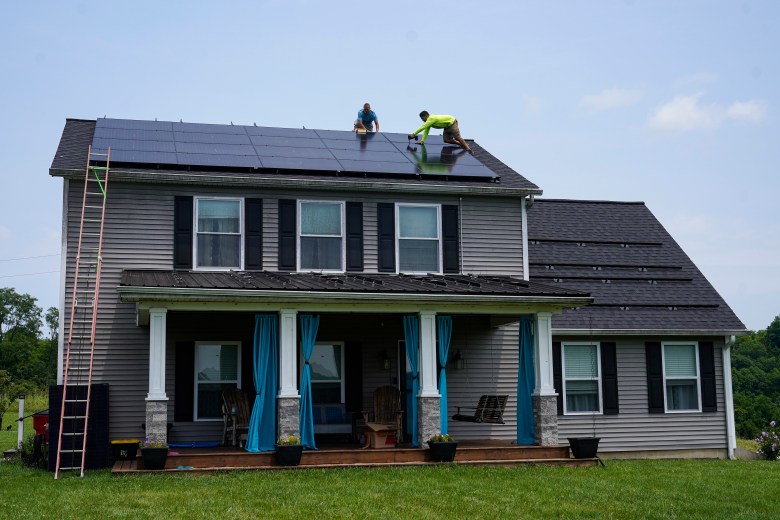
A race against the clock is underway for Connecticut lawmakers to come up with a plan for the future of rooftop solar in the state.
Connecticut’s existing residential and commercial solar programs, established in 2022, are due to expire at the end of next year unless lawmakers vote to reauthorize them. House Bill 5340 would extend both programs, as well as related community solar and battery storage initiatives.
But the bill was still a work in progress Monday, as its proponents worked to hammer out language aimed at keeping the costs of solar development from ballooning. At the same time, the legislation has become a vehicle for lawmakers seeking to advance other provisions on solar permitting and the development of large, grid-scale arrays.
All those moving parts left the bill’s primary author, state Rep. Jonathan Steinberg, D-Westport, rushing to come up with a final draft that can pass through both chambers before the legislature adjourns this year’s session on May 6.
“Every time I think I have it put to bed, it springs another leak,” Steinberg said in an interview Monday. An initial vote on the bill could come as soon as Tuesday in the House, he added.
Solar advocates are fearful that rules and limitations on the development of rooftop solar could hobble an industry that is already reeling from the loss of federal tax credits and President Donald Trump’s general hostility toward renewable forms of energy.
But Democrats in the legislature — including those who have long advocated for expanding solar power — say they need to be conscientious of costs at time when customers are dealing with higher utility bills.
“We have framed this legislation, which is really pretty important, in that it defines our strategy for solar going forward for a number of years,” said Steinberg, who serves as co-chair of the legislature’s Energy and Technology Committee. “But it’s all predicated on being fiscally responsible to ratepayers and containing costs.”
Connecticut’s current solar strategy includes programs setting deployment targets and establishing compensation rates for both residential and nonresidential solar customers. In addition, the state has a “shared clean energy facility,” or SCEF, program to help develop solar and other renewable energy projects and make them available to renters or other customers who lack conventional access to rooftop panels.
All three solar programs are managed by the state’s two investor-owned electric utilities, Eversource and United Illuminating. The costs of running the programs, and of compensating the owners of solar panels for the power they produce, are passed along to customers through the public benefits charge.
A fourth program, administered by the Connecticut Green Bank, provides incentives for solar customers to purchase battery storage systems and is also funded by the public benefits charge.
Containing costs
In February, the state’s Public Utilities Regulatory Commission released a report recommending that lawmakers make several changes to each existing solar program before allowing them to continue.
Among the changes PURA recommended was a reduction in the compensation rates for solar panel owners who export power onto the grid. That would incentivize more owners to purchase batteries to store excess power until periods when solar output is lower, such as in the evenings, thus reducing overall demand on the electric grid, the report said.
The report also recommended placing monetary caps on commercial and community solar projects to help control costs. Currently, the rollout of those programs is kept in check by output-based caps of 100 megawatts for commercial solar projects and 50 megawatts for SCEF projects. There is no annual cap on the residential solar program.
The idea of capping the cost of the solar programs is supported by the state Department of Energy and Environmental Protection and the state’s Office of Consumer Counsel, which advocates on behalf of utility customers.
But solar companies say they’re being unfairly singled out at a time when energy prices are rising for many reasons — including the volatile price of fossil fuel.
“We understand cost containment and affordability, we get all that,” said Mike Trahan, the executive director the Connecticut Solar and Energy Storage Association. “We remain disappointed that the benefits side of solar is not being discussed in any corner of this bill, just the cost side.”
The bill’s budget target also comes on the heels of PURA’s decision in December to reduce payments made to solar owners for exporting power onto the grid, in order to better align the cost of those incentives with the state’s electricity prices.
Trahan said the benefits of solar include lower supply costs and less strain on the electric grid, which reduce the need for costly repairs that get passed along to customers through utility rates. He also criticized the process by which H.B. 5340 has gone through multiple revisions in recent weeks, growing in size from 18 pages in March to 41 pages as of Monday.
“The debate that’s occurred between the bill that came out of committee and [the bill] now is largely — well, is entirely — behind closed doors,” Trahan said. “The bill’s doubled in size and it hasn’t been a public process.”
Still, the latest draft of the bill that was circulating Monday managed to address some of the most serious concerns that had been raised by solar advocates. That included the removal of language that some had said appeared to require owners of solar panels sell all of their output to the local utility company — instead of using some of it to meet their own energy needs.
Steinberg said the bill would establish a “budget target” — as opposed to a hard cap — of $85 million annually for solar, while allowing PURA to determine how to adjust or divide those costs between the three programs. Steinberg said the cap would represent about a savings of about 10% off the current cost of those programs.
(A spokesperson for PURA said the cost of all three solar programs was around $118 million in 2025.)
Residential solar systems that are paired with battery storage would be exempt from the total budget target, in order to further promote the growth of battery storage. Steinberg said that PURA would be able to adjust the target by up to 5% each year in response to market conditions.
“I think it is generally workable,” said Kyle Wallace, senior director of public policy for solar developer Sunrun. “That’s not to say we don’t have our own issues that we’re still trying to get modified in the bill, but I think it’s certainly better than prior versions.”
Jamie Ratliff, a spokesperson for Eversource, said that while the utility supports continuing the state’s solar programs, their costs have risen dramatically over the last decade. Even with an annual budget of $85 million, she said, the costs would be compounded each year because the utilities would have to compensate new panel owners through long-term contracts. After seven years, she said, those costs would add up to roughly $595 million annually.
“Any extension or expansion must include robust safeguards, such as maintaining competitive bidding processes to deliver the best price for the commercial projects selected, reducing compensation rates for residential projects, and maintaining clear budget caps for the programs,” Ratliff said in a statement.
A spokesperson for United Illuminating declined to comment on the legislation. But in written testimony submitted on an earlier version of the bill in March, a lobbyist for the company similarly raised concerns about the costs of the programs.
Steinberg accused both companies of spreading an “irresponsible narrative” that focused on six- and seven-figure sums spread out across many years. He said that other than installing a target budget, the bill wouldn’t change how program costs are calculated.
“We’ve been using this same basic framework through the existing programs,” Steinberg said. “This is a totally new propaganda effort on their part. I think it’s part of the ‘Don’t blame us’ strategy that these utilities have adopted.”
State Rep. Tracy Marra, R-Darien, a ranking member of the legislature’s Energy and Technology Committee, described the negotiations between the committee’s leadership as cordial but said that Republicans were unlikely to lend support for the final product when it comes up for a vote.
“It’s not a route that we’re going to be throwing a lot of support on because it’s most likely going to be adding to the public benefits charge,” Marra said.
A spokesperson for DEEP declined to comment on the legislation, citing the ongoing state of negotiations.
From grid-scale to plug-in
One potential late addition to the bill could come from state Rep. Jaime Foster, D-Ellington, who is pushing for language that would enact a moratorium on further large-scale solar developments in the town of East Windsor, home to the 120-megawatt Gravel Pit Solar project and several smaller arrays.
Foster took Gov. Ned Lamont on a tour of the solar facilities within her district in early April, and she said in an interview Monday morning that she had a “tentative” agreement with the governor’s office on moratorium language. Steinberg confirmed the language was being discussed but said the moratorium would be limited to one year and would not apply to projects that have already been approved.
Late in the day Monday, Foster said in a text message that the proposal “went south” and she was scrambling to include it in the final draft of the bill.
William Herchel, chief executive of West Hartford solar developer Verogy, said he was lobbying lawmakers to ensure that any moratorium provision not be applied retroactively to projects that are under development. He said his company is currently involved in solar projects in Windsor and Ellington, adjacent to East Windsor.
“It’s one thing if you just signed a lease a month ago,” Herchel said. “It’s another thing if you sign the lease, you started the interconnection process, and you actually have obtained a contract with [the utilities] through these state-run programs.”
Asked for comment on Monday, Lamont spokeswoman Cathryn Vaulman said in a text message that “The administration continues to engage in productive conversations with lawmakers on HB 5340 as they work towards a solution that balances the state’s energy needs with local concerns in East Windsor.”
The bill also includes a provision allowing electric customers to use plug-in solar panels with an output of up to 1,200 watts without the approval from their utility. If passed, Connecticut would join Utah and Virginia as one of the first states to eliminate regulatory barriers for plug-in solar.
While the concept has attracted bipartisan support within the legislature, utility officials have raised concerns the devices could cause issues with anti-tampering devices installed on many meters.
As a result, customers could end up getting charged for the excess power produced by the panels, utility officials warn. To address those concerns, the bill would require any plug-in solar devices be certified by a national product safety group. It also recommends regulators update state building codes to recognize the devices.
Steinberg said on Monday that he’d also agreed to include new language taken from another bill put forward by Lamont that would create an statewide online platform to streamline the permitting process for installing residential solar panels.
The idea has strong support from within the solar industry, as well as environmental groups.
“As we’re looking to make the next generation of these solar programs even more cost-effective for ratepayers, one of the ways you do that is by finding ways to reduce these these costs and red tape so that we can build the projects cheaper,” said Wallace, of Sunrun.