What’s in a name? Will a state “minority business revolving loan” program still serve the same function if its target audience is redefined in law as businesses in “historically underserved communities”?
Those were the questions Wednesday night when Senate Bill 307 sped through the Senate and House on the last night of the session. It scrubs racial references from state economic development programs.
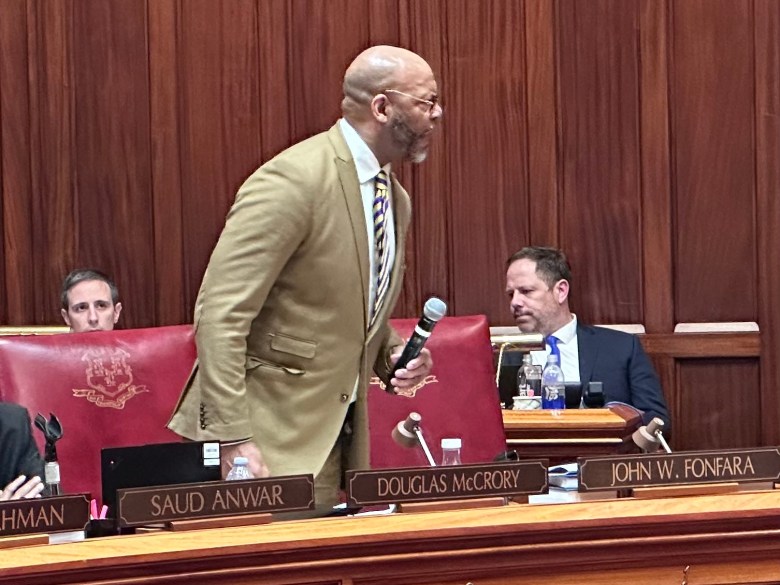
Sen. Gary Winfield of New Haven and Sen. Doug McCrory of Hartford, both of whom are Black, responded sharply, though they ultimately voted for it. In the House, the chair of the Black and Puerto Rican Caucus, Rep. Antonio Felipe of Bridgeport, was grateful of efforts made to keep the mission intact, if under new names.
The bill is a reaction to the Trump administration’s hostility to policies based on race or gender, as well efforts to erase or downplay references to Black historical figures in museums or Arlington National Cemetery.
“I don’t like the fact that we even have this bill,” Winfield said during the debate. “I don’t like the fact that minoritized populations are disappearing out of our statutes. They are disappearing off our web sites. They still exist.”
McCrory was louder, angrier.
“I’m sick and tired of always having to compromise, to make other people happy. I’m sick of it,” McCrory said. “It’s what’s been happening in this country since people have been brought to these shores. We’ve been compromising, compromising to make others happy.”
McCrory was yelling.
Gov. Ned Lamont was on a glad-handing stroll through the House and up one floor to the Senate when he stopped, watching an angry McCrory punch the air as he spoke. Senate Majority Leader Bob Duff, D-Norwalk, came out to greet the governor and deliver a curt message: Not a good time.
Lamont and Duff chatted. The governor left without entering the chamber.

Downstairs, Felipe sounded a different tone when the bill was called for a vote, thanking the Department of Economic and Community Development and the leaders of the legislature’s Commerce Committee for adding new language as they removed the word “minority.”
“We are removing that word and making sure these programs are not based on race or gender, but they do recognize the diversity in our communities,” he said.
Rep. Stephen Meskers, D-Greenwich, co-chair of the Commerce Committee, said he believed that Felipe’s comments and the unanimous votes in both chambers showed a recognition of the “good-faith effort to come together and achieve the best result.”
Winfield, who participated in negotiations the resulted in improvements to the bill, said it nonetheless resulted in a loss to minority-owned businesses, which are no longer the focus of a program that had served them well.
“It fundamentally is a different thing,” Winfield said.
No longer will DECD “provide loans to eligible small businesses that are owned by one or more members of a minority,” but they will on the basis of certain census metrics, among other data points.
Don’t ask any more about a “minority business revolving loan.” But you might inquire about a “Connecticut opportunity fund.”