In just four months, Connecticut lawmakers managed to pass a slate of measures this year that tackle some of the state’s most critical health issues.
Unlike last year, when much of the legislative debate focused on responding to sweeping health policy changes at the federal level, lawmakers honed in on achieving progress on several Connecticut-specific issues they’ve been working to tackle for years with limited success.
Sen. Saud Anwar, D-South Windsor, said the 2026 session marked the culmination of years of work.
“Policy is a process,” Anwar said. “The bills that we weren’t able to pass in the past, we were working on a process to get enough collective wisdom across the House and the Senate and the governor’s office to make this happen.”
Certificate of need
In an era of peak partisanship at the national level, Connecticut lawmakers on both sides of the aisle have for years agreed that the state’s approval process for major hospital transactions — like mergers and acquisitions — needed a major overhaul.
Calls for reform to the process, known as the “certificate of need,” escalated after it took the state’s Office of Health Strategy 16 months to approve a deal for Yale New Haven Health system to purchase three Connecticut hospitals from the now-bankrupt hospital operator Prospect Medical Holdings. The transaction eventually fell through, and many people blamed the failure in part on OHS’s delayed approval.
For years, lawmakers tried and failed to amend the certificate of need process to make it less cumbersome for hospitals while protecting patient access. This year, the legislature passed a measure backed by Gov. Ned Lamont to disband OHS, move approvals under the purview of the Department of Public Health and change the process to allow for quicker reviews.
One change approved this year removes a requirement that hospitals apply for state approval before terminating a service. Hospitals now must simply inform the state of the closure, in advance, and present a plan to maintain patient access.
In the past, some hospitals bypassed seeking advance permission for terminations, shuttering services and applying for state permission retroactively — by which time reopening the units was nearly impossible. Services in rural parts of the state have been particularly affected by such closures.
Rep. Tammy Nuccio, R-Tolland, called removing the approval requirement for service terminations a step in the wrong direction.
“Why would we make it easier for these hospitals to buy up and close rural hospitals?” she said.
Lamont spokesperson Cathryn Vaulman said the governor’s proposal acknowledged that the current termination process wasn’t working, and she said the changes are meant to focus on “patient care and access.”
“The new process requires advanced notice to the state, allows for public input on the needs of the community, requires a plan for continued access to care and enables DPH to impose conditions on the termination to ensure access,” Vaulman wrote in a statement.
Connecticut Hospital Association vice president Paul Kidwell called the governor’s proposal “thoughtful,” adding that the changes will help hospitals “meet the evolving needs of local communities” and “focus resources to support” high-quality care.
Private equity
Legislators have sought reform on private equity investment in healthcare following the deterioration and bankruptcy of three Connecticut hospitals under the ownership of Prospect Medical Holdings, a formerly private equity-backed operator. But for years they struggled to reach consensus on how to tackle the issue.
This year, private equity proposals from both the governor and the legislature passed. The proposal from lawmakers — Senate Bill 196 — prevents any private equity investor from owning a majority stake in the main campus operations of any hospital and from any involvement in a hospital’s clinical decision making. It also prevents hospitals from selling the buildings of their main campuses
A proposal from Lamont that was included in the budget lawmakers approved, will increase oversight of private equity investors through the certificate of need process.
The progress was well-received by most lawmakers. But practicing physician Sen. Jeff Gordon, R-Woodstock, said what the state really needed was legislation prohibiting private equity investment in hospitals altogether. S.B. 196 allows private equity operators to have a minority stake in hospitals or a majority stake in hospital operations apart from the main campus, like outpatient surgical centers.
“To ban [private equity] only at the main campus and not ban it elsewhere in the hospital assets? Completely wrong,” Gordon said. “It’s a huge giveaway and a loophole.”
Medicaid reimbursement rates
Another measure in the budget will raise the rates at which the state pays health providers to treat patients with Medicaid insurance, known as HUSKY in Connecticut. But many legislators said the funding doesn’t go far enough.
In the biennial budget passed last year, lawmakers had earmarked a $30 million increase in funding for Medicaid reimbursement rates in fiscal year 2027. This year, they passed an adjustment to add another $30 million in FY 2027.
But this year’s increase will almost entirely net out next fiscal year with a one-time cut of $25 million to generate savings for the woefully over-budget Medicaid program. When all is said and done, this session will result in a net increase of $5 million for Medicaid reimbursement rates in FY 2027 over what was already budgeted.
Rep. Jillian Gilchrest, co-chair of the Human Services Committee, said that won’t meet the demands for higher rates from legislators and providers.
“Not increasing rates is impacting the workforce and access to care,” Gilchrest said. And though she won’t be returning to the legislature next year, she added: “The work’s not done.”
Rep. Jay Case, R-Winchester, echoed Gilchrest’s comments during a House floor debate.
“These are our people who take care of our most vulnerable. We know what we have to spend,” Case said, adding that rates haven’t increased in over a decade.
Case cited a two-part study commissioned by the state that found Connecticut underpays its Medicaid providers compared to peer states. Department of Social Services Commissioner Andrea Barton Reeves has said that implementing all the rate increases recommended in the study at once would cost an estimated $300 million.
But Gilchrest’s Human Services Committee co-Chair Sen. Matt Lesser, D-Middletown, said the funding marks progress, even if more is still needed.
“I would have liked to have done more for sure, but this is a pretty good step forward,” Lesser said.
Vaccines
A bill to expand Connecticut’s vaccine authority in light of federal changes to immunization policy served as the one notable exception to this year’s focus on state-level issues. A marathon public hearing in March drew over 500 people, with most speakers testifying in opposition to the bill, calling it government overreach and an erosion of religious freedom.
Despite the heated criticism from both the public and Republican lawmakers, Democrats flexed their majority muscle and the bill sailed through to Lamont’s desk with over a week left to go in the session.
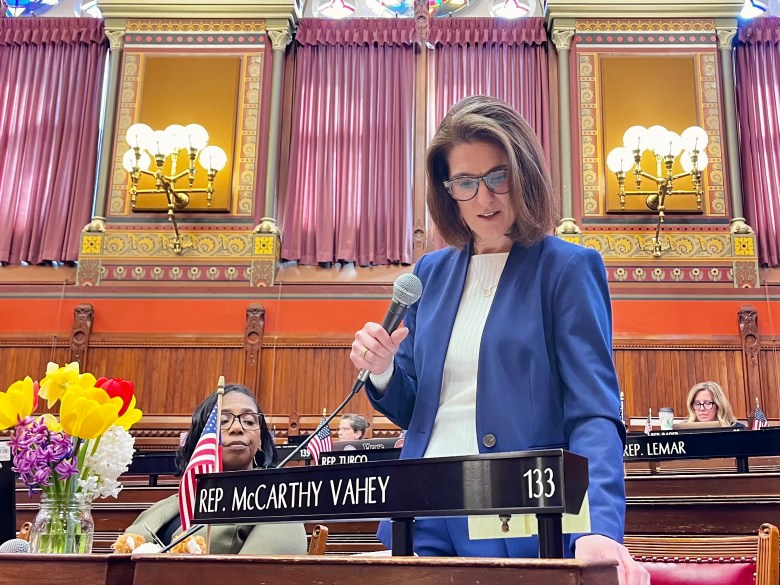
Public Health Committee co-Chair Rep. Cristin McCarthy Vahey, D-Fairfield, said the bill was a priority for both Democratic lawmakers and the governor.
“There was a sense of urgency, a sense of priority and a sense that this is a bill that is actually going to help save people’s lives and to prevent disease,” she said.
The legislation will expand the power of the state’s Public Health Commissioner to establish vaccine recommendations for both adults and children, guarantee insurance coverage of recommended shots and allow the agency to purchase doses from sources other than the U.S. Centers for Disease Control and Prevention.