



.
After 15 years fighting for free and fair elections in the Middle East, I thought nothing could surprise me about how power protects itself. Then I became an American citizen in 2024, just in time for the fall election, and looked closely at my own district for the first time.
What I found was baffling: If you are under 54 today and live in Connecticut’s 3rd Congressional District, as I do, you have never had a meaningful choice for your representative in a Democratic primary. In 35 years, there has never been one.
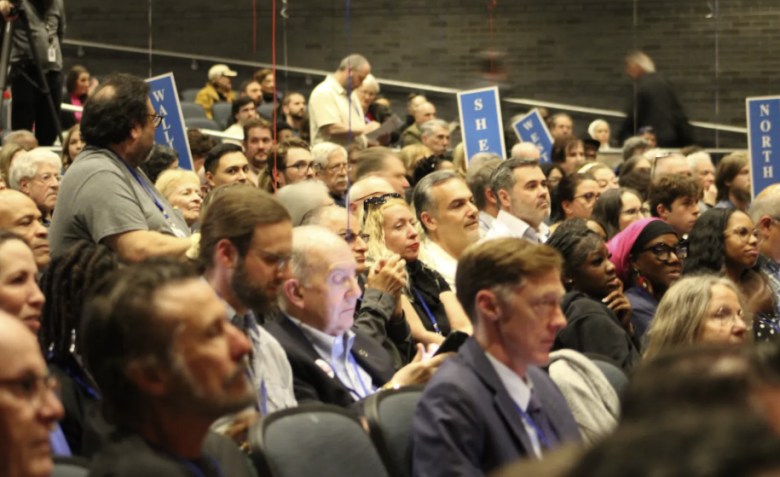
On May 11, that nearly changed. At the 3rd District Democratic convention, a challenger to the 18-term incumbent Rosa DeLauro won 13 percent of the delegate vote, falling six votes short of the 15 percent he needed to reach the August primary ballot. His supporters walked out shouting “Shame on you.” Then they gathered in a parking lot to plan the harder route onto the ballot: collecting roughly 3,800 notarized signatures, town by town, by June 9. He fell short. The 35-year streak continues.
The same evening, just 45 minutes north, something happened that never had before. In the 1st District, former Hartford Mayor Luke Bronin defeated 14-term incumbent John Larson at convention, the first time a sitting Connecticut House member has ever lost a party endorsement.
Consider what it took. Bronin is a former two-term mayor, a Rhodes Scholar and Navy veteran, endorsed by a former presidential candidate, with more than a million dollars in the bank. And even with all of that, he prevailed only by a sliver, on a second ballot, while allies of the incumbent maneuvered a third candidate to exactly 15.04 percent of the vote to engineer a primary that would split the opposition. If a figure of Bronin’s stature can barely force his way through, an ordinary citizen has almost no chance at all.
This is the heart of it. Connecticut is the only state in America where no sitting U.S. House member has ever faced a primary challenger on the ballot. The most durable systems I studied abroad shared a quiet insight: you do not need to win a contest you have prevented from happening. Here, a challenger must either clear the convention threshold, decided by party insiders chosen through a machinery of local loyalists, or gather thousands of signatures in 42 days while the incumbent does nothing at all. It is competition on paper and protection in practice.
A federal judge saw this clearly. In 2003, Judge Peter Dorsey ruled the 15 percent convention threshold unconstitutional, finding that it created a “substantial impairment of the ability of prospective candidates to place themselves and their ideas before the voters.” The attorney general declined to appeal. The legislature declined to act. More than two decades later, the rule still stands.
I find this more reminiscent of Lebanon, where an entrenched political class keeps finding procedural reasons to perpetuate itself, than of anything one would expect in the United States. (Come to think of it, our CT-03 incumbent has held her seat since 1991, longer than Lebanon’s parliament speaker Nabih Berri — a name seen across the Middle East as emblematic of permanent power).
I notice these parallels because I spent years inside such systems. Back in 2019, I organized Tunisia’s first-ever presidential debates, watched by more than six million people and widely seen as a historic event. I was later invited to neighboring Algeria to help launch presidential debates there.
In a meeting with the country’s election authority, I described how debates work in functioning democracies: independent moderators, questions inspired by public concerns and formulated by journalists. An official stopped me. The questions, he said, would of course come from the authority. He said it not as a confession but as a simple statement of fact, the way one notes that rain falls.
What stayed with me was the air of inevitability, the man’s quiet certainty that things could not be otherwise. Closed systems endure less through force than through a shared belief that nothing can change, until officials and citizens alike stop noticing the walls. A fellow contributor to this page recently described Connecticut’s version precisely: “incumbency disguised as democracy.“
But getting on the ballot is only half of a real choice. Voters also need to see candidates side by side, to watch them defend their records and answer questions they did not write. They need debates. And in Connecticut this is not a secondary concern, it is the whole game. This state has voted Democratic in every presidential election since 1992, and all five of its U.S. House seats have been held by Democrats since 2009. The general election is often a formality; the Democratic primary is often the election. To hold no debate in the primary is to deny voters their only real opportunity to choose.
Because our primary system is engineered to protect incumbents from the ballot, the absolute least they can do is face the voters on a stage. Yet Connecticut has never held a primary debate for a congressional seat. Not once.
Even now, with the most competitive primary cycle in the state’s history unfolding, a three-way race in the 1st District, none has been. A debate is, at its core, a job interview: the moment a candidate stops talking about voters and starts answering to them. Nothing else so plainly signals that an election is about the people, not the candidates. And nothing would do more to strengthen the eventual winner’s legitimacy. For an incumbent, agreeing to debate is a small effort with a large return. There is nothing stopping any candidate, in any district, from saying yes tomorrow.
We tend to assume our democracy corrects itself. I have spent my career watching it fail to, elsewhere, one reasonable-sounding rule at a time. I have also seen candidate debates happen in places far harder than this one. If candidates can face voters in Tunisia, they can face them in Connecticut.
Belabbes Benkredda is a Yale World Fellow, a fellow at Pauli Murray College at Yale, and the founding director of The Munathara Initiative, the Arab world’s largest public debate organization. He lives in New Haven.