


The first step to solving a reading delay is knowing it exists.
Decades of research have found that all children learn to read by developing the same core skills. This applies to children with dyslexia, English language learners and those reading well beyond grade level. Per the science of reading, some kids just need more targeted and explicit instruction — more time building whichever specific reading skill (and there are several) isn’t growing as fast.
But to do that, teachers need to figure out which skill is lacking. It takes a particular kind of training and the right tools — and until recently, many Connecticut schools lacked both.
That started to change with the 2023 Right to Read law, which compels districts to use K-3 literacy curricula aligned with the science of reading. Some are already seeing improvements in their ability to detect and address reading delays.
At the same time, a growing number of parents are seeking to screen their kids for such delays themselves.
The Southport School — a private school that has used science of reading-based instruction since long before Right to Read — has for years offered free reading screenings to Connecticut parents through its outreach arm, The Southport CoLAB. This spring, CoLAB partnered with Sacred Heart University to expand capacity for the screenings amid skyrocketing demand.
“It’s twice as many as last year,” said Southport Executive Director and CoLAB founder Benjamin Powers.
Powers said it’s all too common to see kids with reading delays pass undetected through school until fourth or fifth grade. By that point, he said, it’s much harder for them to catch up to their peers. To make matters worse, fourth grade is typically when kids start “reading to learn” — meaning if they can’t read, their other learning will suffer, too.
“From a developmental standpoint, we are much better off — exponentially better — by flagging these kids early,” Powers said.
That’s where reading screeners come in.
How to screen for a reading delay
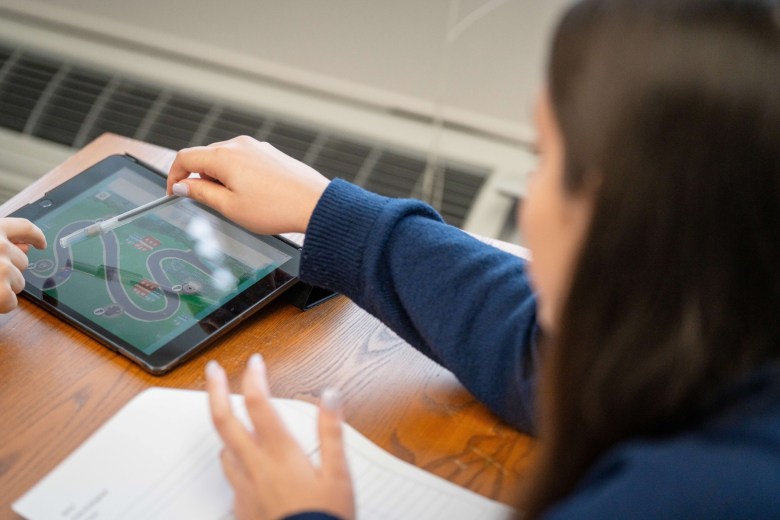
Powers said the screener Southport uses lasts between 20 to 30 minutes, depending on the age of the child. It takes place on a tablet and runs kids through activities that gather data on different cognitive processes — things like “rapid automatized naming,” which tests how quickly a child can retrieve the names of a variety of familiar objects from their memory.
At the end, the program produces a “teacher and parent-friendly report” identifying whether the child in question is at risk for something like dyslexia. Powers said it doesn’t diagnose the condition itself; rather, it “gives us an early marker so that we can just be proactive with the child, the teacher and the family.”
Being proactive, he explained, is largely a question of dosage.

“Some kids just need a lot more exposure and practice,” he said. “And we do need to be targeted … So, if it’s a child who’s really struggling with certain letter patterns or sound symbol relationships, we want to make sure we’re targeting those specific attributes.”
“But,” he emphasized, “every child really needs the same kind of scope and sequence to build the reading brain.” Some may have to work at it a bit longer than others, but overall, “the vast majority — vast majority — of kids can learn to read.”
Through Right to Read, that same principle is now being disseminated throughout Connecticut’s public schools. Although the screeners they use may be shorter — the popular DIBELS assessment, which many districts employ, takes under 10 minutes — the strategy is the same: Guide each child through a series of prompts, use the data to flag specific skills they may be struggling to develop, then respond with targeted intervention.
Stratford Assistant Superintendent for PreK-6 Diana DiIorio explained how the DIBELS screener works.
“The teacher sits one-on-one with the child. It is on a Chromebook. … It’s very self-explanatory. They hit a button that starts, they have prompts of what to ask the child and the child responds on the Chromebook according to what they feel the answer is. A lot of it is timed,” DiIorio said.
Before Right to Read, DiIorio said, Stratford’s screening regimen was much more focused on comprehension.
“What we were missing was the really systematic and explicit teaching of all of those phonemic awareness and phonics skills, which is the basis and the foundation” of more advanced reading, she said.
Consequently, DiIorio said, they would miss students who arrived in kindergarten already reading but who lacked the building blocks for multisyllabic words — a deficiency that wouldn’t become apparent until the students suddenly hit a wall in fourth grade.
New Haven Supervisor of Elementary Reading and Language Arts Jennifer Novelli gave an example of how a teacher might test younger children for “phoneme segmentation fluency,” a skill they develop before they actually learn to read. Phoneme segmentation means breaking down the individual sounds within words kids hear.
“So, if I say ‘mop,’ the child would be expected to take that word and segment it” into its discrete sounds, Novelli said — those being the “mm” sound, the short “o” and the “p.”
In this case, “they’re not looking at letters. We’re just testing to make sure they understand and know how to break words apart,” Novelli said.
Phoneme segmentation, Novelli explained, falls under the umbrella of phonological awareness, which she described as “a precursor skill to reading.”
The schools CT Mirror spoke with all said they screen three times per year, with some employing other forms of progress monitoring in between. Initial results from two very different districts suggest it’s having an impact.
In relatively affluent Fairfield — predominantly white, with under one-fifth of students receiving free or reduced price meals — 74% of kindergarteners in the 2023-24 school year were already proficient in reading. There were concerns that the district’s new science of reading-aligned curriculum and screening regimen (done through Acadience, not DIBELS) would cause a dip as teachers and administrators got acclimated to the new material, but the opposite happened: By the time those same students left first grade the following year, the number had nudged upward to 78%.
“You do expect implementation dips. We did not see them,” said Janine Goss, executive director of PK-12 literacy at Fairfield. That applied to every cohort receiving the new Right to Read instruction.
The story is much different in New Haven — predominantly Black and Latino, with roughly three quarters of students receiving free or reduced price meals. There, the vast majority of students already have substantial reading delays by the time they start school. In 2024, for example, 61% of first graders were “well below” grade level, according to Novelli.
But the science of reading-aligned programming she helped institute has still had a notable impact: By second grade, only about 51% were still testing “well below,” and the percentage of students in that cohort reading at or above grade level increased.
Novelli said the dreaded “summer slide,” a decline in reading ability that typically occurs over the long vacation, has also diminished.
Nevertheless, the results still leave about half of New Haven’s second grade class seriously behind in reading. This despite the fact that, per Powers, the vast majority of them can learn.
Much room for improvement
Novelli said one of the reasons many kids in New Haven are still behind in reading is a shortage of pre-kindergarten education.
“Our students that go to our preschools in the city are definitely better equipped and more ready with the literacy skills,” Novelli said. “If we were able to open more classrooms and have more seats … it would be better.”
She added that New Haven’s director of early childhood, who joined the district three years ago, has implemented “a very strong phonemic awareness and phonics program” for 3- and 4-year-olds.
The kids who don’t get that early education — those who begin school in kindergarten and haven’t built (English) reading skills at home — are more likely to start at a disadvantage. In theory, they can still catch up, but that requires having enough teachers with the right training and the time to administer the needed interventions.
Therein lies another problem.
Although Connecticut has firmly embraced the science of reading, at least for K-3, few new teachers graduate from college with the skills to interpret and act on the results of a screener. It often falls to individual districts to train these new hires — not to mention all the existing teachers who were never taught these skills when they started.
Stratford’s DiIorio said this is where much of the real work of converting a district to the science of reading takes place.
“We spent all last year looking at the data [from the reading screenings],” DiIorio said. “How to analyze the data, and then what to do with it. And then it was a whole ‘nother module of planning lessons based on what data was in front of you.”
DiIorio said Stratford was in one of the first cohorts to attend state training on the science of reading, meeting about once a month, “five or six times out of the year.” Since then, the district has partnered with HILL for Literacy for online training, in-person coaching and data analysis.
The challenge, DiIorio said, is “bringing that knowledge to the entire district.”
“There’s eight schools. We only had a handful [of staff] that went to that first cohort,” DiIorio said.
Goss said many of her efforts in Fairfield have also gone toward teacher training. Under her leadership, Fairfield created district and building-level literacy teams across its elementary and middle schools.
With 200 classroom teachers at the elementary level alone, “there was no way I, one person, was going to be able to get to each and every teacher,” Goss explained.
She also praised her staff for taking new staff members “under their wings.”
“We feel really good about knowing that even though they may not have the experience they need coming straight from college, they’re going to get that support when they come into our schools,” Goss said.
DiIorio said getting new teachers into shape is a challenge that extends well beyond the science of reading.
“I went through it myself,” DiIorio said. “I have a teaching degree. Nobody shows you how to handle management of students, the behaviors of the students, the social emotional skills. You learn about it. You learn that there’s trauma in children. … But the training is not there.”

There is an implicit issue of equity here. Because of how Connecticut funds public schools, those located in wealthier towns typically have far more resources than those in cities like New Haven or Hartford, where the local tax base is stretched thin (Gov. Ned Lamont initiated a Blue-Ribbon Commission this year to find ways to reform the system). More resources can mean more robust training for new hires.
DiIorio said she experienced this firsthand, too.
“I started in a very affluent school district, a couple miles away. My training as a new teacher was so different from when I came to Stratford as a principal. It was so eye-opening … the difference in new teacher training and what they get,” DiIorio said.
Novelli said New Haven has literacy coaches in each building to provide professional development on the science of reading to teachers but would benefit from having more dedicated reading interventionists. A reading interventionist, she explained, spends all day in targeted small group instruction.
“Last year, we did lose two positions … and we don’t have enough people as it is,” Novelli said. “If we could have a certified reading interventionist at each school, it would be so helpful.”
There’s a shortage of these certified specialists. That issue came up at a March meeting of the General Assembly’s BERGIN Commission, where University of Connecticut literacy professor Rachael Gabriel shared data showing so-called Tier 2 interventions (which includes targeted group instruction) can actually create worse outcomes for kids if done poorly.
“There was a shortage in this area [of literacy specialists] when I moved to Connecticut 16 years ago, and the programs [to train them] have shrunk, not grown,” Gabriel said.
She told the commission members the program she oversees at UConn has only 11 students, prompting an exclamation of shock from one of the listeners.
“[This kind of training] is largely inaccessible. Our program is … over 18 months, and it is 21 credits, like the state requires. And so, that’s almost a master’s degree,” Gabriel said. “That is super expensive. So, for a practicing teacher to say, ‘I’m gonna take my evenings and my weekends and do this for two years and pay $30-$40,000 for it,’ is a really significant ask.”
Powers, meanwhile, has his own concerns.
“If you would ask me 10 years ago, I would have been bullish on the science of reading movement, because it is, you know, it is an important movement,” Powers said. But “when I look at the reading scores, we’re really not moving the needle.”
He said something else now keeps him up at night: a steep decline in students’ executive function over the last 10 years or so.
“Ten years ago, somebody could focus on the screen for about two and a half minutes before they got distracted. Today, that’s down to about 40 seconds,” Power said. “We have kids who can pay less attention, are less focused, you know, just aren’t able to have that same uptake.”
And executive function, Powers said, is directly tied to reading outcomes.
“When I go in, especially now, like K-5 schools, what I hear from them is alarming,” Powers said.
As to why kids’ executive function is declining, Powers said he has a few ideas.
“Qualitatively speaking, you see, going to the grocery store, parents are just giving kids their phones to keep them occupied. Or even on the playground, you’ll see parents pushing kids on the swing set, and they’re looking at their phone,” Powers said. “Kids just don’t have the same reading exposure they used to.”
