


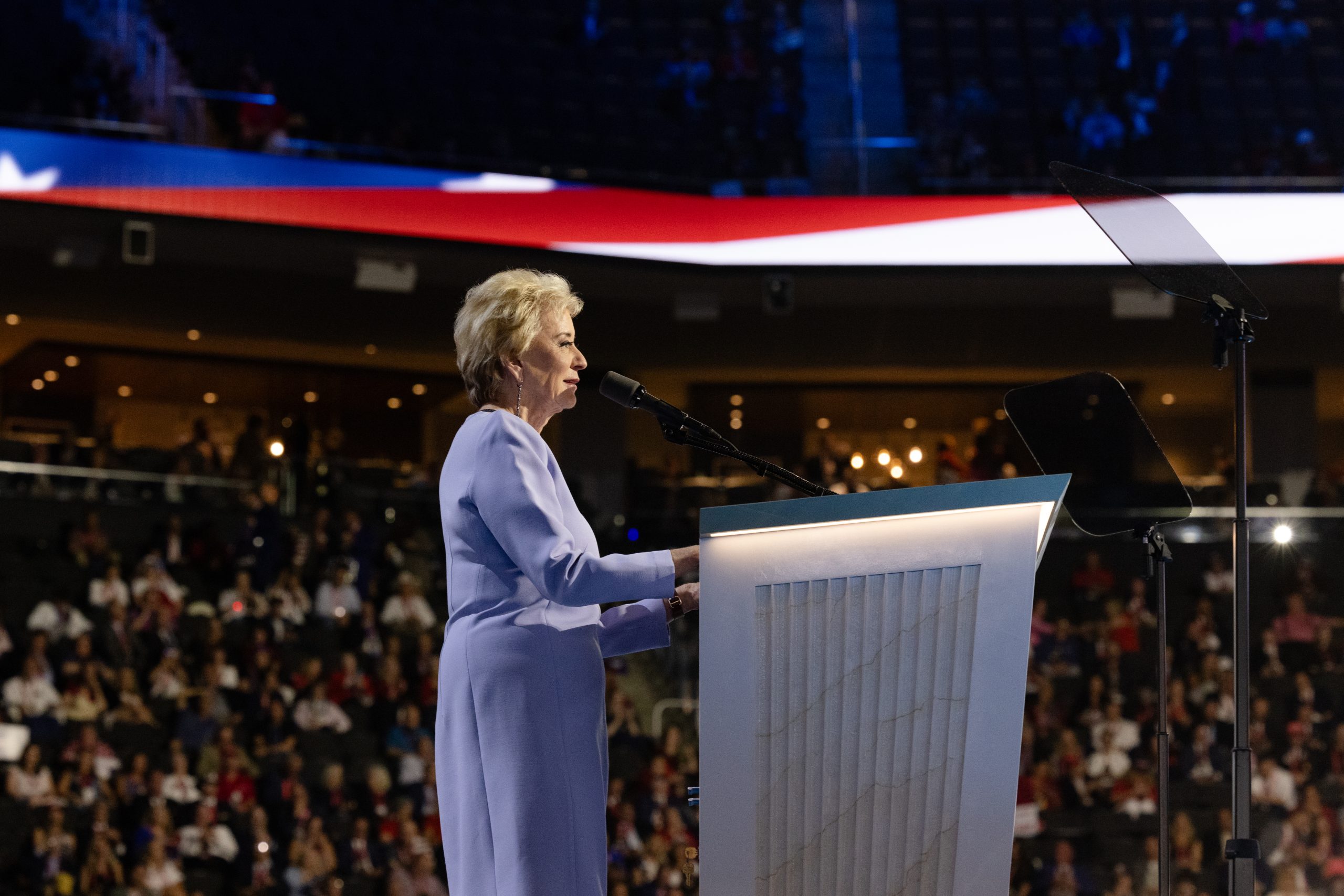
As U.S. Education Sec. Linda McMahon describes it, the Trump administration’s decision to rehouse two key special education offices is all about safeguarding the rights of students with disabilities.
The Office of Special Education and Rehabilitative Services, OSERS, and the Office of Civil Rights, OCR, both play key roles in ensuring schools follow the nation’s bedrock special education laws. As the Trump administration works to dismantle the U.S. Department of Education, it’s moving OSERS to the Department of Health and Human Services and OCR to the Department of Justice.
In a press release Tuesday, McMahon suggested this move would preserve access to the offices’ services.
“As the Trump Administration scales back federal micromanagement when it hinders success, we are equally committed to bolstering the efficacy of federal oversight where it is essential,” McMahon wrote.
But Connecticut special education advocates see little evidence that the move “bolsters” anything — quite the opposite.
“We regard [Tuesday’s] move as nothing short of an assassination attempt on the right of students with a disability to a free appropriate public education,” wrote Andrew Feinstein, a longtime special education attorney and treasurer of the group Special Education Equity for Kids, in an email.
Kathryn Meyer, an attorney with the Center for Children’s Advocacy, said, “It will greatly weaken already insufficient federal oversight” of special education — even though that oversight is “absolutely statutorily required.”
The Council of Parent Attorneys and Advocates, a national organization for special education advocacy, also described the administration’s move as “unlawful.”
The federal government’s role in overseeing special education stems from two key laws: the Individuals with Disabilities Education Act, IDEA, and Section 504 of the Rehabilitation Act.
IDEA guarantees children with disabilities an appropriate education in the “least restrictive environment” possible, while Section 504 protects access to education itself. Traditionally, OSERS has gathered data and offered valuable guidance to schools on IDEA, while OCR has fielded complaints from parents and attorneys about 504 violations.
In theory, both offices can continue to do all that under new management. However, neither Meyer nor Feinstein has much confidence.
For starters, both noted that HHS is designed to look at problems through a medical lens, not an educational one. Feinstein said he thinks this “will result in segregation and triaging services.”
That’s already an issue in many school districts, particularly those that struggle to afford the necessary number of paraeducators and special education teachers.
Meyer said it doesn’t help that OSERS’ ultimate supervisor is now Health and Human Services Sec. Robert F. Kennedy, Jr., who is known for promoting the theory that vaccines can cause autism.
“Framing autism as something that happens due to vaccination, quote-unquote, ‘injury’ is saying that, if you have autism, you’re damaged, and that it’s a mistake,” Meyer said. That’s “completely antithetical to [the] disability rights movement.”
She fears Kennedy’s view undermines an ongoing effort to see children with disabilities as full “members of the school community” — a key part of her advocacy work.
“This happens a lot in local schools, where you’ll have a classroom of students with special education, and they’re seen as ‘other than’ in the school,” Meyer said. “They’re isolated physically, and the administrator may or may not see them as their responsibility.”
Meyer said trust in the administration to meet its special education obligations was already low before Tuesday’s move. For example, OCR’s 504 enforcement has effectively shuttered under Trump, leading many to write off the federal support they’d once relied on.
“People would file, and they would get a response that they’re not accepting complaints. … or people would file and get no response. Literally no response,” Meyer said.
She said she hasn’t filed a complaint with OCR in over a year and doesn’t know of any other advocates who have, either.
Feinstein said OCR “has been gutted for the last year.”
“Placing it within the Department of Justice, which appears highly focused on punishing Trump’s enemies, is certain to put the final nail in the coffin of federal enforcement of civil and disability rights enforcement,” he wrote.
In explaining the rationale for the move, McMahon pointed to the broad dissatisfaction many parents feel as they struggle, sometimes for months or more, to get much-needed special education services for their children.
“It should not require herculean effort to obtain what the law guarantees,” McMahon wrote in Tuesday’s press release.
But Feinstein said the problem was never with the federal bureaucracy in the first place.
The barriers “are generally erected by local school districts. Reducing federal involvement will enhance the power of local school districts to erect even more daunting roadblocks,” Feinstein wrote.
